This Blog Has Moved


APRIL 2010: THIS BLOG HAS MOVED
GO TO THE NEW ADDRESS TO COMMENT. THANK YOU.

New Address:

http://nafkamina.wordpress.com

All posts are available in the new blog

Please do not post any comments here. Go to the new address to comment. Thank you.


Tuesday, May 03, 2005

Golden Week in Tohoku

This week is Golden Week in Japan, so named for the fortunate grouping of four national holidays together – Greenery Day, Constitution Day, National Day and Children’s Day - giving the week its auspicious name. We took advantage of this golden opportunity, so to speak, and joined throngs of Japanese vacationers on a 3-day trip to the Tohoku region in the northern part of Honshu, the main island of Japan.

Day 1 – Hiraizumi and Ichinoseki

We left Tokyo on the north-bound bullet train, the Tohoku Shinkansen. Two and half hours later we got off at Ichinoseki, a small city in Iwate prefecture. The plan was to drop our bags in a station locker and connect 20 minutes later to a local train that would take us to the town of Hiraizumi. Unsurprisingly, all the lockers at the station were taken and we had to search for lockers outside the station, resulting in a last-minute dash to catch the train. Normally, I would avoid unnecessary exercise when on vacation, but the next train was almost an hour later…

Hiraizumi is a small peaceful town that used to be of some importance in the 11th and 12th centuries, when it was ruled by the Fujiwara family. They built several temples and dwellings but then fell out with the shogun of the time, Minamoto Yorimoto, who got very angry and practically razed Hiraizumi to the ground. Indeed, when one walks around the grounds of the temples today, all that is left are signs explaining which building used to stand at which spot and a few foundations here and there. Not very impressive.

From Hiraizumi train station we walked to Motsuji temple. A block away from the station we heard someone call out our names; it was an Israeli couple from Tokyo we know, who are also touring this area. We were supposed to meet up with them in Morioka City in the evening, so meeting them like this in Hiraizumi was somewhat of a surprise… After the appropriate polite exchanges, we continued on to Motsuji.

This formerly large temple is mostly known today for its expansive garden with a big pond in the middle. Apparently, it is a special garden, categorized as a Pure Garden, a Buddhist concept of designing paradise-like gardens. To me, it looked pretty standard; much like many other parks in Japan.
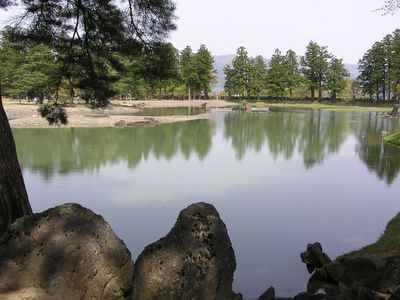
Motsuji Temple, Hiraizumi

A short taxi ride away is the most famous temple in Hiraizumi: Chusonji. Actually, it is a collection of temples of varying sizes and shapes, strung along a mountain road which, at this time of year, was unsurprisingly packed with people. Of the original 300 buildings or so that made up Chusonji, only around 20 remain standing today. We walked along the road, popping into the various temples. Shortly after 2pm, while we were purchasing some ice cream, we heard drums and hurried over with everyone to watch a group of masked old ladies perform some ancient dance, accompanied by an octogenarian drummer. The children were mesmerised by the performance.
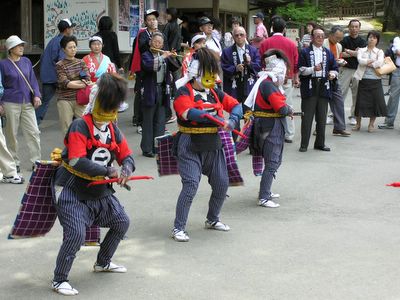
Dance at Chusonji Temple, Hiraizumi

To head back to the station we hailed a taxi. Strangely enough, it was the same driver that took us from Motsuji to Chusonji.

We took the train back to Ichinoseki and walked to the local river to have a bite to eat; we found a yakimo (sweet potato) vendor right by the river, which was fortunate. Several groups of Japanese were having a picnic and the flags they put up indicated they belonged to labour organizations, so apparently they were celebrating May Day. While eating we suddenly heard a choir singing; we turned around and saw a group of male singers accompanied only by a guitar singing some local songs. They were pretty good and seemed to be content to move around the picnic area and sing to different groups of people only to be rewarded by clapping and ample amounts of sake for free.
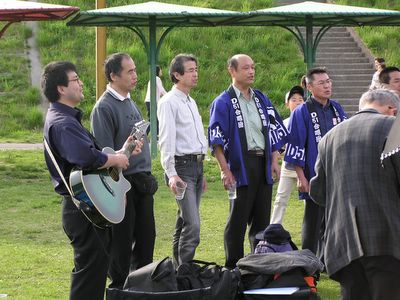
Singing by the river, Ichinoseki

Back at Ichinoseki station we boarded the shinkansen again, north to Morioka City, the biggest city in Iwate prefecture, where we were going to spend the night. While walking from Morioka station to the hotel, my son noticed a Tully’s coffee shop (a Japanese Starbucks-wannabe) and remarked wryly: “fancy that, a Tully’s; now that’s a good start”. A whole day in the countryside with no coffee shops, he finally reached what for him is a mark of civilization. Such an urban child…

Our hotel, a 2-minute walk from the station, belongs to a new chain of the so-called “business hotels”, catering mostly to business people and offering decent lodgings for a relatively low rate. During the holiday season, these hotels are very popular with tourists, mainly because of their convenient locations (near train stations) and their affordable prices. After showering and changing clothes we met up with our Israeli friends and trekked together to the only Starbucks in town, across the river; after a week-long abstention due to Pessach, we were eager for our dose of caffeine and hot chocolate.

Day 2 – Kakunodate and Tazawako

We got up around 8am to check the breakfast offered by the hotel. Turned out to be a buffet of miso soup, two types of onigiri (rice cakes) and coffee; not much help for us…

Around 10am we took the west-bound Akita Shinkansen to Kakunodate, less than an hour away in Akita prefecture. Because the cherry trees blossom in this area of Japan only in late April or early May, Kakunodate during Golden week is a powerful magnet for tourists. They flock to the area by train, bus and car to see the local sakura matsuri (cherry blossom festival). The city, a former castle town well-known for its preserved samurai district, turns almost totally white during this season. Aside from the “standard” somei yoshino variety of cherry trees, seen throughout Japan, this area is mostly known for the shidezakura variety, the so-called “weeping cherry trees”, with branches hanging down almost to the ground.

Weeping Sakura, Kakunodate

From the train station we walked for about half an hour to the old samurai district. Along one street are several old houses and mansions, some of which are open to the public and exhibit the way of life of the samurai. We walked along the street and took a look at some of the houses. We also tried what seemed to be a local specialty: rice on a stick, dipped in miso sauce and cooked for a couple of minutes on a charcoal grill. Beats the hell out of those grilled fish on sticks, a standard fare for any fair in Japan.

On the walk back to the station we walked along the Hinokinai river, where several hundred cherry trees provided the perfect background for hundreds of hanami (“flower watching”) picnics. Fortunately, despite the forecasted rain, we had a rather pleasant weather.
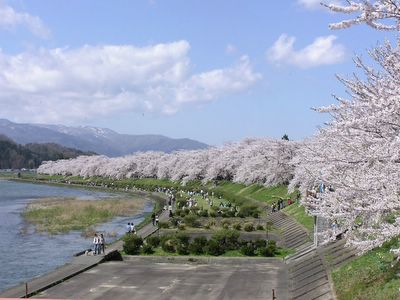
Hinokinai River, Kakunodate

Back at Kakunodate station we boarded the train again for a short ride to Tazawako station, at which we took a bus to Tazawako lake. The guide books say this lake is a popular spot for vacationers, but when we got there it was practically deserted. On the beach, the kids bounced up and down on a trampoline and their cries of joy echoed around the empty shores. The lady selling the tickets for the boat rides in the lake looked royally bored. Perhaps at this late hour (around 3pm) everyone was away at the onsen, enjoying a nice dip before dinner.

The ride back to Morioka City was uneventful. Back to our hotel (and a visit to Starbucks, needless to say) on our 2nd and final night.

Day 3 – Morioka City

Got up a bit later today, to check out and take a walk around Morioka City. First we walked around a shopping district not far from the hotel, but it was evidently too early (10am) for the shops to open. So we headed towards the main attraction of the city: Morioka Castle. This castle dates back to the early 17th century, but it was destroyed during the Meiji Restoration period and today all that remains are the huge stone walls that used to surround it. Here too many people were enjoying their hanami picnics under the cherry trees, although the blossom here was almost all gone.

We continued past the castle into the main business district. A distinctive building turned out to be the Bank of Iwate, looking oddly out of place with its European-style facade. We continued on to another of Morioka’s famous sites and a national treasure: the Rock-Splitting Cherry tree. This tree sprouted from a crack in a giant granite boulder, splitting the rock neatly in the middle as it grew. The sign said the tree is 300-400 years old and today it sits in the yard of the Morioka Court of Justice building.
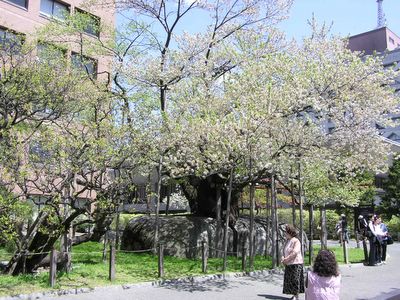
Splitting Rock Cherry Tree, Morioka

On our way back to the station we walked through the main shopping area, a pedestrian mall which this time turned out to be rather lively. During our stroll we noticed a handful of gaijin; we noticed them because up until now we had seen no Western faces during this trip.

At 1:40pm we boarded the shinkansen back to Tokyo, "tired but content" as the saying goes.

Thursday, April 28, 2005

90 Seconds

The train disaster in western Japan this week is the deadliest in four decades. The death toll has risen to 91, with bodies still to be retrieved from the wreckage. Although the investigation of what exactly happened is not over yet, it looks increasingly likely that the driver was speeding in order to make up for lost time. He was running 90 seconds late.

Yes, 90 seconds. Anywhere else in the world, a delay of 90 seconds would not be considered such a terrible failure. But in a country that a reported average 6-second delay in the shinkansen (bullet train) schedule last year caused heads to roll and policies to be revised, 90 seconds is an eternity. The Japanese obsession with punctuality, especially when it comes to their world-leading rail system, leaves little room for mistakes.

Almost immediately after the accident, people put the blame on this obsession. The same driver, a 23-year old, was reprimanded a few months ago for missing the platform stop by 100 metres. Apparently he did so again last Monday, hence the lost 90 seconds; it is likely that he wanted to avoid further reprimanding, or worse, a fine. A colleague of mine told me that Japan Rail drivers are fined for delays and the fine is deducted from their salary.

Is this accident going to change something? I doubt it very much. The pride and joy of Japanese industry is not going to be deterred by one accident and, admittedly, such accidents are a rarity in Japan. Furthermore, the obsession with time is not particular to the rail industry; it permeates all levels of Japanese society and is too much ingrained in the mentality of "Industrial Japan" for swift and sudden changes to be possible. When I asked my colleague - after he complained that the stress of a possible fine was probably the cause of the accident - whether he would put up with less punctual trains in return for less stringent rules being imposed on the drivers, he looked at me as if I had lost my mind...

Pessach - Restraint in Praise

בנפול אויבך אל תשמח, ובכשלו אל יגל לבך

(משלי כ"ד, י"ז)

One of the unique features of prayer on Pessach is the fact that we say a full Hallel only on the first day of the holiday. On chol ha-mo'ed days and on the seventh day of Pessach we say the "half Hallel", a shortened version. This is irregular because on the other two regalim, Sukkot and Shavu'ot, as well as on Chanuka (all 8 days), we say a full Hallel. If Hallel is praise we give to God for delivering us from trouble and performing miracles for us, why only a partial praise is given on most days of Pessach? After all, on the seventh day of Pessach God parted the Red Sea for the Israelites and thus saved them from their Egyptian pursuers, prompting them to sing the Shira; surely this qualifies as an appropriate occasion for us to give full praise to God. So why only a half Hallel?

The redemption of the Israelites from Egypt was accompanied by a lot of misery. Pharaoh's stubborness brought upon his people and country ten plagues, culminating in the killing of all first-borns in the kingdom, including his own son. The parting of the Red Sea meant not only the safe passage of the Israelites but also the drowning of all of Egypt's army. Many human lives were lost during the Exodus.

The Gemarah in Megillah (10:) tells us the following story. After the drama of the Red Sea, when the danger was over and the Egyptians lay dead at the bottom of the sea, the angels up above wanted to sing out to God to praise him for the great miracle he had performed for his people. God silences them by asking a rhetorical question: "The works of my hands are drowning in the sea, and you wish to sing?!".

God teaches the angels (and us) that one should not rejoice over the death of human beings, even if they are the enemy. True, sometimes it is necessary to fight and to win, and in the process lives are inevitably lost, but this is no reason for singing out and praising the occasion. One should regard all loss of human life as a tragedy. This idea was espoused by the "wisest of all men", king Shlomo. In Mishley he writes:

Rejoice not when your enemy falls, and let not your heart be glad when he stumbles.

(Mishley, 24, 17)

The Meshech Chokhma, Rabbi Meir Simcha HaCohen, explains this rule in his commentary to the Torah (Shemot 12, 15). He says many people and religions dedicate a "day of victory" to commemorate the fall of their enemies, but Jews do not. Their days of celebration are not for celebrating the fall of the enemy, but rather the salvation of the Jews. Pessach is for celebrating the redemption from slavery; Chanukah is for celebrating the miracle of the oil in the temple; and Purim is for celebrating the miracle of being saved from Haman's decree. Song and praise are therefore reserved for being saved from trouble, not for the fall of the other side. Indeed, we have an obligation to praise God, but we must frame that obligation in the right context.

Now we understand the reason for the half Hallel in Pessach. On the first day, we say a full Hallel to praise God for the redemption from Egypt. But on the seventh day, we do not say it because we wish to express restraint and repress our feelings of joy in light of the great loss of human life that accompanied the miracle at the Red Sea. We do so by saying the praise, but not in its entirety. (The reason that in chol ha-mo'ed we say a half Hallel is that we do not want to make chol ha-mo'ed seem more important than a full holiday, i.e. the seventh day of Pessach).

The idea for this Thought is from R. Avraham Rivlin of Eretz Chemda

Tuesday, April 26, 2005

My Brother the Yakuza, by Ya'akov Raz

The Japanese mafia, a.k.a the Yakuza, has drawn the attention of many writers. Few have been able to penetrate this secretive organization and remain alive to report their findings. Most of the movies made about the Yakuza paint a Hollywoodian picture that is only partly reflective of the real nature of "the people who walk in the sun". Professor Ya'akov Raz, until recently head of the East Asia studies department at Tel Aviv university, seems to have done the impossible: penetrate the Yakuza and study it from within. This book is his account of this ten-year journey.

Raz tried to make inroads into the real Yakuza for a very long time. He pursued countless leads only to be let down and warned about his efforts. Eventually, he met a member of the Kyokuto-kai, one of the leading Yakuza families in Japan, who agreed to introduce him to the Oyama Oyabun, head of the Oyama branch of the family. The Oyabun gave Raz his blessing for conducting his research of the Yakuza using his family as a case study, saying that "just like you Jews" we are wanderers and outcasts.

Raz is very modest about his success in getting so intimate with the Yakuza. He claims, over and over, that he was very lucky and has no idea why he, of all people, has managed to win their confidence and they had warmed up to him.

The book is fascinating. Contrary to what one might expect, the account is not dramatic. Raz's story is mild, almost pastoral, to the point that half way through the book I found myself warming up to the characters and had to stop and remind myself these are criminals who work for one of the world's most violent organizations. I think this is to Raz's credit, succeeding to expose the personalities behind the facade and show that deep inside these are outcasts that perhaps had little or no choice but end up as a Yakuza. Some of these people were born as outcasts, as the infamous burakumin, the "non-touchables" of Japanese society that nobody speaks about but everybody knows of. The name of the organization symbolises this outcast status: Ya means 8, Ku means 9 and Za means 3, the total being 20, the losing number in Black Jack.

I learnt a lot about Japan reading this book. Many customs and codes of behaviour are explained through the story of the Yakuza. I suspect that many Japanese would also learn some things about their society by reading this book. Hopefully it will be translated into Japanese some day.

Monday, April 25, 2005

"Frankly Speaking..."

In a discussion in an online forum I participate in, someone brought up the topic of the recent demonstrations in China against Japan. One of the questions asked was why the Japanese do not apologize for the crimes they committed against the Chinese (and other Asian nations) during WW2.

I answered by saying that from the Japanese point of view, they have apologized enough times, both officially and non-officially. They do not think that they are not responsible for these crimes, but implicitness is ingrained in Japanese culture and therefore one should not expect explicit, public outpouring of regret and mea culpa confessions. Because everybody knows the Japanese were wrong, and because an apology has been made, the thinking here is that there is no use in talking about the subject endlessly and it is time to move on.

Following this, another forum participant asked if this was an example of the famous tatemae and honne traits of Japanese culture. I posted the following reply:

Yes and no.

To the best of my understanding, tatemae ("facade") and honne ("true sound") are used to explain the restraint which one should show in public (tatemae) regardless of what his inner feelings truly are (honne). The public display of emotions and opinions is considered impolite and may lead to confrontation, therefore it is better to keep up appearances and act according to your expected role or position and not say what you really mean. I heard that this social behaviour is derived from the old Samurai code, the bushido, which considered display of emotions as
a sign of weakness.

So, in a sense, you could say that tatemae requires implicitness, in order to hide the explicit emotions and feelings one may have. However, I believe that in every culture there is a degree of tatemae-honne; we don't always say or act according to how we really feel inside. When we do, people usually view it as inappropriate social behaviour.

I think that Japanese implicitness goes further than that. Not only when hiding internal emotions do Japanese convey their feelings implicitly. It is a way of life, a way of talking and communicating. Public displays of emotion, even between family members, are still widely frowned upon (even though I find it is changing and the younger generation is much more open). To this day, if one raises his voice or bangs on the table during a business meeting, he is looked upon as weak, as someone who cannot convey his thoughts in the proper fashion.

A friend of ours, a student from Australia, told us the following story. She travelled to northern Japan with a Japanese student friend, on home leave from university. Her friend had not seen her parents in almost a year. And yet, when she met them at the train station, there was no hugging or kissing, only a curt nod and a polite exchange of "how have you been?". It is clear that in this case there is no conflict between the tatemae and the honne; surely the parents were happy to see their daughter after a long absence and vice versa. But cultural etiquette dictates that public display of affection is inappropriate, or if you like, too explicit.

So, in most cases, if you hear a Japanese using the phrase "frankly speaking...", you should make sure to treat that frankness with caution and not expect too much candor and honesty. That is probably the tatemae speaking.

Friday, April 15, 2005

Metsora - The Power of Words

No time before Shabbat comes in...

So here is a dvar Torah given by R. David Green, "The Power of Words", from the torah.org website. Shabbat Shalom.

--------------

Parshas Metzora deals with a skin condition which people at one time contracted as a result of speaking ill of others. Many people have difficulty relating to the idea that the Torah forbids negative speech about others. Often when cautioned about speaking negatively, people will react by saying "well, it's true!" Still, the Torah looks askance at such speech. The question is: why?

The Chofetz Chaim (Rabbi Yisroel Meir Kagan, d. 1933) offers a beautiful explanation in his book "Shmiras HaLoshon." King David in Psalms 34 says "Who is the man who desires life, loves days to see good? (My advice is) guard your tongue from evil, and your lips from deceit etc." Why does it say that life and goodness depend on proper speech? King David wants to convey to us the importance of concern for the well being of others. This means that people should be careful even about what they say of others, taking care not to harm anyone through something they say. Someone who is that careful will certainly develop a sensitivity not to DO an action which would cause harm to another person.

However, although this is true, it seems that speaking ill of others has an intrinsic negative side to it as well, aside from what it leads to. The Talmud Yerushalmi writes that the act of learning Torah is the greatest of all of the commandments, and corresponding to that, is that the transgression of speaking ill of others is the worst of sins. The Chofetz Chaim explains that the more spiritual a force is in the world, the stronger it is. His example is fire. It has an ability to consume most things more physical than it is. Wind is the second example he cites. Wind is less of a physical force, and it has the ability to destroy in a most profound way. Since speech involves air, it is a very spirtual force. When it is used positively, its effect is more profound than a positive act which takes on more physical trappings. The same is true in the converse. Negative speech has a more significant effect than a corresponding negative act on a more physical plane.

No one needs to be convinced of the problems people cause through negative speech. We probably all remember the time we wished we hadn't said something. Sensitivity in what we say is an important key to living a happy, effective life.

There is a famous analogy regarding the topic of speech. A man who was not particularly careful about his speech came to a Rabbi. He had decided to change, and needed advice on how to go about it. The Rabbi gave him a very peculiar answer. "Take a feather pillow into the street, and release its feathers in every direction." The man was perplexed, but his resolve was firm to do as he was advised and change his life. After doing as he was told he returned to the Rabbi. "Now what should I do?" he asked. "Go back into the street and collect all of the feathers to the very last one," was the astounding reply. Again the man made his way into the street and began the daunting task. At his wits end he returned to the Rabbi dejected reporting his inability to keep his last words of advice. "Remember," said the Rabbi, "that your words are like those feathers. Once they leave your mouth they never return. Make sure the words you allow out are ones you won't have to go chasing after!"

One Room Apartment - Tokyo

A picture I saw on Yossi Raz's blog in Notes. I assume the reason they built the house up in the air is the need for that much-coveted luxury in Tokyo: a parking spot.

Tuesday, April 12, 2005

Did Grandma Make Tea Today?

The ageing population of Japan gives rise to many social and economic problems, but also to new business opportunities.

Many Japanese people live alone, their spouses dead and their children far away in other cities. The estimate is that more than 3 million elderly people lead solitary lives. Should something happen to them, it might take a while for someone to notice and send help. Zojirushi, a home applicance company, came up with a new service a few years ago: i-Pot.

i-Pot (for "information pot") is a standard electric kettle, the kind that every home has, sitting in the kitchen and keeping water hot for a cup of tea or a bowl of miso soup. Except i-Pot also has a wireless communication device at the bottom that sends out a signal to a server that in turn periodically sends out an email to a designated internet address. Thus, the recipient can keep track of the i-Pot usage. Put differently: let's check our email and see if grandma woke up this morning to make a cup of tea? The service costs $30 a month, plus a $50 deposit on the kettle.

Apparently, the idea for this invention came up following a notorious case back in the mid-90s, when a 77-year-old woman and her 41-year-old disabled son were found in their Tokyo apartment three weeks after they died of starvation. Zojirushi, together with Fujitsu and NTT, developed the i-Pot to help prevent such tragedies from happening again. Today, more than 2,000 families use i-Pot to help them track the well-being of their loved ones.

Saturday, April 09, 2005

Where Are My Pants?

Funny and insightful article in the Sunday Observer this weekend. Apparently, men have this annoying habit of asking their spouses for information on the whereabouts of their pants. Don't ask me; I'm a man...

Sunday, April 03, 2005

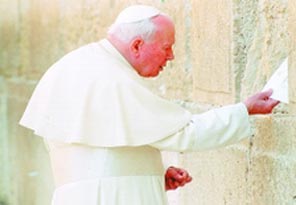
Pope John Paul II

Pope John Paul II died this weekend, at the age of 84. I will carry two memories of him with me.

The first is of his election in 1978. I was a young boy growing up in Rome at the time and I remember both the relief and the surprise surrounding the news of his election. Relief, because it concluded the prolonged wait for the decision, coming so soon after the premature death of his predecessor. Surprise, as he was the first non-Italian pope to be elected in more than 400 years. I remember the day vividly; suddenly all the church bells started ringing out to announce that white smoke was coming out of St. Peter's basilica.

More importantly, I will always remember him as the pope who went a long way to mend the relationship between Christianity and the Jews, in words and in deeds. He was the first pope to visit a synagogue and the first pope to visit Israel. During his visit to Yad VaShem, the Holocaust memorial museum in Jerusalem, he said: "the fact that anti-Semitism has found a place in Christian thought and teaching requires an act of teshuva (repentance)". I can only hope his successor continues his ways.

May he rest in peace.

Friday, April 01, 2005

Shemini - The Sound of Silence

ויאמר משה אל אהרן: הוא אשר דבר ה' לאמר, בקרובי אקדש ועל פני כל העם אכבד. וידם אהרן

(ויקרא י', ג')

Picture the moment: The mishkan is ready and the week-long inauguration ceremonies are reaching their climax on the eighth day. And in the middle of all the celebrations, Aharon's sons enter the tabernacle to perform a ritual service with their fire-pans and as a result of this expression of servitude to God, they meet their death.

Moshe tries to console his brother for the death of his two sons:

Then Moshe said unto Aharon: "This is it that the LORD spoke, saying: Through them that are nigh unto Me I will be sanctified, and before all the people I will be glorified." And Aharon held his peace.

(VaYikra 10, 3)

Aharon's reaction to Moshe's words are silence. The Hebrew vayidom is irregular in this usage and a more appropriate verb would have been vayishtok, he was quiet. Vayidom expresses more than silence; it expresses total submission, no reaction of any kind. The Hebrew word for inanimate objects - the lowest rung in the categorisation of nature (humans, animals, plants, inanimate objects) - is domem. Aharon's reaction was that of an object. In face of tragedy, he did not mourn as a human would, he did not cry out as an animal would and he did not even wilt as a plant would. He was completely domem.

Perhaps we can learn something from this sound of silence by looking at the rest of this week's parasha. The story of the tragedy of Aharon is one of the two main topics in Shemini, the other being the laws of kashrut regarding animals we are allowed and not allowed to eat. Both topics relate to discipline and acceptance. Aharon's silence represents the total acceptance of God's will and the understanding that we humans are unable to comprehend fully the terrible mysteries and tragedies of human existence. There are many events in our lives that we have no control over - death of a relative being perhaps the most tragic - and silence is one way in which we can discipline ourselves to submit to the will of God.

The same goes for the laws of kashrut. To be able to control our eating habits based on religious principles which are sometimes not fully understandable to us, is a matter of discipline. We are witness to many people who do not follow the laws of kashrut and yet seem to lead perfectly healthy lives. And yet we understand that the reason we keep kashrut laws is not health or other tangible benefits but rather the acceptance of the will of God. Like the silence in face of tragedy, our faith in keeping the dietary laws dictated by the Torah is a matter of discipline and submission to God's will.

This week a good friend of mine lost his mother. Aharon's silence relates also to one of the laws of Shiva. Many people come to visit the mourners during this week, offering their condolences trying to provide whatever comfort is possible. Sometimes they engage the mourners in conversation about this and that, thinking that by doing so they are helping them to take their mind of things. But oftentimes the mourner wishes to just sit quietly and be comforted by silence and not by words. The Halacha says that the visitor should take cue from the mourner and refrain from engaging in unnecessary conversation if silence is more appropriate. We often do not feel at ease with silence and feel the urge to put an end to the awkwardness of quiet. The Halacha tells us to overcome this urge and be more sensitive, to follow the example of Aharon and be silent.

In memory of my friend Amnon's mother, Rut bat Reuven HaCohen, z"l.

Thursday, March 31, 2005

Non-Orthodox Conversions

The Israeli High Court of Justice gave a ruling today which might have far-reaching implications for the future of Israel and Judaism.

The court ordered the state to recognise the so-called "leaping conversions", in which the study itself is conducted in Israel but the actual conversion ceremony is performed overseas. People have used this mechanism to bypass Israeli law, which recognizes only Orthodox conversions when performed in Israel but also non-Orthodox conversions when performed overseas. Therefore, converts who studied in a non-Orthodox institute in Israel would go abroad for a few days to perform the actual conversion in a Jewish community there, and then return to Israel and apply for citizenship under the Law of Return.

I am not familiar with the details of the new ruling and therefore cannot guess the full impact it will have on the Law of Return, but if I understand correctly then the practical meaning is that any person producing a conversion document from any community in the world will be automatically accepted as an Israeli citizen. I shudder at the ramifications of such a reality.

When I lived in Israel, this was a non-issue to me. But having lived in Japan for a few years and having witnessed several "conversions" performed by the local community's rabbi here, I now realise the consequences of such blanket approvals of conversions. Suffice it to say that the gap between these conversions and "mail order" conversions is not that big. On two separate occasions I heard Japanese women undergoing studies for conversion here complaining that they are not learning much about Judaism and that many of their questions go unanswered. If this is indicative of the status in other communities - and there is no reason to believe it isn't so, as there no central supervising body - I don't see how anyone can take a conversion diploma from some anonymous community seriously. Certainly it shouldn't be the basis for accepting someone under the Law of Return and granting Isareli citizenship.

Time will tell what will happen as a result of this ruling, but I'm not very optimistic.

Tuesday, March 29, 2005

Samba in a Kimono

Can an actor known for his role as a Samurai warrior become a king of samba? In Japan, the answer is yes.

Ken Matsudaira, one of Japan's most famous actors, best known for his role as shogun in a long-running TV series, is currently a huge music phenomenon here with his "Matsuken Samba II" hit (Matsuken is his nickname, a combination of his last and first name).

Last week he filled Tokyo Dome with 20,000 fans who danced and shook their backsides in sync with Matsuken. The king himself appeared clad in a golden kimono outfit, complete with the samurai hairstyle and white-painted face, surrounded by dozens of male and female dancers in similar outfits.

So "hit the bongo, sound the samba" as the lyrics go, and join Matsuken in the new samba craze sweeping over Japan. Here's an audio sample: Windows Media Player.

Sunday, March 27, 2005

Occidentalism, by Ian Buruma and Avishai Margalit

The attacks of September 11th have spawned a plethora of books about Islam and the Middle East, all trying to explain to the bewildered Westerner how those planes came crashing out of the skies on that bright and fateful autumn day. Occidentalism is one of these books, the authors taking the opportunity of the hightened attention to write a book that, although not officially positioned as such, is an attempt to form a response to the late Palestinian intellectual Edward Said's famous 1978 work: Orientalism.

I read this book largely because I enjoyed another book by Ian Buruma about the history of Japan. Unfortunately, Occidentalism is a far cry from the eloquent and gracious Inventing Japan. Buruma and Margalit succeed in combining their knowledge into one book that does not read as if it was written by two authors, but fail in making a clear and coherent argument to explain Occidentalism (i.e. the way the East views the West). Although they try to bring together the many cultures and nations of the Occident, including Asian history, their analysis is most meaningful only when they write about Islam, which I suspect was what they set out to explain in the first place.

Buruma and Margalit begin by listing the main differences between the West and East, as these are perceived in the eyes of the East: the West is urban - the East is rural; the West is capitalist (see the picture on the book cover) - the East values social values; the West is materialistic - the East is spiritual; and, of course, the West is always evil, out to destroy or at least conquer and subdue the East. Then they set out to show that most of the (mis)conceptions of the East about the West - i.e. Occidentalism - is nothing but a product of the West's (or, more precisely, European) influence and ideas. So basically the East is using Western thought and philosophy and adapt it to its needs, turning against those they perceive as evil, the West.

There are a few problems with this argument. First, the Orient cannot all be lumped into one basket. Arguing that Japanese nationalism, German nazism and Muslim fundamentalism all come from the same roots and share the same view of the West is stretching it a bit. Second, the Occident itself is not homogeneous. For example, the authours bring Jewish Zionism as an example of the "evil West", providing a very simplistic view of Zionism as "Jews buying land with money from Arabs". Third, the authors seem to ignore the widespread ties between West and East - e.g. the US-Japan relationship, or the backing of the Gulf states by the US - as these ties would blow holes into the neat Occident-Orient divide they try to picture.

Despite its flaws, Occidentalism is a good read (and it's a short book), as long as one approaches it as one would approach an essay or a commentary column in the newspaper, not a book that purports to explain the problem of "the West in the eyes of its enemies".

Thursday, March 24, 2005

"Thanks" Tails

Drivers all over the world rely on the good will of fellow drivers, be it when they need to switch lanes or exit from a parking space. There are different ways to say "thank you" for an expression of good will on the road. One may lift up a hand in a gesture of appreciation or honk the horn briefly. In Japan, the custom is to turn on the emergency lights (all lights blinking) for a couple of seconds, to let the driver behind you know that you appreciate his good manners.

But now there is no need for all that. There is the "Thanks Tail", another brilliant invention from Japan. I suppose the inventor got the idea from watching dogs wag their tails when they're happy or when they want to say "thank you" for a particularly juicy bone. So why not do the same with cars? Why not have the car wag its tail in appreciation?

Enter the "Thanks Tail":

To see the tail in action, press here and wait for the video to start. You won't regret it.

Tuesday, March 08, 2005

Daf Yomi - We Run, They Run

There is a special prayer one says at the end of each massechet. In it, one mentions several differences between those who study Torah and those who don't: we get up, they get up; we work, they work; we run, they run - each party for a different purpose obviously.

In the wake of last week's siyum hashas (the ending of the Daf Yomi cycle) I received by email the following picture, with the caption: "we run, they run".


Friday, March 04, 2005

YaYakhel - When Too Much is Enough

והמלאכה היתה דים לכל המלאכה לעשות אותה, והותר

(שמות ל"ו, ז')

After a break of one week's parasha (and what a parasha it was!), the Torah goes back to the story of the building of the mishkan, the tabernacle that was the focus of worship during the years in the desert. All men and women of all tribes contributed to the mishkan, bringing gold, copper, textiles, wood - all that was necessary for the construction of God's tabernacle. The outpouring of giving was so large that Moshe needed to put a halt to it, asking the people to stop bringing their offerings. The Torah then says:

For the stuff they had was sufficient for all the work to make it, and too much.

(Shemot, 36, 7; KJV)

This pasuk is confusing. Either the stuff was "sufficient" or it was "too much". What is the Torah telling us? That only by there being too many offerings the condition of enough offerings was fulfilled?

One of the explanations for this strange wording is that the Torah wanted to teach Bnei Israel a lesson in humility. The situation can be explained by the following example. In a close race in a political electio both candidates are running neck-to-neck and the polls give no clear indication as to who would win. When the votes are all counted (and recounted), it turns out that the winner won by one vote only, no more no less. The winner is obviously delighted, but his jubilation is quickly overcast by the hundreds of voters who approach him in the days following his victory, saying: "You see! It was my vote that got you elected!".

This is the situation Moshe wanted to avoid. The accomplishment of completing the mishkan was remarkable. The joy of the people, who succeeded to build this temple to God from their donations, was enourmous. But imagine what could have happened had there been just enough contributions to complete the construction. This could have easily turned into a false send of pride, into a feeling of "kochi ve'etsem yadi": It was I who made the whole thing possible. If it weren't for my piece of gold, there would be no mishkan.

Therefore, it was only by having more than was necessary that Moshe could have avoided this turn of events and at the same time taught Bnei Israel an important lesson in humility. It is not our offering which turns the tide, it is God's will. The "too much" was necessary in order for it to be "sufficient".

The idea for this week's Parasha Thought is from R. Mordechai Kamenetzky.

Sunday, February 27, 2005

Tokyo - A Clean City?

Last Friday night, a friend came over for dinner. He's been living in Tokyo for several years, this being his second stint here. He has also lived in Hong Kong for many years. He claimed that Tokyo is the "filthiest city" in Asia and in comparison with the time he spent here in the 80s, the situation had deteriorated considerably.

This comment took us a bit by surprise, as Tokyo is generally a very clean city. Compared with any major metropolis in the world, and considering the fact Tokyo is home to more than ten million residents (only in Tokyo, not including the suburbs), it is remarkable how clean it is. A lot of this can be attributed to the Japanese sense of cleanness, aesthetics and hygiene. I also heard there is a law that the public area in front of your home is your responsibility, and this is why every morning I see the old ladies from neighbouring houses busy cleaning the pavement and the street and picking up every stray leaf. It is very rare to see someone dropping litter in the street or throwing something out of a driving car.

But there is one area where the Japanese, at least in Tokyo, seem to forget their manners completely: cigarette butts. They seem to be everywhere. In certain areas, most noticeably nearby train stations, the pavements are littered with hunderds of them. Here, I agree with my friend: stricter fines should be imposed on people who litter the streets, especially with "small litter" like cigarette butts. If a person had to pay 20,000 yen (about $200) if caught littering, I'm sure this would do a lot to improve things. Perhaps it is not time yet to enact Singapore-like laws here, but if the authorities do not halt this trend now, it may quickly evolve to become a major problem.

MBA - A Degree for Crooks?

Last week, The Economist ran a story on the MBA degree, following a recent spate of articles blaming business schools for the unethical behaviour of MBA graduates, leading to scandals such as Enron, Tyco and WorldCom.

The critics claim that MBA students are taught according to economics principles of maximizing wealth and that this "frees them from any sense of moral responsibility" for what they do in the business lives. The Economist points out that this view stems from a gross misunderstanding of the MBA degree and that students and employers alike are wrong in assuming that the MBA is a qualification for business leadership. Just as law or medical degrees are necessary but not sufficient for the making of good lawyers or doctors, so business degrees provide skills and knowledge but do not guarantee that a person will become a successful business leader.

From my experience, there is truth to both sides of the argument. All too often during my MBA studies I witnessed students and teachers adopting a stance that if a certain methodology is followed, success is guaranteed. The "case study" approach, which is the dominant approach in most leading business schools, has many merits but one of its failures is that a particular case study provides a false sense of cause-reason certainty. To prove (or disprove) a certain theory, a case study is brought forth as "proof" that the theory can (or cannot) succeed in a real business environment. This results in fallacies such as hasty generalizations or biased samples, leading to over-confidence in business being an exact science and businessmen being pesudo-scientists that can shape the market and the future of their companies solely by their actions.

Having said that, I do agree that an MBA degree cannot be blamed for the corporate scandals that rocked the business world in recent years. Honest people are not bred in business schools. Economic theories such as maximization of shareholder value or the agency paradox or competitive strategies are nothing but tools. Put them in the right hands, and they will be put into practice in a worthy manner; put them in the hands of crooks and they will use them to further unethical practices. Not unlike a doctor, who can use his knowledge to cure or to kill. In that sense, I agree with The Economist's conclusion that "happily, there is no degree programme for [teaching maturity and wisdom]".

Saturday, February 26, 2005

Chaos

This picture was taken in Tel Aviv by a young artist, Gilad Benari. I think it captures nicely the dichotomic nature of Israeli society.

I Had This Yank in My Cab...

Browsing through Arts & Letters Daily today, I came across this book review in The Daily Telegraph.

Seems like the combination of American writers who think they are funny and writing about England is doomed to end up as a bad book.

Friday, February 25, 2005

Bin Laden - The Perfume

Would you buy a Bin Laden brand perfume?

For the time being this is only a theoretical question, as such a perfume does not exist. But the Swiss-Saudi businessman Yeslam Bin Laden, a half-brother of the notorious terrorist, has just received legal authorization from a court in Switzerland to trademark the name "Bin Laden".

Although there are no "immediate plans" to go commercial with the new brand, Mr. Bin Laden does plan to market a perfume under the name "Yeslam" later this year. I'm sure it will be a hit in France.

Manga - Comics for All

Any person visiting Tokyo will immediately notice the widespread use of animation and comics. At least half of the people reading on the subway will be reading comics. Posters advertising products and services use animated characters. Even respectable organizations will use animated characters: the police use an animated character as their mascot, construction workers put up signs with cartoons showing the way around the pylons and All Nippon Airways has a few of its aircraft painted with Pokemon figures:

Anime (アニメ in katakana) is the Japanese term for animation, apparently a shortened form of the English word. Locally, the more common word for this art form is Manga (マンガ). There are hundreds of manga publications availalbe for sale on every street corner. Entire shops are dedicated to manga (both comics and animation) and some Japanese go to "manga bars" after work to discuss the latest and greatest manga over a glass of beer. At first, it is a little disconcerting to see a 50-year-old man in a business suit standing in the train and reading comics, but after a while one gets used to this common sight:

Manga cartoons and movies are divided by genres, just like any respectable art category. There is the "magical girl" genre, the "cute girls" genre, the shounen genre for boys and its equivalent, the shoujo for girls and the ubiquitous special hentai genre, specializing in erotica. There are manga books, manga films, manga figures and manga merchandise in all shapes and sizes.

If one is disinclined to spend money in order to read a manga read, no problem. In all convenience stores and bookstores in Tokyo there are long rows of shelves offering a wide selection of manga and anime literature. At any time of day (and night) one can see people standing and reading entire books, sometimes for hours on end. Nobody tells them to buy the book if they want to read it... In fact, this practice is so widespread that there is a special term in Japanese for these people: tachi-yomi, literally "standing - reading". And there's a whole etiquette for tachi-yomi: the front copy is the one to pick up and read, so as not to wrinkle the other copies available for purchase; bending down to the thigh-high shelf is done by bending one's knees, in order to avoid taking up too much space; and the line will always move from right to left.

Tuesday, February 22, 2005

Notes From A Small Island, by Bill Bryson

One word kept coming to mind while I was reading this book: "tarchan". It is a word in Hebrew than I find difficult to translate into English. Perhaps fussy or fastidious or maybe even nit-picker would help to convey its meaning. Bill Bryson reveals himself to be a real tarchan in this book, fastidious to the point of being almost unbearable to read. Considering I loved the only other book I had read by Bryson - A Short History of Nearly Everything - it was even more disappointing to find out that he can be such a fussy fellow.

Notes From a Small Island is a travelogue. After living in England for almost 20 years and before moving back to his native USA, Bryson took a seven-week trip around Britain - from Dover in the South to John O'Groats in the North - in order to "analyse what precisely it was he loved so much about" this small island. The book gets off to a brilliant start, with Bryson recounting his first arrival to England on a ferry from Calais to Dover and his first experiences with British culture and people. This first encounter is written beautifully and Bryson fulfills the promise of the quote from The Times on the front cover: "not a book that should be read in public, for fear of emitting loud snorts". But then something goes terribly wrong.

It is obvious Bryson loves Britain. He also loves the British people and their sense of humour. Appropriately, he mimicks that sense of humour in the way he tells his story. However, he misses one important, indeed crucial, aspect of the British raison d'etre: the understatement. Just like a typical American (and I apologise for the generalisation) he overdoes it. Page after page, city after city, Bryson whines and moans about things he does not like. At first, it is funny and somewhat endearing; very quickly it becomes tiresome and annoying. Very quickly I was asking myself: how can Bryson love Britain as much as he says he does, if he feels so much is wrong with it? I guess it is OK to be critical of the subject of your infatuation, but it is quite another to bash it around mercilessly and endlessly.

Here are some random examples:

... Lulworth wasn't anything like I remembered. Its central feature was a vast and unsightly car park, which I had quite forgotten, and the shops, pubs and guesthouses along the street to the cove were dusty and looked hard up... (I) made a small, heartfelt vow never to return to Lulworth as long as I might live (pp. 125-127)

Exeter is not an easy place to love... there seemed to be no reastaurans in Exeter... Exeter was in a foggy glooom that didn't do anything for its appearance (pp. 133-135)

There are certain things that you have to be British or at least older than me, or possibly both, to appreciate... I'm not saying that these things are bad or boring or misguided, merely that their full value and appeal yet eludes me. Into this category, I would also tentatively insert Oxford (p. 152)

My gripe with Oxford is that so much of it is so ugly (p. 154)

I didn't hate Milton Keynes immediately, which I suppose is as much as you could hope for the place (p. 176)

Bradford's role in life is to make every place else in the world look better in comparison, and it does this very well (p. 196)

My problem with Manchester, you see, is that I have no image of it, none at all (p. 224)

And so on and so forth, ad nauseam. I avoided quotes about how miserable Bryson felt because of the weather, the food, the service, the trains, the architecture and God knows what else. I think you get the picture.

Interestingly, in the concluding chapters of the book, as Bryson tours Scotland and the northernmost areas of the British Isles, the tone changes and the mood is palpably more positive and upbeat. Alghouth he does not stop the whining completely (I suppose that would be too much to ask for) it does get considerably smaller and further apart. Perhaps it was the indecipherable Scottish accent that made him less angry at everything and everyone. Or perhaps he was just happy to be getting close to the end of the trip and being put out of his misery.

I still think Bryson is a good storyteller and I believe I will be reading more of his books. I just wish Notes From a Small Island would not have been my first dip into the world-famous Bryson travelogue books. The bad taste will remain with me even if his other books do turn out to be less annoying.

Friday, February 18, 2005

Daf Yomi - New Cycle

In less than two weeks, on March 2nd (21st Adar Aleph), a new cycle of the Daf Yomi will begin. It will be the twelfth cycle since R. Meir Shapira created this monumental project in 1923, at the First World Congress of Agudat Israel in Vienna. Each cycle takes about 7.5 years to complete the entire Babylonian Talmud, from Berachot to Niddah, by studying one double-sided page per day (Daf Yomi in Hebrew means "daily page").

I joined about 2.5 years ago, in the middle of Sanhedrin. At the time, I was not sure whether I would be able to devote 40-45 minutes every day to study. Occasionally I was indeed unable to keep up with the pace of the Daf (right now I'm about a week behind), but I always succeeded to catch up. It wasn't always easy, especially considering that the bulk of the study in the past couple of years has been in Sedder Kodashim, which deals with issues that have had no practical significance for over 2,000 years. Today I am more confident that this is an achievable goal and it is with renewed vigour that I look forward to starting the study of Berachot in a couple of weeks and completing my own cycle in about five years!

In our day and age it is easier than ever to study the Daf Yomi. There are shiurim on the internet, in both audio and video formats, from various rabbis in different languages. Personally, I download the MP3 files and study whenever I have time: at home, on the road and during long flights. One no longer has to commit to go to a fixed shiur every day (not that there is one in Tokyo...). I started with R. Elnekave, whose lectures are available in Hebrew at Moreshet but today I study with the excellent rabbis of Meorot HaDaf HaYomi. I highly recommend their website, where one can find the Daf taught in Hebrew, English, French and even Yiddish.

Tetsave - Where is Moshe?

Needless to say, Moshe is the central, most dominant, figure in the Torah; after all, he wrote it as he heard it from God. Four out of the five books of the Torah deal with Moshe, from his birth in Egypt until his death on the eastern side of the Jordan river. So it is not surprising that Moshe appears in almost every chapter of the Torah, beginning with Shemot and ending in VeZot HaBeracha. Curiously, he is absent from this week's parasha. The name "Moshe" does not appear in this shabbat's reading.

The Ba'al Turim explains this absence by referring us to next week's parasha and the story of the golden calf, the egel. In face of God's fury, Moshe prays and pleads with God not to punish the people of Israel for their abominable sin, and he adds a condition: either you, God, forgive them or else you erase my name off the book you wrote, the Torah. Moshe tells God that if He is not willing to pardon Israel for their sin, he does not want to be mentioned in the Torah that God gave Israel. God accepts Moshe's prayer and responds by saying that Moshe's name will not be erased; the names of those who sinned will.

However, since we have a rule that a curse placed by a great sage does not go unfulfilled, Moshe's threat had to be accomodated in some way. And the way was to "erase" his name from one of the parashot in the Torah, and that's the reason why tomorrow we will not mention Moshe's name in the reading.

But why this week and not any other week? Tetsave is almost always read during the week of the 7th of Adar (today is the 9th), which is the date of birth and death of Moshe. We know that Moshe died on this date by calculating back from the date the people of Israel entered the promised land, as described in Yehoshua (it was the 10th of Nissan, after 3 days' work by the spies in Jericho plus 30 days of mourning after Moshe's death, hence the 7th of Adar). And we know this was also his birth date as sages always "complete" their years, and Moshe lived exactly 120 years.

So that is the reason Moshe is absent from this week's parasha. Although we do not have the custom of mourning the death of Moshe on the 7th of Adar, we nevertheless have a sign to mark this date: the absence of his name. It is a reminder both of his unfulfilled curse and of the date of his passing away.

Sunday, February 13, 2005

A Short History of Nearly Everything, by Bill Bryson

I picked this book up at the airport, thinking at first that it was a book about human history. I confess I did not know at the time who Bill Bryson is and was blissfully unaware of his widely acclaimed writing record. Obviously, the book turned out to be completely different from what I had expected. Bryson wrote a book about "how we went from there being nothing at all to there being something, and then how a little of that something turned into us, and also what happened in between and since." In short, a story about the natural history of the world and much more.

Bryson's accomplishment inspires awe and envy. Here is a person with no scientific background who, driven by an insatiable desire to learn, has mastered biology, astronomy, paleontology, geology, chemistry and much much more, and then translated this knowledge into a readable account of "nearly everything". The New York Times Book Review wrote that A Short History of Nearly Everything "is destined to become a modern classic of science writing" and I fully agree. Bryson succeeds to explain where we came from and how our world works in terms that every person can understand, while at the same time peppering his tale with humouristic anecdotes about the greatest scientists in history: their lives, their mistakes and their feuds.

This book is a journey in space and time. It takes the reader from the core of the Earth to the infinite reaches of outer space, and from the beginning of time to the future outlook for our planet. In this journey, Bryson brings home two messages, over and over again. First, how insignificant our lives are in comparison with the age of the world and the forces of nature, especially when we take into account the improbable odds of our very existence. Second, how little we know and understand about how we came about, how our planet works or indeed who and what inhabits it besides us. The book is full of facts which leave the reader open-mouthed; several times I had to re-read a sentence just to make sure I understood the full implication of the facts presented in it.

The first thing I did today after finishing the book was to log on to amazon.com to search for other Bryson books and order them. I am looking forward to getting more acquainted with this wonderful writer in the very near future.

Friday, February 11, 2005

Terumah - God is in the Details

ועשית חמשים קרסי זהב, וחברת את היריעת אשה אל אחתה בקרסים, והיה המשכן אחד

(שמות כ"ו, ו')

I admit that every year when we reach parashat Terumah I feel a mild anti-climax. After the stories of our forefathers in Bereshit and then the long weeks of the Exodus saga in Shemot, culminating in Matan Torah, come the closing chapters of Shemot with all the minute details of the construction of the tabernacle, the mishkan.

Every year I recall the words of Prof. Yeshayahu Leibowitz who pointed out to the glaring discrepancy between the story of creation and the story of the tabernacle. Whereas the Torah devotes a mere thirty-something verses to the entire creation of the world and man, it recounts the details of the building of the tabernacle, basically a roofless mid-sized shack, in more than 300 verses. This, says Leibowitz, is an indicator of what we should focus on in our lives: the worship of God. The whole purpose of the mishkan is avodat hashem, and because this is our purpose in life, the Torah draws our attention to every minute detail. Creation is important of course, but it is irrelevant to what we do with our lives, unlike the "standing before God" which is what we are supposed to strive to achieve every day.

One of the details in our parasha is about the sheets that the tabernacle was wrapped in. These sheets were connected together by hooks and once they were all connected together, the Torah says the "mishkan was one" (Shemot, 26, 6). The Even Ezra points out that the tabernacle wasn't really "one" as it was wrapped in ten different sheets, and that there is only one "one" and that is God. In other words, the tabernacle's "incomplete oneness" reminds us that only God is trule "one".

Let us look at the first occurences of the word "one" (echad) in the Torah. The first echad refers to the oneness of time: "And God called the light Day, and the darkness he called Night, and the evening and the morning were the first day" (Bereshit 1, 5). The second echad refers to the oneness of place: "And God said, Let the waters under the heaven be gathered together unto one place" (Bereshit 1, 9). And the third echad refers to the oneness of man: "Therefore shall a man leave his father and his mother, and shall cleave unto his wife, and they shall be one flesh" (Bereshit 2, 24). So the first three instances of oneness in the Torah refer to time, place and man. As such, they include within them the entire creation.

But interestingly, all of these oneness concepts deal with pairs: day-night, water-land and man-woman. So in this sense, the oneness expressed in the story of creation is not a oneness of uniqueness but rather a oneness of unification. God's creation is the unification of opposites, creating a world that is "many" but operating as "one".

We are commanded to do the same with the tabernacle. In building this mishkan we are unifying the sheets together to create one place for God to dwell in, one place for us to worship him. But at the same time we are not forgetting that this unification does not create a oneness that is truly unique, as such oneness can only be attributed to God: Shema Israel, HaShem Elokenu, HaShem Echad. As the Rambam taught us, is it a mitzvah to constantly remember that there is only one God and that the attribute of "unique oneness" is only His.

The idea for this week's Parasha Thought is from Mr. Uriel Rosenheim in Oz VeShaom-Netivot Shalom.

Wednesday, February 09, 2005

Sapporo Snow Festival

This week sees the celebration of the 56th Sapporo Snow Festival, and finally (after more than three years living in Japan) I made it to see this world-famous festival.

Sapporo is the largest city on the northern island of Japan, Hokkaido, an hour and a half's flight from Tokyo. Hokkaido is covered in snow all winter, but apparently this year the snowfall was heavier than normal and indeed the amount of snow on the streets is remarkable. Every year in February people from all over Japan, and some international tourists, flock to this city in order to stroll up and down Odori park and gawk at elaborate snow statues and ice sculptures, some as tall as three-storey buildings. The festival began in 1950 and nowadays it attracts snow-builders from all over the world who compete to build the best sculpture.

Here are pictures I took of some of the statues on display in this year's festival:

Incidentally, Sapporo is also home to one of Japan's leading beer breweries, aptly named... Sapporo Breweries. Although their beers are good what distinguishes them in my book from other Japanese breweries is the fact that they are the importers to Japan of that most perfect of pints: Guinness.

On our second day in Hokkaido we took the train up to Otaru, a relatively small port city that models itself after Venice. It has its own canal (see below) and several glass-blowing factories. The snow seemed to pile even higher in Otaru... And as if it weren't cold enough outside, one of the city's tourist attractions is the Hall of Ice, a museum built entirely out of ice, boasting a small room that replicates antarctic temperatures (-40 celsius)!

Metaphysique des Tubes, by Amelie Nothombe

Amelie Nothombe does it for me once again; I loved this book. It's my third Nothombe book, after Fear and Trembling and Le Sabotage Amoureux. Again this is an "autobiographical fiction" novel, as one can hardly trust Nothombe that she truly recounting her experiences and memories from infancy...

Nothombe was born in Kobe, Japan, while her father was serving as the Belgian consul there. The family lived in a small village, Shukugawa, and the story begins with the birth of Amelie. Only she wasn't Amelie yet; she was only a tube. A tube that thought of itself as God. This God did nothing but eat, digest and excrete its food (hence the "tube") but as far as it was concerned, the tube was happy with its existence. Its parents and doctors, on the other hand, were at a loss. This tube did not develop as a normal child and up until the age of two, it is basically a vegetable and indeed it does not have a name. It is named "the plant" by its parents.

But then everything changes. Suddenly "the plant" starts to cry and protest and from a baby that needed nothing but cleaning and feeding, it becomes an insufferable nightmare. Day and night it cries and cries, and its parents no longer know what to do. They miss the days of "the plant".

The turning point in the life of the tube comes with the visit of her grandmother from Belgium (the visit is somewhat delayed due to the visitor's sartorial needs in preparation for the trip to the east). The grandmother enters the room where the tube is protesting, produces a piece of white chocolate (which the tube accepts after some hesitation), and the transformation occurs. The sweet taste releases the identity of the baby, and Nothombe switches to writing in the first person. Amelie is finally "born".

I will stop here. But the story just begins, with many wonderful and dramatic events in the infant's life unfolding at a fast and spellbinding pace. It's a small book, but it succeeds where many a mightier book fail: a captivating story that is both amusing and dramatic.

Wednesday, February 02, 2005

Ayn Rand's 100th Birth Anniversary

One hundred years ago today, on February 2nd, 1905, Alissa Zinovievna Rosenbaum was born. The name might not sound familiar, but this was the name at birth of Ayn Rand, the famous author and proponent of the Objectivism theory.


I read The Fountainhead and Atlas Shrugged at a relatively late age; I think I was in my late twenties at the time. I recall reading one of Rand's books on a flight from Israel to Europe when one of the passengers turned and said to me: "I would not have expected a religious person to be reading Ayn Rand". Seems like most people still view religious belief as being incompatible with belief in reason, individualism and self fulfillment, not realizing the two sets of beliefs need not necessarily be mutually exclusive.

Friday, January 28, 2005

Yitro - An Interlude with Meaning

וישמע יתרו כהן מדין חתן משה את כל אשר עשה אלהים למשה ולישראל עמו, כי הוציא ה' את ישראל ממצרים

(שמות י"ח, א')

This week's parasha contains one of the most momentous, perhaps the most momentous, event in Jewish history: the covenant of Sinai and the giving of the Torah. This is the denouement of the story about bnei Israel leaving Egypt, the raison d'etre of their liberation, indeed their existence, as the people of God. And yet this parasha is named after Yitro, Moshe's father-in-law, and opens with Yitro "hearing" about what happened:

When Yitro, the priest of Midian, Moshe's father in law, heard of all that God had done for Moshe and for Israel his people, and that the LORD had brought Israel out of Egypt.

(Shemot 18, 1; KJV)

The Torah then goes on to recount the encounter of Moshe and Yitro and Yitro's advice to Moshe on how to govern the people by setting up administrative layers to better manage his time. All this procedural account comes as an inexplicable interlude in the story, between the parting of the Red Sea and the giving of the Torah. This has prompted a debate among commentators about the chronological place of Yitro: some say this took place before Sinai, while others claim Yitro came only after Sinai. Regardless of the reasoning behind each of the opinions, the fact remains that the Torah tells us about Yitro before it tells about the covenant of Sinai, and the question is: why?

The Talmud (Shabbat 88.) tells us that when bnei Israel received the Torah in Sinai, God took mount Sinai and hung it above their heads, threatening: either you accept the Torah, or this is where you die! Even if the Talmud is speaking metaphorically and there was no actual physical threat, this story conveys the fact that the people of Israel basically had no choice in accepting the Torah. One can imagine that a people who witnessed God's presence and deeds first hand was in such a mental state that left no choice but to accept the Torah as the truth. The freedom of choice we have must be based on some incertitude about faith and God; in a certain world, where there is absolutely no doubt about God's existence and will, we are faced with one option only: accepting. This was the state of mind that bnei Israel were in when they "accepted" the Torah by saying "na'asse ve'nishma".

This poses a huge question mark for future generations, for us. We have not had the benefit of witnessing Sinai first hand; indeed we live in an era where God is not present directly in our world, there are no evident miracles happening every day. Since the destruction of the Second Temple we also lack the medium of the prophets to tell us what God wants. We must accept the Torah based on our own faith and understanding, on the reading of the texts and on our inner ability to accept the truth. Indeed, the Talumd continues to say that the people of Israel "re-accepted" the Torah in the days of Achashverosh, after understanding that God works to save them even when he is not directly present in the world.

Going back to Yitro, we can perhaps venture to guess now why the Torah places Yitro came before Sinai. Yitro did not see the plagues of Egypt; he did not witness the parting of the Red Sea; he did not see Israel defeat Amalek; and he did not see the Manna descending from heaven. As the first passuk of our parasha says, Yitro only "heard" about these miracles. But this hearing was enough for him to accept God and convert to Judaism, linking his fate to that of the people led by Moshe. Before we read about the "forced" convenant of Sinai, the Torah pauses and uses this interlude to teach us that there is an alternative way to accept God and the Torah: Yitro's way. Miracles and direct intervention of God are not the only way; one can attain faith by "hearing" and "understanding". We should not feel incapable of attaining what bnei Israel attained at Sinai only because they "saw" and we merely "heard". The power of our inner conviction and our decision is no less an engine (perhaps even a greater one) than God's "coercive" miracles.

History proves this point. We read later in the Torah about the deeds of the same generation that witnessed all these miracles and we wonder how a people who saw God almost face-to-face can cotinuously put its faith to the test. On the other hand we know of generations of Jews throughout history who preferred to give their lives rather than give up their religious beliefs. This is the "inner faith" that derives from our own hearing and understanding, a faith that has proved to be real and enduring.

The idea for this week's Parasha Thought is from R. Yehuda Amital.

Thursday, January 27, 2005

Post-Traumatic Nearly-Naked-Breast Disorder

A year after Janet Jackson's unfortunate wardrobe malfunction at the Super Bowl, millions of US children are still suffering. The Onion reports.

Sunday, January 23, 2005

Fontanelle, by Meir Shalev

Fontanelle is the term used for the soft spots between the unfused sections of the baby's skull, which enable the skull to compress slightly during its passage through the birth canal. The fontanelles usually close when the baby is about one year old.

Fontanelle is the nickname of the storyteller in Meir Shalev's book, a nickname given to him by an older woman who rescued him from a fire when he was five and named him for his "soft spot" (she is his only real love and the whole novel revolves around his yearnings for her). His real name is Michael Joffe, fifty-five years of age, father of twins, who tells us the story of the Joffe family, him being the only "normal" person in the family. Well, if you count someone who can hear and feel things through his fontanelle as being "normal".

Shalev masterfully weaves the story of four generations of the Joffes, from the grandparents who built their home in Emek Izrael (in northern Israel), through their four daughters, ending in Michael Joffe ("Fontanelle") and his family. As in his other novels, Shalev pays careful attention to details and repeats them throughout the book, as a result of which the characters gradually become more real, people we can connect to and understand.

When I read Shalev's novels I am always reminded of Gabriel Garcia Marquez, the Nobel price novelist from Colombia. Shalev's storytelling is borderline fantasy, combining surrealistic characters and happenings with minute care that somehow makes it all sound real in the context of the story. And yet, when one pauses to reflect on the book, one has an uneasy sense of "this is too big to be real". To try and explain this, here is a partial list of the charcters in this book:

  • David Joffe, the grandfather. A "bigger than life" (literally), ambidextrous, bellowing man who carried his wife on his back for weeks until she found the right place to build their home. Ends up as a shrivelled, old man in an incubator.
  • His four daughters: Pnina - the beautiful one, who is locked up in her home by a husband to whom she was promised before she was born; Batia, who married a German and ran off to Australia; Rachel, who lost her husband in the war and cannot sleep alone since, so the Joffes take up turns to cuddle up to her at night; and Chana, Fontanelle's mother, a radical vegetarian who is married to a diehard womaniser.
  • Gavriel Joffe, David's grandson. Born prematurely from an illegitimate pregnancy, a brave soldier and expert bike driver, who also loves to dress up as a woman.
  • "The groom", Pnina's husband, an inventor and skilled engineer, who is busy building a vast underground network of tunnels under the Joffe house because "something terrible is about to happen".

The Joffes also have their own family sayings and customs, a "language" which has descended through the generations and which distinguishes them from the rest of the world. One of these is the particular usage of the term "to compensate for". An example: he might be stupid, but to compensate for that he is also an idiot.

Shalev was voted last year as Israel's "most loved" novelist in an online poll. His first novel, A Russian Novel, was published in 1988 and was a huge bestseller. Fontanelle is his fifth novel. I admit that I did not take immediately to this book; it was a slow start. But after a while, once the characters established themselves and started to take shape in my mind, I found that I was enjoying the reading. Perhaps not as much as Shalev's previous novels, but it did make me laugh out loud several times and that is surely a positive sign for a good book.

Tuesday, January 18, 2005

Tsunami "Predicted" in the Bible

I received by email the following text from Yirmiyahu (chapter 54), supposedly showing the word "tsunami" in Hebrew in proximity to some text about sea and waves. Another fine product of the experts using the "bible code" technique.

The hour is late so I won't go into why this whole "bible code" thing is ridiculous. I'll just say that I'm still waiting for these so-called "experts" to predict - for once, just for once - an event in the future and not something that has already happened.

Click for larger image

BeShalach - A Painless War?

ויאמר משה אל העם: אל תיראו, התיצבו וראו את ישועת ה' אשר יעשה לכם היום. כי אשר ראיתם את מצרים היום, לא תספו לראתם עוד עד עולם

(שמות י"ד, י"ג)

Bnei Israel have finally left Egypt, led by Moshe to the shores of the Red Sea, where they are caught between a rock and a hard place: the Egyptians have caught up with them and have trapped them on the shore. Out of fear, they complain to Moshe for liberating them and remind him that back in Egypt they had actually pleaded with him to let them be: better the devil you know than facing certain death in the wilderness...

To this, Moshe replies:

And Moses said unto the people: Fear ye not, stand still, and see the salvation of the LORD, which he will show to you today: for the Egyptians whom ye have seen today, ye shall see them again no more for ever

(Shemot 14, 13; KJV)
Is this the appropriate response? One cannot help but wonder about the attitude of Bnei Israel. After all, they just witnessed miracles that no living person before them has witnessed: God brought down the great nation of Egypt to its knees with the ten plagues and provided a group of slaves its freedom. Surely this calls for them to exhibit a different behaviour and show a little courage and willingness to fight, rather than complain and whine about their fate using phrases such as "are there no grave in Egypt that you took us to die out here?" One would also expect Moses to be angry or discouraged; instead, he promises them a "painless war" in which God does all the fighting and they merely stand by and enjoy the show. Instead of being punished, they are being rewarded. Or so it seems.

The Midrash in Eicha Raba provides us with an insight to a possibly different angle on this promise of "painless war". It tells us about four Jewish kings - David, Assa, Yehoshafat and Chizkiyahu - the way they approached the issue of war and how God responded to their approach:

David said: "I have pursued my enemies and overtaken them, I did not turn back till they were consumed" and God responded by giving David the strength to beat his enemies and pursue them. Assa said: "I have no power to kill my enemies, but I will pursue them so that you, God, can kill them" and indeed God answers Assa's prayer and aids him in vanquishing his enemies. Yehoshafat said: "I have no power to pursue and kill my enemies, so I will pray (sing) and you, God, will do so for me" and we read that God took care of Yehoshafat's enemies once the singing started. Finally, Chizkiyahu said: "I have no power to pursue and kill my enemies, and not even to sing, so I will lie on my bed and you, God, will do so for me", following which we read that God's angel fought against the Assyrians directly.

What we see here is a gradual decline through the ages, from David who believes in God but also fights his own wars, down to Chizkiyahu who does not even have the strength to pray and has to rely entirely on God's powers. It is obvious from this Midrash which kings are to be praised and which are to be pitied for their inability to take action.

The same goes for Bnei Israel on the shores of the Red Sea. By casting aside their faith in God and "forgetting" the miracles they witnessed but a few days ago, they forfeited the right to stand and fight. Furthremore, they also forfeited the right to even sing and pray for God to help. It is as if they are punished twice: God will fight for them and they must be silent. Instead of being rewarded with courage and the ability to stand on their own feet, as is befitting a people freed from generations of slavery, they need to be "nannied" and taken care of.

It is only after Bnei Israel show faith and leap into the Red Sea to cross it, that they regain some of their rights, as is shown by the song they sing with Moses on the other bank, the Shira that we read in this week's parasha.

The idea for this week's Parasha Thought is from the weekly newsletter of Hemdat Yamim.

Sunday, January 16, 2005

A World Without Israel

Imagine that Israel never existed. Would the economic malaise and political repression that drive angry young men to become suicide bombers vanish? Would the Palestinians have an independent state? Would the United States, freed of its burdensome ally, suddenly find itself beloved throughout the Muslim world? Wishful thinking. Far from creating tensions, Israel actually contains more antagonisms than it causes.
Thus opens A World Without Israel, an article by Josef Joffe in the latest edition of Foreign Policy. The author dismisses the widespread notion that Israel is the root of all evil in the Middle East and points out some basic facts about the sad state of the Arab world: lack of freedom, widespread illiteracy and low participation of women in politics and economics. As Joffe puts it: "Israel is just a strip of land in the world’s most noxious neighborhood, and the cleanup hasn’t even begun".

The full article is here.

Thursday, January 06, 2005

A Tale of Love and Darkness, by Amos Oz

Amos Oz is one of Israel's best known novelists; some label him as Israel's "number one". Any new book by Oz gets the immediate attention of everyone, gets translated to several languages and hits the no. 1 spot in the bestsellers list almost immediately. Indeed, Oz has become an icon in Israel to whom many turn to, not only to discuss literary matters but also get his opinion on politics, society and life in general. As my wife says, he has become a "sacred cow", elevated to a status where it has become extremely difficult for any critic to harm sales of his books in any significant way.

I read A Tale of Love and Darkness (in Hebrew) during my trip in New Zealand and it accompanied me throughout the journey. It is an autobiography that Oz started writing shortly after he turned 60, at the end of the previous century. It tells mainly the story of his childhood in Jerusalem, growing up during the time Israel was being formed (Oz was 9 when Israel gained independence). Although the book covers many aspects of his life, the one overriding theme surfacing over and over again is the suicide of his mother when he was 12. This event shaped Oz's life and led to the abrupt change he embarked upon two years later: the move from the book-centric, scholarly life of his father in Jerusalem to the freedom and agricultural life of Kibbutz Hulda.

Oz's writing is at times long-winded and pompous. Even daily, mundane events are recounted in excruciating detail that sometimes make the reader wonder whether they indeed made such an impact on his life to deserve such attention. Despite this, Oz manages to combine tragedy and comedy in his family's saga and his occasional self-effacing manner make the reader forgive him for his long-windedness. Throughout the book, the leading figures of Israel as a young nation pop up: Bialik, Tchernikhowsky, Agnon, Ben-Gurion and Yadin all came and went in Oz's childhood.

The book is more of a memoir than an autobiography. The storyline is not linear and Oz repeats some events several times. If we ignore the fact that Oz wrote this book and thus remove the "sacred cow" factor, the book is an enjoyable read and contributes to the understanding of how Ashkenazi Jews coped with their new life in the Middle East.