This Blog Has Moved


APRIL 2010: THIS BLOG HAS MOVED
GO TO THE NEW ADDRESS TO COMMENT. THANK YOU.

New Address:

http://nafkamina.wordpress.com

All posts are available in the new blog

Please do not post any comments here. Go to the new address to comment. Thank you.


Wednesday, March 29, 2006

Back in Tokyo (For a Short While)

Three months after leaving Tokyo, I was back. A whole week in Tokyo, mostly business, but with a weekend in the middle.

Truth is... it felt like home. No problem giving the taxi drivers directions in Japanese, no need for a map to get around and a general feeling of ease and familiarity. Yes, I know it's only been three months, but given my hectic work schedule of late and the incessant running around getting settled back in Israel, it seemed like much more.

The Japanese are as polite and as service-oriented as ever. No big suprise here, but now that I'm back living in Israel, the contrast is even starker. Nobody tried to jump a queue; nobody ignored me when I stepped up to a service counter (be it in a shop, a hotel, a train station... anywhere); and most importantly, nobody pushed, shoved and shouted his/her way through. In a way it's ironic: a metropolis triple the size (in population) with merely a fraction of the stress and tension so common on Israeli streets.

But I ramble... It was great to be back, if only for a short while.

Sunday, March 05, 2006

Leipzig, Germany


On my way to a meeting in Magdeburg last week, I stopped for a few hours in Leipzig, a city of half a million inhabitants in former Eastern Germany.

Leipzig is "the city of Bach". The great composer spent the last three decades of his life here, as the director of music and cantor at the St. Thomas church. Outside the church stands a larger-than-life statue of the plump Sebastian. Leipzig also prides itself for other notable German culture heroes: Goethe studied here; Felix Mendelssohn lived here.

In more recent history, Leipzig is known as the city where the "Peaceful Revolution" began in 1989, with demonstrations outside the famous St. Nicholas church, culminating in the fall of communism and unification of Germany.

The old city centre is a small area, easily explored on foot, enabling the passing tourist to see it all in a couple of hours: the old and new city halls, the churches, the tall university building (that is no longer the university) and other famous buildings such as the opera house and a couple of ancient restaurants and coffe shops.

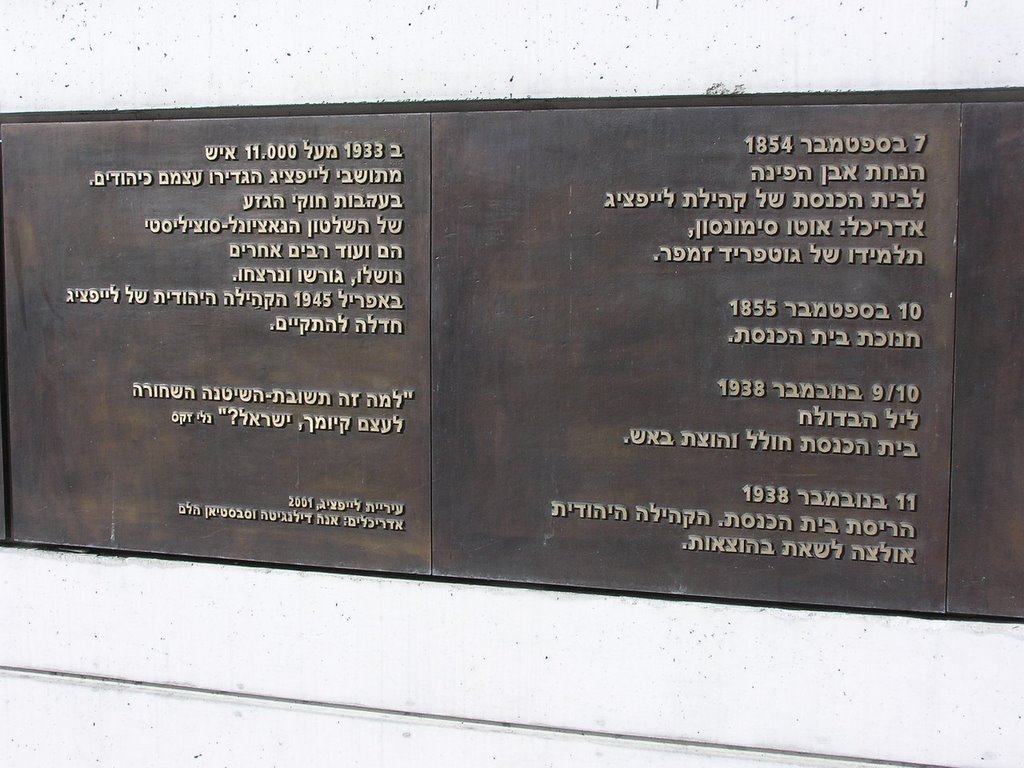
But the memory I will carry with me from Leipzig is from none of the above. In the middle of an innocuous square, not far from St. Thomas church, stand a few dozen wooden chairs. They mark the site of the former synagogue of the Jewish community of Leipzig, destroyed in the events following Kristallnacht in November 1938. More powerful than any monument, these simple chairs serve as a reminder of a community of 11,000 Jews that is no more.

Wednesday, February 15, 2006

The Joys of Israeli Bureaucracy

For a while now I've been meaning to write about the infernal bureaucratic road one has to follow when building a new house in Israel. But every time I started writing I found myself wondering where to begin, how to convey the horror of it all in one post - thoughts which quickly led to despair and abandonment of the effort. The labyrinthian nature of this kafkaesque experience requires writing skill that are beyond my capabilities.

So instead of a comprehensive post I will tell of one small incident.

Our house is a semi-detached one, built behind a 5-storey building. The entrance to our house (and the other three adjacent to ours) is from the parking lot of the building, so one has to walk through the car entrance to the rear of the building before reaching the house. To the left of our house (and the building) is a public path that is about a metre below the level of the parking lot. Today, there is a fence between the parking lot and this public path.

A while ago, the four families living in the houses requested the local authorities to open a small opening in the fence and build a few stairs leading down to the public path. This way, people could enter our houses by walking down the public path and up the stairs, instead of walking all the way around the building and through the car entrance. Not to mention the safety issues of walking through the same road as the cars. Our request was backed with photographs and a draft engineering plan. After a short meeting at the city hall, the appropriate bureaucrat approved the concept "in principle" and everyone was happy.

A couple of months ago we received a letter saying that upon re-consideration the request was denied. No explanations given. We wrote a letter back requesting another meeting to understand this reversal of decision. After a few weeks of silence, and several phone calls, another bureaucrat agreed to see us. In the meeting, she produced a letter (supposedly sent to us but which we never received) saying that the decision was reversed because after a "visit by professionals" to the area they realized the height difference between the public path and the parking lot is "more than 2.5 metres" and thus requires a "significant" flight of stairs, which is unacceptable.

Sounds fair enough, right? After all, why construce a massive of more than 10 stairs on a public path just to satisfy four families? Well, not so easy. This morning I took a measuring tape and checked the height difference. Turns out it is less than a metre... All it takes is 3-4 stairs.

So what are the possibilities? Perhaps nobody ever came on-site and the city hall just thought they could brush us off with a letter? Or perhaps the measuring tape of the "professionals" they sent was a biblical one and they measured amot instead of metres? Or perhaps this is just standard procedure and we need to go through the "proper" number of meetings, phone calls, letters and voice-raising scenarios before getting to a positive resolution of the matter.

And this is just a drop in the ocean. Oh, if I were to start writing about the other hundreds (yes, hundreds) of problems one has to solve in order to find peace and tranquility under a new roof. A heartfelt recommendation to anyone considering building a new house in Israel: DON'T. Buy an existing one instead and spend your time and energy in renovating it.

Monday, February 06, 2006

Sennacherib at the British Museum

I had a free half-day in London yesterday and decided to pay the British Museum a rather overdue visit (I think it's been 10 years since the last time). Not having too much time, I headed straight for the Ancient Far East rooms, which I remembered as being pretty impressive from my last visit.

As it turned out, I spent most of my time in and around the "Lachish" and the "Nineveh Palace" rooms, displaying items excavated in and around modern-day Iraq from the Sennacherib period. Sennacherib, king of Assyria in the 8th century BCE, is mentioned in the Bible and in the Talmud as the evil king from the North that descended upon Judah to try and quench the rebellion of the Jews in the times of king Hezekiah (helped by the Egyptians). He succeeded in conquering the city of Lachish, south-west of Jerusalem, but despite a long siege could not take Jerusalem and returned to his city of Nineveh. The Bible attributes this failure to a divine intervention: the angel of God descended upon Sennachrib's camp and killed 185,000 men (Melachim Bet). The Assyrian chronicles, on display at the British Museum, obviously tell a different story: Hezekiah was forced to surrender and to pay large sums of money to Sennacherib, and this is why the Assyrian king retreated back to his kingdom and spared the city.

Most of the reliefs in the Niniveh Palace room are partial, but the battle scenes they depict are still grandiose. Even more astounding are the reliefs in the Lachish room. One of the more interesting reliefs shows prisoners of war being brought before Sennacherib, who is sat on a throne and sentences some of them to death. Interestingly, the relief is almost intact and spans across an entire wall, but the king's face was deliberately defaced, probably after the end of his reign, when Nineveh fell in 612 BCE.

Now I need to visit the site at Nineveh, where apparently the Iraqi department of Antiquities did a fabulous job of preserving the excavated remains of Sennacherib's palace.

Tuesday, January 31, 2006

Sushi - The Guide

It's been a while since I posted... And I'm afraid this is not going to be a "proper" post.

Here's an amusing link I got from a friend: sushi. Enjoy.


Thursday, January 05, 2006

A Prayer for Sharon


On this day, my thoughts are with Ariel Sharon. I pray for a speedy and healthy recovery and hope for a miracle. Given the alternatives, Israel without his leadership is a thought almost too hard to bear.


Tuesday, December 20, 2005

Sayonara Japan, Shalom Israel

Last Friday we landed in Israel, back home after more than four years of living in Japan.

When I signed the contract to relocate to Tokyo, the expectation was that we would be in Japan for two, maybe three, years. At the time, despite me being familiar with Tokyo from several years of regular business trips there, living in the Land of the Rising Sun seemed like something we would never get really used to. We did not think it would become possible for us to call Japan "home". After all, it is so far away from Israel, geographically and culturally. How wrong we were.

Almost four and a half years have gone by and alarmingly fast. Not only did we get used to living in this foreign land, but we actually grew to love it. It is true that it would never be "home" in the deeper sense of the word - after all, a gaijin is a foreigner for life - but for us it did become a place we could call "home". A place we will terribly miss.

So it is with these mixed feelings that we start a new chapter in our lives, this time in our real "home".

Tuesday, November 29, 2005

Chayey Sarah - Overcoming Our Self-Interest

ויאמר אליו העבד: אולי לא תאבה האשה ללכת אחרי אל הארץ הזאת. ההשב אשיב את בנך אל הארץ הזאת אשר יצאת משם?

(בראשית כ"ד, ה')

Avraham's servant, Damasek Eliezer, is mostly described in rosy colours by our sages. They tell us that although he was Canaanite, his knowledge of the Torah was wide and deep. They tell us that he was not only a faithful servant that carried out his master's wishes, but he was also very smart and intelligent. The slight changes he makes in describing his duties to Rivka's parents and brother are brought as an example of his diplomatic (and selling) skills. So much so that the Midrash states: "the talk of servants is more beautiful than the Torah of the sons", alluding to the Torah's lengthy recounting of Eliezer's story.

It is therefore somewhat surprising to read, in the same Midrash, that Eliezer's intentions were not always entirely faithful to Avraham. In fact, he had a daughter and wished for her to be the chosen one for Yitzhak; he could not comprehend why Avraham would go to such lengths to find a wife for his beloved son when a most suitable woman was available right there in his household. The Midrash goes as far as to alter a word in the Torah to express the extent of Eliezer's wishes:

And the servant said to him: what if the woman will not be willing to follow me to this land? Should I bring your son back to the land you came from?

(Bereshit 24, 6)

"What if" in Hebrew reads "אולי", and the Midrash tells us to read this word as a similar sounding work: "הלוואי", meaning "hopefully", thus revealing Eliezer's true intentions. He was not asking a legitimate question about the possibility of the woman not wanting to follow him back to Canaan; he was expressing his innermost wishes that this would indeed happen, so that Avraham would have no choice but give Yitzhak to his daughter. The Midrash goes even further. When Eliezer recounts the story to Rivka's household, the word "what if" in Hebrew is written with the ommission of the letter Vav - "אלי" - implying that Eliezer was telling them that he wishes Rivka not to go back with him to Canaan.

Why does the Midrash go to such lengths to find wrongs in Eliezer's behaviour and to put blemish on his otherwise impeccable loyalty to Avraham?

The Midrash teaches us something here about human nature. Even sages, even the most holy of men, cannot escape the basic human trait of self-serving interest. No matter how much Eliezer was loyal to Avraham, deep inside him, perhaps even at a sub-conscious level, he had a different agenda. He wanted his own daughter to marry the son of his master. Nobody is exempt from the occasional slip, from the urge to overlook what's right and act out of pure self-interest.

And yet Eliezer accomplishes his task. He brings back Rivka to marry Yitzhak, thus giving up his hopes and those of his flesh and blood. Why? It is here that the Torah teaches us a great lesson. True: one cannot entirely escape one's yetzer ha'ra, one's evil inclination, and avoid harbouring secret desires. But we have a choice. We can choose between what is right and what is wrong. Either we let our yetzer ha'ra overcome us, or we do everything in our power to overcome it.

Eliezer proves he can overcome. He realises that deep inside he wishes his mission to fail, but does everything in his power to make it successful, because it is the right thing to do. He hurries to give Rivka the presents, even before she says yes; he refuses to eat at Betuel's house until he tell them his wishes; and the following morning he rejects the suggestion that Rivka stay home for another week or so before leaving and insists on leaving immediately. He makes sure he does not allow himself to make any mistakes by hurrying through his mission to assure it is ends successfully.

The idea for this week's Torah thought is from R. Ronen Neurwirth.

Thursday, November 10, 2005

Eat What You Like, Pay What You Wish

I spent the last few days in Singapore. I've been here once before and it was a pleasure being back. Despite the rather annoying weather - always hot, often raining - it is a very pleasant place.

Last night I asked the concierge whether he knew of any vegetarian Indian restaurants. He sent me to the Annalakshmi restaurant at the Excelsior hotel. Quite an experience. The setting and the food were pretty standard for Indian restaurants, but what was not standard was the price. Or rather, the lack thereof.

It turns out the restaurant is operated by a cultural organization called The Temple of Fine Arts, a volunteer-based group that teaches music and dance for free. To finance themselves, these people set up a chain of restaurants where food is offered for a price determined by the diners. You order from a priceless menu and when you're done, you pay what you feel is appropriate. Certainly a different kind of experience.

How much did we pay? Well, as money is not the point here, I won't tell.

Friday, October 28, 2005

Bereshit - A Constant Challenger

ויאמר ה' אל קין: למה חרה לך ולמה נפלו פניך? לוא אם תיטיב, שאת, ואם לא תיטיב, לפתח חטאת רבץ; ואליך תשוקתו ואתה תמשל בו.

(בראשית ד', ו'-ז')

With Bereshit we start the Torah from the beginning. This parasha has a lot of beginnings, the obvious one being the creation of the world. But this is also a first for many other things: the first sin, the first murder, the first excuse. In many ways Bereshit is the foundation for many of our traits as human beings. One of these is our propensity to sin.

The two sons of Adam make an offering to God. Abel brings the firstlings of his flock and Cain brings the fruit of the ground. After God rejects Cain's offering He tells him:

Why are you angry and why is your countenance fallen? If you improve yourself, shall it not be lifted up? And if you do not improve yourself, sin crouches at the doorstep, and its desire is towards you, but you may rule over it.

(Bereshit 4, 6-7)

So our yetzer ha'ra, our evil inclination, is always there, always lurking. It is at the doorstep, willing us to fulfill our desires and commit a sin. But it does not have full control over us, we may yet "rule over it" if we only so desire. There is an evil force blocking the doorway, but we may conquer it and get past it.

Here is a story that may help us understand the meaning of yetzer ha'ra and the significance of overcoming its desire. The head of a yeshiva noticed that one of the students missed classes on Sunday and Monday. This was a very good student who never missed class, so the rabbi approached him on Tuesday asking what happened. After some hesitation, the student replied that the rabbi would not understand. "Try me", said the rabbi. So the student explained that he went to watch the finals of an important soccer tournament and that, in fact, he would probably be away also tomorrow as it was the final day of the tournament.

The rabbi smiled and asked the student to explain more about this soccer game. "How does one win this game?", he enquired. The student explained that there are 11 players and the idea is to kick the ball into a large goal. The rabbi frowned and said: "So what's the problem? Kick the ball into the goal and come back to study!". The student laughed and explained that there is an opposing team of 11 players, and they have a goalkeeper that stops the ball from going into the goal. The rabbi asked: "Surely the other team does not sleep at the soccer grounds. So why don't you just slip out at night, put the ball into their goal, and declare victory the next morning?". The student, perplexed at this bizarre suggestion, answered: "But that wouldn't be a challenge. If there's no goalkeeper trying to stop you, then there's no point in winning!".

At this point the rabbi gave the student a large smile and said: "Listen to yourself. You're a good student and it's no big deal for you to come to yeshiva when there is nothing holding you back. But when the urge to skip class is there, when the yetzer ha'ra is the goalkeeper keeping you from entering the classroom, then it becomes a real challenge. This is when you score the real points in the game."

The Torah tells us not only about the nature of the yetzer ha'ra as an adversary, but also as a challenger. It challenges us to overcome our desire and to do the right thing. It is always crouching at the doorstep, ready to block us. Our job is to realize that we must overcome it at the point when the urge is the greatest. When it is difficult to do the right thing, it is up to us to make the effort to score the goal.

The idea for this week's Torah thought is from R. Mordechai Kamenetzky.

Monday, October 03, 2005

A Ray of Hope

Tonight it is Rosh HaShana and we enter a new year, 5766. Time for teshuva, time for collecting one's thoughts about the past and making new resolutions for the future.

Rosh HaShana is the day on which we make God king over the world. It is also Yom HaDin, the day of judgement, the day when all creation passes before God and is judged for the coming year. In ten days' time it will be Yom Kippur, the day of repentance and atonement, the day on which we confess our sins before God and ask for forgiveness.

One wonders about the order of things here. Surely the order needs to be reversed: we should first detail our sins and ask for forgiveness and only then be judged and accept God's rule as king. How dare we we come before God and make him our king while still not being purified from our sins?

The reason for this requires a look into the human psyche and may be illustrated using the following story. One important gentleman was a source of pride to his family and his community. He was intelligent and wealthy and dedicated his time and money to help others. But he had one fault: he was an alcoholic. Every now and then he would get completely drunk and bring disgrace upon himself and his family. To try and make him realise his bad ways, his sons took him for a ride in the street and showed him a homeless drunk who was sprawled on the sidewalk, knocked out from too much alcohol. They told their father: see, this is what you look like when you get drunk. The man looked at the drunk, got off the car, approached him and whispered a few words in his ear. The drunk looked up and answered. Upon returning to the car, the man's sons were curious about this exchange. Their father smiled and said: I asked him where he got the good stuff that made him this superbly drunk...

The morale from this story is the following. For us to be able to repent for our sins in a serious manner we need first to have a ray of light, a beacon of hope. One cannot fight against a bad reality without any hope, when still mired and lost in sin. If we are not shown an alternative of good, it is difficult for us to extricate ourselves from the bad. The man was not shown an alternative; he was shown only bad, therefore he was unable to pull himself up and improve.

In Rosh HaShana we are shown the alternative. God is made king and we see the light of his kingdom. After this uplifting experience, after we are shown the alternative of good, we are more prepared to come before Him and ask for forgiveness on Yom Kippur. God, in His infinite wisdom, understands that for us human beings to be able to help ourselves, we need to have some hope in order to be able to truly repent and mend our ways. This hope is given to us in the form of Rosh HaShana.

Shana Tova to all.

Friday, September 30, 2005

Apropos Air Travel

This is my first ever post from 33,000 feet, somwhere over Siberia.

I may be travelling on a crappy A340 - with cramped seating arrangements, a global screen for entertainment (3 movies, seen them all) and Stogel for kosher food - but at least Lufthansa is one of the first airlines to offer internet access.

What I need now is one of those aircraft power cords for my laptop to make sure I can stay online for all 11 hours of the flight...

Wednesday, September 28, 2005

Air Travel Questions

Travels over the past couple of weeks have brought me to six different airports, on four different airlines and seven different flights. The inevitable long waits in airport lounges and during taxiing gave me an opportunity to think about several questions concerning air travel. Perhpas someone out there can help me answer some of them.

  1. Why does the business class line (before security or check-in) almost always move slower than the economy class one?
  2. Why does the laptop need to go through the security x-ray machine separately? Will the machine not scan the laptop if it's in the bag? And what's the deal with removing your shoes?!
  3. And on the same subject, why do most European countries require you to remove the laptop but the Brits don't?
  4. Exit row seats are coveted by many, and for a good reason (extra leg room). But why on earth can't one lift the arm-rests in these rows?
  5. When the flight attendants dispsense that all-important security information to passengers ("the seat belt can be unfastened by lifting this buckle"), do they get offended by the fact that nobody pays them the least attention?
  6. Why is the kosher food distributed to passengers before the regular food? Could it be because it takes the average person almost half an hour to wrestle with those impenetrable plastic wrappings?
  7. Why does every airline on the planet air episodes of "Everybody Loves Raymond"?
  8. Why do pilots always promise to try and make up for lost time after a delayed departure? One would think they would go as fast as they can in any case, no?

There's more, but these will do for now.

Sunday, September 11, 2005

Shikata-ga-nai

Years ago, when I started doing business in Japan, I was working on a rather large deal with one of the largest Japanese insurance companies. They thought our price increase was way too high and had no real justification. Negotiations were tough. At a certain point, after having exahusted all possible avenues of persuasion, I was beginning to lose hope of convincing the customer to continue working with us. It was then that a colleauge of mine, with decades of experience of working in Japan, told me it was time to use the ultimate weapon: shikata-ga-nai.

Translated into English, Shikata-ga-nai means "it cannot be helped" or "it is hopeless". What my friend was recommending was to tell the customer that there was no more room for negotiations. It was a "hopeless" situation and that was that. Apparently, once shikata-ga-nai is uttered under such circumstances, the other party understands you have reached the limit of your bargaining leeway; it is now decision time, a sort of "take it or leave it" situation. My friend added that shikata-ga-nai should be used only in extreme situations - "once a year at most" I recall him saying - otherwise one loses his credibility very quickly. With trepidation, I followed my friend's advice. It worked and we got the deal.

Shikata-ga-nai is a word you hear often in Japan although almost never in a business context. Its more informal version - sho-ga-nai - is used in daily conversations and is usually accompanied by a light shrug, an expression of hopelessness. People use it to tell you that they tried everything, but "it just cannot be helped". In a sense it conveys the opposite message of ganbatte, another popular Japanese expression meaning "do your best".

Sometimes the use of shikata-ga-nai is a chilling expression used by someone coming to terms with a bitter reality. I recently read "Hiroshima" by John Hersey, a book about the dropping of the atomic bomb on Hiroshima city on August 6, 1945. In his first-hand account of six survivors, Hersey provides a unique glimpse into the state of mind of the people of Hiroshima in the hours and days following the bombing. One expression by survivors which is mentioned several times throughout the book is shikata-ga-nai, but here it has a different meaning. Injured by the bomb, separated from their families, left with no possessions, these survivors answer the journalist's questions by a final shikata-ga-nai, here truly meaning there is no more hope.

Friday, September 02, 2005

To Become a Superhero!


Just as Japanese love their anime, so do they love their mascots. As mentioned earlier, even the police have their own mascot...

Today, I came across Kutan, the new mascot for Tokyo's international airport, Narita. His job is quite straightforward: keep everybody using the airport happy. But this is no ordinary mascot. He has a dream: to become a superhero!

Words fail me...

Sunday, August 07, 2005

Some Girls


During a brief visit to London last week I managed to go see a play at the West End: Some Girls by Neil LaBute, starring David Schwimmer (a.k.a Ross Geller from Friends). I thoroughly enjoyed it, despite the cramped seating of the Gielgud theatre.

This is David Schwimmer's debut in the West End. He plays a man who is about to get married and decides to visit four of his ex-girlfriends. Just before taking the plunge to the other side, he wants to make sure that he is making the right choice. He also wants to make amends for some of the hurt he has caused in the past, such as going to the prom with another girl or running away from an illicit affair with a married woman. As the dialogue with each woman progresses, he finds out how little he actually knows about what they felt, and indeed still feel, about him.

The play is funny, but at the same time it touches on some of the finer points in the relationship between man and woman, of couples who have been very close to each other and in hindsight are surprised to discover new things about themselves.

If you get a chance to visit London (and the tickets for The Death of a Salesman are sold out...) this play is well worth watching.

Saturday, July 30, 2005

Magdeburg, Germany

I was in Germany last week on business and spent a night in Magdeburg, a medium-sized city (population ~210,000) in former Eastern Germany. It was my first time ever beyond the old “iron curtain” and I was curious to see if I would note any differences from the Germany I know on the Western side.

The differences were minimal. Indeed, had I not known Magdeburg used to be part of Eastern Germany I would not have been able to tell the difference from any other German city. There are almost no remnants from those days. Communist street names have been all changed, I did not see any Trabant cars (I was really hoping to get a glimpse of one) and even the socialist-looking buildings from the FDR era were mostly renovated and blended in with the new architecture. Perhaps only the wide avenues , once grounds for May Day parades, gave an indication this city was part of the Communist Block a mere 16 years ago. Oh, and the fact that hardly anybody spoke or understood English.

Over dinner, our hosts told us more about the city. Apparently, when the Berlin wall came down the population of Magdeburg was almost 300,000. Local industry was mostly composed of mom & pop factories, producing widgets that nobody had use to once the old regime collapsed. Over the course of the 90s the population dwindles by almost a third and unemployment rose to the highest level in Germany, about 20%. In the past few years the authorities are trying to redefine the city as an academic center. There are two universities, a conservatorium and several research institutes.

After dinner we were taken for a short drive around Magdeburg, which this year is celebrating its 1,200 anniversary. The cathedral is an imposing structure, built by the Catholics but used, soon after its completion and to this day, by the Reformists. The Americans spared this magnificent piece of medieval architecture when they bombed the city in January 1945. REM recently gave an open-air concert in the square facing the cathedral. The river Elbe crosses the city and the numerous bridges provide pleasant views of this tranquil city.

Wednesday, July 20, 2005

Orange vs. Blue

We are in Israel for a month or so for a summer vacation. These are exciting times in Israel, less than a month away from the Gaza disengagement, the first time an Israeli government will displace Jews from their homes. The Knesset voted today against the motions calling for a delay in the plan execution, and all seems set for the big showdown in mid August.

One of the most striking public displays of this buildup, at least the one which immediately drew my attention upon arriving here earlier this week, is the orange vs. blue "ribbon war". Those against the disengagement have long ago chosen orange as the colour symbolising their opposition: orange t-shirts, orange flags, orange banners and, most prominently, orange ribbons attached to car antennas. In a somewhat late response, the other side chose blue as their colour. So while driving around one gets to see many ribbons flapping in the wind.

Most of these ribbons are, I hate to admit, orange. But my wife says that the cars with no ribbon at all (i.e. most cars) represent the "silent majority", those who are in favour of the disengagement plan but are too lazy or cannot be bothered to "flap" their opinion in public. I hope she's right.

I am now looking for a blue ribbon for my rental car...

Saturday, July 09, 2005

France - The Malaise Continues

I was in Paris last week for a couple of days, arriving a few hours before the announcement of the Olympic Games Committee that London would host the 2012 Olympic Games. On my way from the airport the news on the radio were almost exclusively focused on the imminent decision, with live reports from Singapore on the French presentation, the highlights of which were a film about Paris directed by Luc Besson and an emotional speech given by Jacques Chirac about the merits of the French capital.

During my morning meetings the tension was palpable. By lunchtime, the shortlist was down to London and Paris, and the conversation around the table touched on the generations-old rivalry between the two countries straddling the English Channel. Needless to say, the obvious clichés about the gaps in food quality and esprit de corps were the main course.

By early afternoon, when the announcement was made, the mood changed. Some shrugged the whole thing off as being unimportant and said they opposed the whole thing from the beginning anyway (“who wants all those foreigners invading Paris and creating traffic jams in the height of summer?”). Others blamed the whole thing on politics; this was nothing but a way to get back at France for rejecting the referendum on the EU constitution last month. Yet others said this was all too predictable, another milestone in the long string of French failures on the global stage in recent years. After all, this is the third consecutive time Paris has competed and lost for the bid to host the Olympic Games.

To me, this whole story is yet another symptom of the sickness France has been suffering from in the past decade or so, a general air of malaise the roots of which are hard to pinpoint but which everyone agrees is clearly there. The general sentiment is that anything that can go wrong, will indeed go wrong. The feeling that no matter what France does or says, the world will, at best, misunderstand or in the worst case shrug off as irrelevant. The list is long: France’s stance on the Iraq war, its hesitant position regarding the enlargement of the EU community and Turkey’s candidacy, the awkward balance between a “social” economic policy and the required “capitalist” measures so sorely needed to revive the economy and the belated and hotly contested steps taken against the Muslim minority (the so-called “Chador law”). The feeling is that everything is breaking down and the country is not going anywhere.

My personal experience this week (although it can hardly be representative), confirms this last feeling. I took two taxis during my short stay, and both could not find their way to the destination without problems. The first driver, once we finally arrived, also could not get the credit card machine to work. Both blamed everything but themselves for not doing their job properly: the road signs, the bad advice of other drivers, the non-functioning GPS system... A Swedish colleague of mine, who was unfortunate enough to share one of these rides with me, said this was a “known thing” in Europe: French taxi drivers simply do not know their way around. As far as I’m concerned, at least one of the systems in France is most definitely broken down.

Sunday, July 03, 2005

The Legacy of the Settlers

I usually refrain from writing about politics in Israel, avoiding in particular the current debate regarding the Gaza disengagement plan. But after last week's lynching of a Palestinian by Jewish teenagers, the "high point" of a week of daily violence from the "orange" side of the spectrum, I feel compelled to post here an op-ed piece Uzi Benziman in Ha'aretz. Benziman simply tells it the way it is.

Not an isolated spectacle

By Uzi Benziman (Ha'aretz July 3, 2005)

The recent events in Gush Katif are a clear reflection of the settlers' grasp of Judaism: First you take over an abandoned Palestinian house, then set a mezuzah in it and declare it as Jewish property. Then you hold prayer sessions and Hasidic dancing in it. Later you provoke the Palestinian neighbors - an act that leads to stone throwing and ends with attempts by Jewish youths to stone to death an unconscious Palestinian teen.

This, in a nutshell, is the story of the Israeli takeover of the territories since 1967: seizing foreign lands, vindicating the robbery in the name of halakha and the right of the forefathers, creating friction and causing violent confrontations with the Palestinian neighbors, using force to ensure the hold on the new properties and relying on the state's powerful security apparatuses to eliminate the Palestinians' resistance to the injustice inflicted on them.

The sanctimonious rhetoric accompanying last Wednesday's attempted lynch at the Tal Yam outpost is typical of the entire settlement project. (Pasting Hebrew names, usually biblical, on outposts and communities in the territories, is part of the process of converting them to Judaism.) MK Shaul Yahalom called on the public in Israel and the world to believe that the thugs who stoned Hilal Ziyad Majaida were not religious Jews, they were only dressed up that way. Other settler leaders, some of whom sounded sincerely shocked by what they had seen, also said things to that effect.

We may assume that at least some of the settlers' leaders, rabbis and political representatives are sincerely disgusted with the murderous behavior of the hilltop youth and the Kahane youth who gathered in the hotel in Neveh Dekalim. If this is so, a few truths should be made clear to them: The settlement project has turned into an institute for contemporary Judaism. This is the assembly line that produces the neo-Jew or the neo-Israeli believer.

The settlers came to the West Bank and Gaza Strip, and forced their view on the feeble Israeli governments (throughout the generations) in the name of a primordial right, taking over territories that were not theirs and usurping the Palestinian residents of their rights and lands. The state, after being dragged into this manipulation, retroactively backed it. It then found itself painted into a
corner from which it was obliged to support the project with quasi-legal military and security tricks. This is how the Jewish enclave in Hebron was established in `68, followed by most of the 122 settlements and 105 illegal outposts. The process, a fundamentally distorted act of government, was politically stupid, immoral and inhumane, and it created dynamics whose inevitable results are, among other things, along the lines of the spectacle that shocked Yahalom last week.

From the outstart, deranged and radical people accumulated in a few communities in the territories. The violent friction with the Palestinians created conditions that unleashed the animal in man. Whether or not these were the causes, the outburst of the skinheads in Gush Katif last Wednesday was not a rare spectacle. The history of the settlements is full of killing and robbery, disgraceful violations of the rights of the Palestinian neighbors and trampling on their dignity.

The Talia Sasson report is filled with examples of law violations on the part of the settlers, their collaborators in the state and the politicians above it. This air of lawlessness derives from the original sin - the urge to settle in the territories - and provides the petri dish for murderous urges, as displayed in the Machpela Cave massacre, the murder of innocent farmers, the assassination of Yitzhak Rabin and the attempted lynch in Gush Katif.

The settlers reject this description. They see their settlement in the West Bank and Gaza as an implementation of the Jewish nation's right to its forefathers' land. They justify the contradiction between their motives and the fatal, corrupting consequences as the isolated acts of "wild weeds." This is their mistake. Even taking into consideration the Palestinians' contribution to the conflict, even taking care not to generalize and being aware of the humaneness of many settlers, there is no escape from the conclusion. The settlement project has created the circumstances that generate the terrible acts carried out by the state and by individuals, in the name of the Jews' right to a national home.