This Blog Has Moved


APRIL 2010: THIS BLOG HAS MOVED
GO TO THE NEW ADDRESS TO COMMENT. THANK YOU.

New Address:

http://nafkamina.wordpress.com

All posts are available in the new blog

Please do not post any comments here. Go to the new address to comment. Thank you.


Thursday, May 25, 2006

Man in the Shadows, by Efraim Halevy


What should one expect when picking up a book with a subtitle that reads: "Inside the Middle East Crisis with a Man Who Led the Mossad"? Surely this is going to be a real-life rendering of a Tom Clancy novel, or at the very least, a John Le Carre one? Well, not exactly. Efraim Halevy, who was at the helm of Israel's notorious and legendary secret service organization for five years, is not your typical cloak-and-dagger type. Far from it. I happened to have met him personally on a couple of occasions many years ago, and if anything, he reminded me of Sir Humphrey in the TV show "Yes Minister": the quintessential British civil servant, with impeccable manners and the Queen's English.
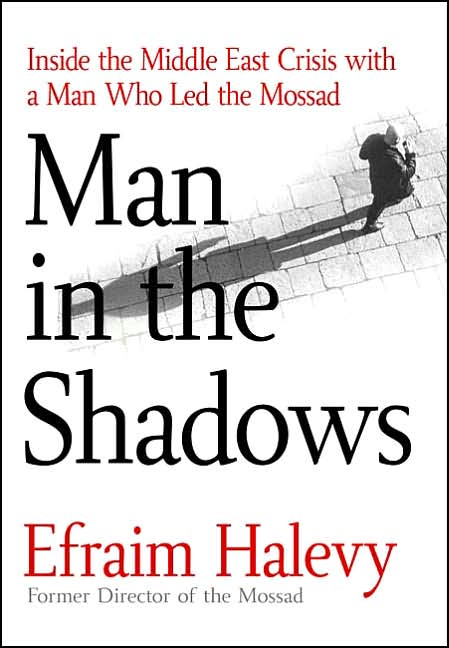
"Man in the Shadows" is more of a political memoir than an account of the Mossad's activities. Halevy played a dominant role as the secret envoy of several Israeli prime ministers (Shamir, Peres, Rabin, Netanyahu, Barak and Sharon) and as such was privy to many negotiations that shaped the region's politics in the 1990s. He writes of these experiences in a low-key and level-headed manner; rarely does he lapse into the emotional zone and when he does so it usually, and suprisingly, concerns Shimon Peres and/or the Israeli foreign services. Although not stated in so many words, it is clear that Halevy has little sympathy for Peres. He speaks fondly of other prime ministers he served under, but for Peres he has nothing but scorn and distrust. As for the foreign office diplomats, he makes them out to look like total amateurs.

A lot of attention is given to Jordan and to its late king, Hussein. This is understandable given Halevy's special relationship with the Hashemite kingdom and the late monarch. His involvement in bringing about the peace agreement between Jordan and Israel was substantial. His account of the Khaled Mashal incident - a botched attempt by the Mossad to kill a Hamas leader in Amman that brought about a serious crisis between the two countries - is probably the most fascinating chapter in the book. Halevy is well aware of this "Jordan bias" of his and admits to it; nevertheless, he remains of the opinion that Jordan plays a pivotal role in the Middle East, well and above what most observers will admit to.

Halevy also devotes many pages to how he views the intelligence community and its interaction with its political masters. I found these parts of the book to be more interesting than the historical accounts (especially as there are no new revelations anyway). Halevy laments the decline of the special standing of the intelligence community, especially in the US, in the aftermath of the 9/11 structural shake-ups. He believes that in the current war of the civilised world against global terrorism - a war he calls "World War 3" - the West cannot win if it does not accord its intelligence organs the proper standing and freedom of operation they deserve.

Monday, May 15, 2006

Sento - Washing Away

Reading the Daily Yomiuri over breakfast this morning (I am in Tokyo this week) I came across some distressing news: the number of sento in Tokyo has fallen below 1,000! The exact number as of today - everything is tracked and recorded in Japan - is 999.

Sento are public baths (literally: "penny baths", sen = penny; to = bath). Most people are familar with the Japanese onsen, the natural water hot springs so popular with tourists and locals. Sento are the ugly step-sisters of onsen. They are spread around the city and comprise of a small changing room with tiny lockers, a few shower stalls (the sitting type, of course) and the hot bath itself. All of the sento today are separated, unlike in the old days when everybody soaked together. They are not easy to spot as usually the entrance is very small with nothing but a small sign saying yu (hot water) over a blue-curtained noren.

Back in the times when most houses in Tokyo were not equipped with running hot water, sento was the way to keep clean. Even today, it is not uncommon in certain neighbourhoods to see people making their way to the sento at the end of the working day. However, with the more hectic life style of Tokyoites and the availability of higher-end spas and health centres, onsen are gradually washing away, yet another sign of the changing face of Japan.

Saturday, May 06, 2006

Four Billion Dollars

Many years ago - it was either in the application for an MBA or during the Foreign Office tests, I don't recall exactly - I was asked to write a short essay about the person I admired most. I chose Steph Wertheimer, the Israeli entrepreneur who set up his business empire, the Iscar group, in northern Israel. Wertheimer was a Member of the Knesset for four years, built the industrial park in Tefen and the neighbouring community of Kefar Veradim. In 1991 he received the highest award the State of Israel can bestow upon its citizens - The Israel Prize.

Warren Buffet, the legendary investor and "the world's second richest man", announced yesterday that his investment company will buy 80% of Iscar for 4 billion dollars. That's a valuation worth more than 4% of Israel's annual GDP, for a privately-owned company!

Beyond its economic value, this deal has tremendous implications regarding foreign investment in Israel. Kudos to the Wertheimer family; Israel needs more of these people.

Sunday, April 30, 2006

Maccabees - Then and Now


A few minutes ago Maccabi Tel Aviv lost to CSKA Moscow in the European basketball finals in Prague.

The original Maccabees were warriors from the house of Matityahu the Hasmonean, whose name derived from the Jewish word for "hammer" (makevet) and who rose up in revolt and fought an heroic war against Hellenism in the 2nd century B.C.E. Their victory is celebrated every year during the festival of Hannukah.

I admit that I too am occasionally interested in the modern-day "maccabeem". I watched the second half (I missed the first half due to the Daf Hayomi shi'ur) and I too cheered for Maccabi during certain moments in the game. But the passion just isn't there any more. Why? Consider the following picture, from today's game:


A Maccabi player against a CSKA player. Both 2nd rate players from the US, NBA dropouts or wannabees, mercenaries in the world of professional basketball. And yet they manage to stir up enough passion and interest among Israelis (me included!), who still view a victory by Maccabi Tel Aviv as a victory of "the Jews against the goyim".

I struggle to find that passion within me. It does not come easily. Gone are the days of a team of Israeli (or at least Jewish) players - like Mickey Berkowits, Motti Aroesti and Tal Brodi - who made me proud as a teenager growing up in Italy when they beat Mobilgirgi Varese in 1977. It's all business nowadays and passion for business I keep for my working hours, not my leisure time.

Wednesday, April 26, 2006

Basel, Switzerland


A few hours spent earlier this week walking aimlessly around Basel, in northern Switzerland, during a beautiful sunny spring afternoon, generated the following random thoughts:

1. Basel is a lot more multi-cultural than I had imagined, even given the fact it sits in the junction between three countries. Aside from the obvious German and French, I heard Italian, Turkish, Russian, English, Greek and a few other languages I could not name.

2. Why can't any city, or even a small town, or you know what, the tiniest village in Israel, be half as clean as Basel is?

3. How pleasant is the sight of mothers and their children riding together on a bicycle to/from school, weaving their way patiently through traffic composed of cars and trams, and yet not for a moment looking worried that someone will cut them rudely off the road.

4. The cherry trees blossom also in Basel, not only in Tokyo. And these are real cherry trees, with real fruit, unlike the Japanese "fake" sakura.

5. For an airport carrying the dual name Basel-Mulhouse (after the Swiss and French cities it serves), Euro Airport is astonishingly small.

6. A kosher restaurant outside Israel can serve good food, in a quiet and clean environment and for a reasonable price. Sounds impossibly crazy? Try the Topas restaurant at the Jewish Community Centre on Leimenstrasse 24 in Basel.

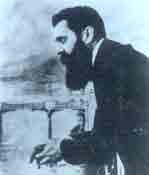
7. Finally, the Israeli angle. The Three Kings Hotel is closed for restoration, so to try and recreate what Herzl felt like when he was contemplating the establishment of a Jewish state, I had to make my way to the promenade underneath the hotel.


The Balcony: then and now.

I put my elbows on the stone wall, leaned forward, looked thoughtfully at the other bank and tried to concentrate hard, to capture that unique "Zionist moment". Conclusion: I have no clue what made Theodor yearn for the dusty landscape of Palestine while watching the beautiful Rhine river flowing vigorously a few feet below. He must have been smoking something. Or perhaps I should have waited longer, enough time to grow a beard.


Thursday, April 20, 2006

The Israeli Arse

One of the least appealing aspects of life in Israel is living side-by-side with "The Israeli Arse". No, I am not referring to the backsides of my fellow denizens. I'm talking about that ubiquitous character that makes life in Israel much more colourful perhaps, but at times also very annoying and almost unbearable.

The "Arse" is by now a stereotype: tight jeans, white t-shirts, copious amounts of hair jel, heavy golden jewelery, hand jestures, blue neon lights under the car, etc... (if you've lost me here, watch the movie I linked to above). But what used to be an amusing anthropological pastime has fast become the norm of Israeli society. "Arseem" are everywhere: on the road, in supermarkets, in malls, at the airport, in the synagogue. Perhaps it's just my being away for a few years, but it seems like the "Arseem" population has grown immensely.

But it's more than that really. The "Arseem" themselves are not the whole problem. What bothers me is the the "Arse culture" which seems to have become the de-facto Israeli culture, the zeitgeist. The total lack of basic manners (queuing up, or saying "sorry" after bumping into someone), the rudeness, the loud talking, the lack of respect for other people's space or even presence. I find myself appraising people judgmentally on the street and in shops, to ascertain whether they are friends or foes.

I am currently reading a book about the 1967 "six day war", which describes the general atmosphere of Israeli society before, during and after the war. What a different country! I'm not referring to the political/military differences but to how people wrote, spoke and behaved. Despite the harder times - both economically and politically - people back then had respect for fellow citizen and for country. I regret to say I don't see that around me today. It's every man for himself (except for rare moments of short-lived unity, around some major tragedy like a suicide bombing).

Last week, after a particularly nasty road incident with an "Arse" (I use the term freely here; he looked pretty respectable but his driving was definitely "Arse" in nature), I remembered something a friend told me many years ago. We were talking about life in Israel and how hard it was to get used to some aspects of it, and he said: "There is no choice. At a certain point in your life you come to realize that in order to protect your family and your sanity, you need to erect virtual walls around you. You block yourself off from the rest of the world and care only about the ones you love most". How true, and how sad.

Monday, April 03, 2006

Midlife Crisis and Hairdressing

A friend of mine opened a hair styling salon in Tel Aviv last month. He and I did our MBA together. Like me, he works at a high-tech company and is used to life in the fast lane, but a couple of years ago he decided he would learn how to cut hair and open his own salon.

"Atmospera", as the place is called, is a cross between a hair salon and an art gallery. The idea is to promote young artists' work with a revolving display.

I wish him all the best with this initiative. I know we're all going through our midlife crisis right now, but hair styling!? I admire him for taking the leap and doing what he felt he wanted to do (whilst keeping his day job...).


Sunday, April 02, 2006

I am Charlotte Simmons, by Tom Wolfe


This book is about the corruption of a young American girl from Sparta, a remote mountain town in North Carolina, who makes it against all odds to a top university in Pennsylvania ("Dupont"), only to find out that not top-notch education but rather sex, alcohol, drugs and generlly being "cool" are top-most on her fellow students' minds. Tom Wolfe paints a vivid picture of college life on American campuses, or at least that's what he would have us believe, not too successfully in my mind.

I guess Wolfe was out to write the definitive book about college life. And indeed the book is nothing but a long (700+ pages) description of the frivolities of college students. It is full of stereotypical characters: the basketball players who get academic discounts and lead a life (literally) above the rest, the drunken frat boys and the giggly sorority girls, the group of smart nerds who are after the Rhodes scholarship and, above all, the innocent hillybilly who cannot believe it all - Charlotte. Wolfe, in his charcteristic style, does not leave much to the imagination when describing Charlotte's encounter with college life. One of ther first experiences on campus are the sounds produced by a boy defecating loudly in the stalls of the co-ed bathroom (I will spare you the details). Shortly thereafter, Charlotte's room-mate throws her out in the middle of the night so that she can spend time there alone with her boyfriend; thus Charlotte learns what it means to be "sexiled". And so on and so forth.

Despite its weakness in credibility - I refuse to believe this is what life in Ivy League colleges is all about - what saves this book is Wolfe's excellent writing style, captivating the reader and transporting him to a world that although removed from reality seems at the same time very realistic. I read the book while travelling between three continents and it was a faithful companion on the long flights and sleepless nights. As far as pop fiction goes, it's an entertaining read.

One final thought. Wolfe, author of excellent books such as Bonfire of Vanities and A Man in Full, gives thanks in the foreward to the book to his daughters, who apparently let him into the secret lives of college students based on first-hand experiences. If I am Charlotte Simmons faithfully portrays what Wolfe's daughters went through in college, I shudder to think how he reacted, as a father, when hearing their stories.

Wednesday, March 29, 2006

A Partial Eclipse

There was a solar eclipse today. In Israel it was only partial, but still quite impressive.

Sadly, while I was watching the sun being gradually eclipsed by the shadow of the moon, I could not but think about the greater eclipse that occurred only hours earlier: the great vanishing act of the Israeli electorate. In this election - which saw the disappearance of the third largest party, the near-disappearance of the ruling party and the suprising rise of a party of sexagenarians - a large portion of the Israeli public chose not to choose. This election set a record low turnout (just over 60%), in a country that used to be proud of the deep involvement of its citizens in the democratic process.

Some say this is the result of a general feeling of "what's the point?". Israelis have long distrusted their politicians and with Prime Ministers such as Netanyahu and Barak who can blame them? But maybe this is only another sign of Israel growing up and becoming a "normal" country; after all, in most Western democracies the voter turnout is even lower. Perhaps it is time to follow the Australian example, and fine people who choose not to vote. Especially as election day is traditionally a day off in Israel, giving people ample time to spend a few minutes fulfilling their democratic duty. The chutzpah has no limits..

Back in Tokyo (For a Short While)

Three months after leaving Tokyo, I was back. A whole week in Tokyo, mostly business, but with a weekend in the middle.

Truth is... it felt like home. No problem giving the taxi drivers directions in Japanese, no need for a map to get around and a general feeling of ease and familiarity. Yes, I know it's only been three months, but given my hectic work schedule of late and the incessant running around getting settled back in Israel, it seemed like much more.

The Japanese are as polite and as service-oriented as ever. No big suprise here, but now that I'm back living in Israel, the contrast is even starker. Nobody tried to jump a queue; nobody ignored me when I stepped up to a service counter (be it in a shop, a hotel, a train station... anywhere); and most importantly, nobody pushed, shoved and shouted his/her way through. In a way it's ironic: a metropolis triple the size (in population) with merely a fraction of the stress and tension so common on Israeli streets.

But I ramble... It was great to be back, if only for a short while.

Sunday, March 05, 2006

Leipzig, Germany


On my way to a meeting in Magdeburg last week, I stopped for a few hours in Leipzig, a city of half a million inhabitants in former Eastern Germany.

Leipzig is "the city of Bach". The great composer spent the last three decades of his life here, as the director of music and cantor at the St. Thomas church. Outside the church stands a larger-than-life statue of the plump Sebastian. Leipzig also prides itself for other notable German culture heroes: Goethe studied here; Felix Mendelssohn lived here.

In more recent history, Leipzig is known as the city where the "Peaceful Revolution" began in 1989, with demonstrations outside the famous St. Nicholas church, culminating in the fall of communism and unification of Germany.

The old city centre is a small area, easily explored on foot, enabling the passing tourist to see it all in a couple of hours: the old and new city halls, the churches, the tall university building (that is no longer the university) and other famous buildings such as the opera house and a couple of ancient restaurants and coffe shops.

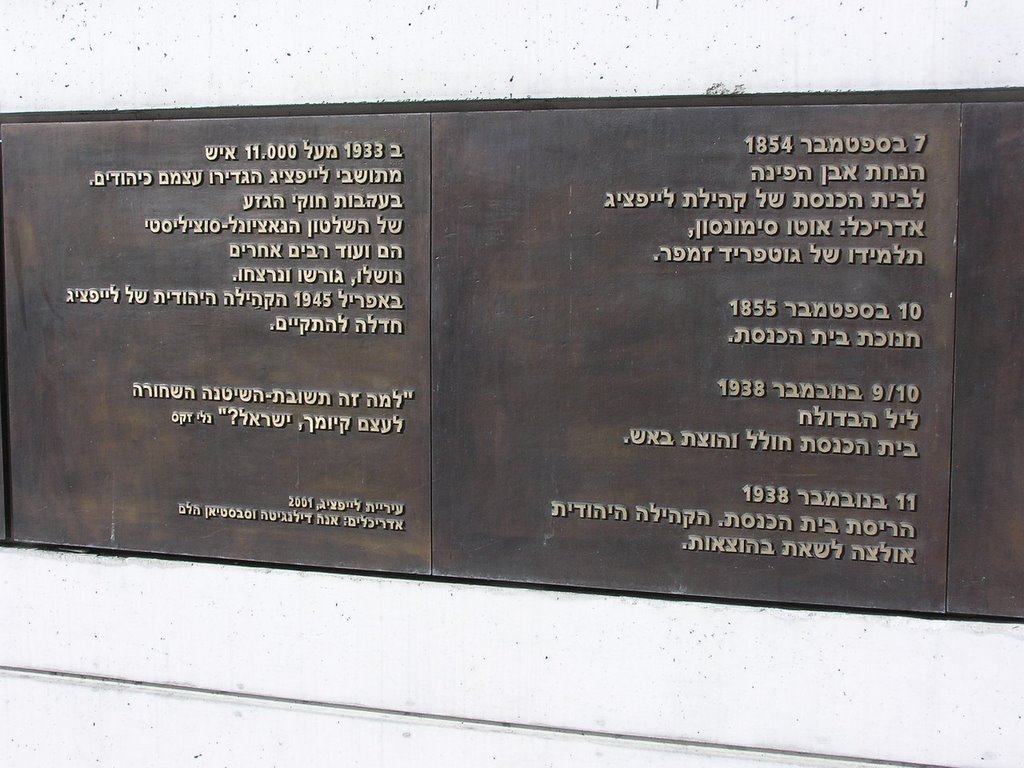
But the memory I will carry with me from Leipzig is from none of the above. In the middle of an innocuous square, not far from St. Thomas church, stand a few dozen wooden chairs. They mark the site of the former synagogue of the Jewish community of Leipzig, destroyed in the events following Kristallnacht in November 1938. More powerful than any monument, these simple chairs serve as a reminder of a community of 11,000 Jews that is no more.

Wednesday, February 15, 2006

The Joys of Israeli Bureaucracy

For a while now I've been meaning to write about the infernal bureaucratic road one has to follow when building a new house in Israel. But every time I started writing I found myself wondering where to begin, how to convey the horror of it all in one post - thoughts which quickly led to despair and abandonment of the effort. The labyrinthian nature of this kafkaesque experience requires writing skill that are beyond my capabilities.

So instead of a comprehensive post I will tell of one small incident.

Our house is a semi-detached one, built behind a 5-storey building. The entrance to our house (and the other three adjacent to ours) is from the parking lot of the building, so one has to walk through the car entrance to the rear of the building before reaching the house. To the left of our house (and the building) is a public path that is about a metre below the level of the parking lot. Today, there is a fence between the parking lot and this public path.

A while ago, the four families living in the houses requested the local authorities to open a small opening in the fence and build a few stairs leading down to the public path. This way, people could enter our houses by walking down the public path and up the stairs, instead of walking all the way around the building and through the car entrance. Not to mention the safety issues of walking through the same road as the cars. Our request was backed with photographs and a draft engineering plan. After a short meeting at the city hall, the appropriate bureaucrat approved the concept "in principle" and everyone was happy.

A couple of months ago we received a letter saying that upon re-consideration the request was denied. No explanations given. We wrote a letter back requesting another meeting to understand this reversal of decision. After a few weeks of silence, and several phone calls, another bureaucrat agreed to see us. In the meeting, she produced a letter (supposedly sent to us but which we never received) saying that the decision was reversed because after a "visit by professionals" to the area they realized the height difference between the public path and the parking lot is "more than 2.5 metres" and thus requires a "significant" flight of stairs, which is unacceptable.

Sounds fair enough, right? After all, why construce a massive of more than 10 stairs on a public path just to satisfy four families? Well, not so easy. This morning I took a measuring tape and checked the height difference. Turns out it is less than a metre... All it takes is 3-4 stairs.

So what are the possibilities? Perhaps nobody ever came on-site and the city hall just thought they could brush us off with a letter? Or perhaps the measuring tape of the "professionals" they sent was a biblical one and they measured amot instead of metres? Or perhaps this is just standard procedure and we need to go through the "proper" number of meetings, phone calls, letters and voice-raising scenarios before getting to a positive resolution of the matter.

And this is just a drop in the ocean. Oh, if I were to start writing about the other hundreds (yes, hundreds) of problems one has to solve in order to find peace and tranquility under a new roof. A heartfelt recommendation to anyone considering building a new house in Israel: DON'T. Buy an existing one instead and spend your time and energy in renovating it.

Monday, February 06, 2006

Sennacherib at the British Museum

I had a free half-day in London yesterday and decided to pay the British Museum a rather overdue visit (I think it's been 10 years since the last time). Not having too much time, I headed straight for the Ancient Far East rooms, which I remembered as being pretty impressive from my last visit.

As it turned out, I spent most of my time in and around the "Lachish" and the "Nineveh Palace" rooms, displaying items excavated in and around modern-day Iraq from the Sennacherib period. Sennacherib, king of Assyria in the 8th century BCE, is mentioned in the Bible and in the Talmud as the evil king from the North that descended upon Judah to try and quench the rebellion of the Jews in the times of king Hezekiah (helped by the Egyptians). He succeeded in conquering the city of Lachish, south-west of Jerusalem, but despite a long siege could not take Jerusalem and returned to his city of Nineveh. The Bible attributes this failure to a divine intervention: the angel of God descended upon Sennachrib's camp and killed 185,000 men (Melachim Bet). The Assyrian chronicles, on display at the British Museum, obviously tell a different story: Hezekiah was forced to surrender and to pay large sums of money to Sennacherib, and this is why the Assyrian king retreated back to his kingdom and spared the city.

Most of the reliefs in the Niniveh Palace room are partial, but the battle scenes they depict are still grandiose. Even more astounding are the reliefs in the Lachish room. One of the more interesting reliefs shows prisoners of war being brought before Sennacherib, who is sat on a throne and sentences some of them to death. Interestingly, the relief is almost intact and spans across an entire wall, but the king's face was deliberately defaced, probably after the end of his reign, when Nineveh fell in 612 BCE.

Now I need to visit the site at Nineveh, where apparently the Iraqi department of Antiquities did a fabulous job of preserving the excavated remains of Sennacherib's palace.

Tuesday, January 31, 2006

Sushi - The Guide

It's been a while since I posted... And I'm afraid this is not going to be a "proper" post.

Here's an amusing link I got from a friend: sushi. Enjoy.


Thursday, January 05, 2006

A Prayer for Sharon


On this day, my thoughts are with Ariel Sharon. I pray for a speedy and healthy recovery and hope for a miracle. Given the alternatives, Israel without his leadership is a thought almost too hard to bear.


Tuesday, December 20, 2005

Sayonara Japan, Shalom Israel

Last Friday we landed in Israel, back home after more than four years of living in Japan.

When I signed the contract to relocate to Tokyo, the expectation was that we would be in Japan for two, maybe three, years. At the time, despite me being familiar with Tokyo from several years of regular business trips there, living in the Land of the Rising Sun seemed like something we would never get really used to. We did not think it would become possible for us to call Japan "home". After all, it is so far away from Israel, geographically and culturally. How wrong we were.

Almost four and a half years have gone by and alarmingly fast. Not only did we get used to living in this foreign land, but we actually grew to love it. It is true that it would never be "home" in the deeper sense of the word - after all, a gaijin is a foreigner for life - but for us it did become a place we could call "home". A place we will terribly miss.

So it is with these mixed feelings that we start a new chapter in our lives, this time in our real "home".

Tuesday, November 29, 2005

Chayey Sarah - Overcoming Our Self-Interest

ויאמר אליו העבד: אולי לא תאבה האשה ללכת אחרי אל הארץ הזאת. ההשב אשיב את בנך אל הארץ הזאת אשר יצאת משם?

(בראשית כ"ד, ה')

Avraham's servant, Damasek Eliezer, is mostly described in rosy colours by our sages. They tell us that although he was Canaanite, his knowledge of the Torah was wide and deep. They tell us that he was not only a faithful servant that carried out his master's wishes, but he was also very smart and intelligent. The slight changes he makes in describing his duties to Rivka's parents and brother are brought as an example of his diplomatic (and selling) skills. So much so that the Midrash states: "the talk of servants is more beautiful than the Torah of the sons", alluding to the Torah's lengthy recounting of Eliezer's story.

It is therefore somewhat surprising to read, in the same Midrash, that Eliezer's intentions were not always entirely faithful to Avraham. In fact, he had a daughter and wished for her to be the chosen one for Yitzhak; he could not comprehend why Avraham would go to such lengths to find a wife for his beloved son when a most suitable woman was available right there in his household. The Midrash goes as far as to alter a word in the Torah to express the extent of Eliezer's wishes:

And the servant said to him: what if the woman will not be willing to follow me to this land? Should I bring your son back to the land you came from?

(Bereshit 24, 6)

"What if" in Hebrew reads "אולי", and the Midrash tells us to read this word as a similar sounding work: "הלוואי", meaning "hopefully", thus revealing Eliezer's true intentions. He was not asking a legitimate question about the possibility of the woman not wanting to follow him back to Canaan; he was expressing his innermost wishes that this would indeed happen, so that Avraham would have no choice but give Yitzhak to his daughter. The Midrash goes even further. When Eliezer recounts the story to Rivka's household, the word "what if" in Hebrew is written with the ommission of the letter Vav - "אלי" - implying that Eliezer was telling them that he wishes Rivka not to go back with him to Canaan.

Why does the Midrash go to such lengths to find wrongs in Eliezer's behaviour and to put blemish on his otherwise impeccable loyalty to Avraham?

The Midrash teaches us something here about human nature. Even sages, even the most holy of men, cannot escape the basic human trait of self-serving interest. No matter how much Eliezer was loyal to Avraham, deep inside him, perhaps even at a sub-conscious level, he had a different agenda. He wanted his own daughter to marry the son of his master. Nobody is exempt from the occasional slip, from the urge to overlook what's right and act out of pure self-interest.

And yet Eliezer accomplishes his task. He brings back Rivka to marry Yitzhak, thus giving up his hopes and those of his flesh and blood. Why? It is here that the Torah teaches us a great lesson. True: one cannot entirely escape one's yetzer ha'ra, one's evil inclination, and avoid harbouring secret desires. But we have a choice. We can choose between what is right and what is wrong. Either we let our yetzer ha'ra overcome us, or we do everything in our power to overcome it.

Eliezer proves he can overcome. He realises that deep inside he wishes his mission to fail, but does everything in his power to make it successful, because it is the right thing to do. He hurries to give Rivka the presents, even before she says yes; he refuses to eat at Betuel's house until he tell them his wishes; and the following morning he rejects the suggestion that Rivka stay home for another week or so before leaving and insists on leaving immediately. He makes sure he does not allow himself to make any mistakes by hurrying through his mission to assure it is ends successfully.

The idea for this week's Torah thought is from R. Ronen Neurwirth.

Thursday, November 10, 2005

Eat What You Like, Pay What You Wish

I spent the last few days in Singapore. I've been here once before and it was a pleasure being back. Despite the rather annoying weather - always hot, often raining - it is a very pleasant place.

Last night I asked the concierge whether he knew of any vegetarian Indian restaurants. He sent me to the Annalakshmi restaurant at the Excelsior hotel. Quite an experience. The setting and the food were pretty standard for Indian restaurants, but what was not standard was the price. Or rather, the lack thereof.

It turns out the restaurant is operated by a cultural organization called The Temple of Fine Arts, a volunteer-based group that teaches music and dance for free. To finance themselves, these people set up a chain of restaurants where food is offered for a price determined by the diners. You order from a priceless menu and when you're done, you pay what you feel is appropriate. Certainly a different kind of experience.

How much did we pay? Well, as money is not the point here, I won't tell.

Friday, October 28, 2005

Bereshit - A Constant Challenger

ויאמר ה' אל קין: למה חרה לך ולמה נפלו פניך? לוא אם תיטיב, שאת, ואם לא תיטיב, לפתח חטאת רבץ; ואליך תשוקתו ואתה תמשל בו.

(בראשית ד', ו'-ז')

With Bereshit we start the Torah from the beginning. This parasha has a lot of beginnings, the obvious one being the creation of the world. But this is also a first for many other things: the first sin, the first murder, the first excuse. In many ways Bereshit is the foundation for many of our traits as human beings. One of these is our propensity to sin.

The two sons of Adam make an offering to God. Abel brings the firstlings of his flock and Cain brings the fruit of the ground. After God rejects Cain's offering He tells him:

Why are you angry and why is your countenance fallen? If you improve yourself, shall it not be lifted up? And if you do not improve yourself, sin crouches at the doorstep, and its desire is towards you, but you may rule over it.

(Bereshit 4, 6-7)

So our yetzer ha'ra, our evil inclination, is always there, always lurking. It is at the doorstep, willing us to fulfill our desires and commit a sin. But it does not have full control over us, we may yet "rule over it" if we only so desire. There is an evil force blocking the doorway, but we may conquer it and get past it.

Here is a story that may help us understand the meaning of yetzer ha'ra and the significance of overcoming its desire. The head of a yeshiva noticed that one of the students missed classes on Sunday and Monday. This was a very good student who never missed class, so the rabbi approached him on Tuesday asking what happened. After some hesitation, the student replied that the rabbi would not understand. "Try me", said the rabbi. So the student explained that he went to watch the finals of an important soccer tournament and that, in fact, he would probably be away also tomorrow as it was the final day of the tournament.

The rabbi smiled and asked the student to explain more about this soccer game. "How does one win this game?", he enquired. The student explained that there are 11 players and the idea is to kick the ball into a large goal. The rabbi frowned and said: "So what's the problem? Kick the ball into the goal and come back to study!". The student laughed and explained that there is an opposing team of 11 players, and they have a goalkeeper that stops the ball from going into the goal. The rabbi asked: "Surely the other team does not sleep at the soccer grounds. So why don't you just slip out at night, put the ball into their goal, and declare victory the next morning?". The student, perplexed at this bizarre suggestion, answered: "But that wouldn't be a challenge. If there's no goalkeeper trying to stop you, then there's no point in winning!".

At this point the rabbi gave the student a large smile and said: "Listen to yourself. You're a good student and it's no big deal for you to come to yeshiva when there is nothing holding you back. But when the urge to skip class is there, when the yetzer ha'ra is the goalkeeper keeping you from entering the classroom, then it becomes a real challenge. This is when you score the real points in the game."

The Torah tells us not only about the nature of the yetzer ha'ra as an adversary, but also as a challenger. It challenges us to overcome our desire and to do the right thing. It is always crouching at the doorstep, ready to block us. Our job is to realize that we must overcome it at the point when the urge is the greatest. When it is difficult to do the right thing, it is up to us to make the effort to score the goal.

The idea for this week's Torah thought is from R. Mordechai Kamenetzky.

Monday, October 03, 2005

A Ray of Hope

Tonight it is Rosh HaShana and we enter a new year, 5766. Time for teshuva, time for collecting one's thoughts about the past and making new resolutions for the future.

Rosh HaShana is the day on which we make God king over the world. It is also Yom HaDin, the day of judgement, the day when all creation passes before God and is judged for the coming year. In ten days' time it will be Yom Kippur, the day of repentance and atonement, the day on which we confess our sins before God and ask for forgiveness.

One wonders about the order of things here. Surely the order needs to be reversed: we should first detail our sins and ask for forgiveness and only then be judged and accept God's rule as king. How dare we we come before God and make him our king while still not being purified from our sins?

The reason for this requires a look into the human psyche and may be illustrated using the following story. One important gentleman was a source of pride to his family and his community. He was intelligent and wealthy and dedicated his time and money to help others. But he had one fault: he was an alcoholic. Every now and then he would get completely drunk and bring disgrace upon himself and his family. To try and make him realise his bad ways, his sons took him for a ride in the street and showed him a homeless drunk who was sprawled on the sidewalk, knocked out from too much alcohol. They told their father: see, this is what you look like when you get drunk. The man looked at the drunk, got off the car, approached him and whispered a few words in his ear. The drunk looked up and answered. Upon returning to the car, the man's sons were curious about this exchange. Their father smiled and said: I asked him where he got the good stuff that made him this superbly drunk...

The morale from this story is the following. For us to be able to repent for our sins in a serious manner we need first to have a ray of light, a beacon of hope. One cannot fight against a bad reality without any hope, when still mired and lost in sin. If we are not shown an alternative of good, it is difficult for us to extricate ourselves from the bad. The man was not shown an alternative; he was shown only bad, therefore he was unable to pull himself up and improve.

In Rosh HaShana we are shown the alternative. God is made king and we see the light of his kingdom. After this uplifting experience, after we are shown the alternative of good, we are more prepared to come before Him and ask for forgiveness on Yom Kippur. God, in His infinite wisdom, understands that for us human beings to be able to help ourselves, we need to have some hope in order to be able to truly repent and mend our ways. This hope is given to us in the form of Rosh HaShana.

Shana Tova to all.