This Blog Has Moved


APRIL 2010: THIS BLOG HAS MOVED
GO TO THE NEW ADDRESS TO COMMENT. THANK YOU.

New Address:

http://nafkamina.wordpress.com

All posts are available in the new blog

Please do not post any comments here. Go to the new address to comment. Thank you.


Thursday, January 21, 2010

Israel and the Haiti Earthquake

Like most Israelis (OK, perhaps a little more than most) I am critical of Israel and I have a tendency to point out the bad things and ignore the good things. It’s mostly a criticism born out of love, just as a father is more upset with the wrongdoings of his own children than with those of other people’s.

So when Israel does something right, I am only to happy to point it out. Israel’s response to the disaster in Haiti has been fast, effective and disproportionate (in the positive sense of the word). Within 48 hours, two 747 aircraft with 220 military medical personnel and a fully operational field hospital were on their way to Haiti. The Israeli rescue delegation set up and started saving lives almost immediately. This CNN report is worth watching.

On a side note: Many countries sent aid to Haiti – some more, some less. I’m still waiting to hear about a Muslim country sending aid: food, clothes, supplies, medicines. Anything really. I know Abu Dhabi or Saudi Arabia are very poor countries compared with Israel, but surely they can pinch something together for Haiti. After all, isn’t Islam a charitable religion?

Monday, January 11, 2010

What the Dog Saw, by Malcolm Gladwell

Every time I visit the US, I pick up a copy of the New Yorker. I love reading the long, well thought out and superbly written, essays. “What the Dog Saw” is a collection of 19 essays written by Malcom Gladwell and published in the New Yorker over the past decade or so. The essays touch on various subjects but they all have that “Gladwell touch”: a seemingly mundane and boring topic is turned into a fascinating narrative with thoughtful insights.

What the Dog SawThe book is organised into three categories. In the first - “Minor Geniuses - Gladwell explores people who have made a significant impact in their field of expertise. I truly loved the first essay in the book, about Ron Popeil, who single-handedly invented the direct marketing of kitchen appliances, first by selling on street corners and later on late-night TV. The story is fascinating from both a business and a personal perspective. The third essay in the book is about an equally captivating character, Nassim Taleb, who devised an investment strategy based on the “inevitability of disaster”, that is betting that the most unlikely event (like 9/11) will happen. I found other essays in this category less captivating, such as the one about John Rock, the inventor of the birth control pill. I didn’t agree with the conclusions Gladwell drew from Rock’s decisions regarding the Catholic church’s approach to the pill.

Essays in the second category deals with “theories, predictions and diagnoses”. There is an essay about Enron and how how all the information was there for everyone to see. Another, related, story deals with a subject that was at one time close to my heart: the impossible job of military intelligence assessments. In these two stories Gladwell makes a brilliant distinction between puzzle and mystery. A puzzle is a problem which has a definitive answer and finding that answer depends on finding all the relevant pieces of information. A mystery, on the other hand, is a problem with no definitive answer, because it requires judgement and assessment and cannot be solved by gathering more information. Many of the intelligence assessments are mysteries and that is why intelligence organisations have failure built into their very nature.

The last category of essays is about “personality, character and intelligence”. Gladwell makes minced mint out of the “profile builders” of the FBI, those psycho-experts that can tell you who the criminal is (almost) by analysing the crimes he committed. In another essay he asks the question “are smart people overrated?”, and in a third he asks whether it is possible to hire people based on interviews. I found some of the essays in this category to be less engaging and less convincing, as they touched on topics that appeared in Gladwell’s previous book “Outliers”, which I didn’t like.

All in all, this is a delightful collection of long-winded essays but easy-to-read essays. Vintage Gladweel, vintage New Yorker.

PS – This was my first ever audiobook. I never thought I could concentrate on a book by listening to it, but I found out that while driving or jogging, listening to a book is a great way to pass the time. I’m now trying to listen to a novel and see if it works just as well.

Wednesday, January 06, 2010

State, Army and Religion

The past few weeks have seen the age-old discussion about the relationship between state and religion in Israel make the front pages again. The current debate was prompted by Defense Minister Barak’s decision to kick out the Har Beracha Yeshiva from the “Hesder”, literally “arrangement”, by which religious boys can do a shortened army service (about half, 1.5 years) and spend the rest of the time continuing their studies. This arrangement has been around for decades and the army tolerates it because most of the religious soldiers join elite combat units, meaning they will spend considerable time each year doing meaningful reserve duty.

Barak’s decision came after the head of the Har Beracha Yeshiva, R. Eliezer Melamed, vociferously backed a handful of Hesder soldiers that wrote banners proclaiming their right-wing political views, specifically that they would refuse to obey an order to evacuate Jewish settlements. He stated that the soldiers should follow the rabbis’ rulings and where there is a conflict with a military order, they should prefer the rabbi’s directive. Obviously, from the army’s point of view, this is an unacceptable stance. Both R. Melamed and Barak climbed very tall trees and it seems hard for them to find a ladder to climb down. The debate escalated after some of R. Melamed’s colleagues backed him, while other Hesder rabbis sought to calm things down.

The truth of the matter is that once this debate turns to the question of whose authority the religious soldiers should listen to above all else – the army’s or the rabbis’ – there is no way out. No religious person can accept a statement that there is a higher authority than God. And no army will accept a statement that a soldier can decide whether to carry out an order based on his religious belief. (I’m assuming, for the sake of the discussion only, that the rabbis’ right-wing stance faithfully represents God’s will; in my opinion, it doesn’t). So trying to bring the discussion to a head on this point is useless. It will cause more harm than good.

To me, what needs to be done is very clear: a separation of state and religion. Israel is a secular country that has an army to protect it. The army is an organization that has no religious significance, just as the government has no religious significance. A decision by the government to build settlements or to evacuate them is a legitimate democratic decision that has no religious bearing. Speaking of the State of Israel, its government or its army as having any kind of religious meaning is not only ridiculous from the secular state’s point of view. It is also ridiculous from the religion’s point of view! It belittles the Jewish religion and relegates it to a position of subservience to a civilian organization, instead of allowing it to be independent of any authority. Israel is not governed by the laws of the Torah and by associating themselves with it from a religious standpoint, the various religions institutions are, pardon the expression, prostituting themselves and the religion they purport to represent.

Compare it if you will to religion and science, or religion and academia in general. There are many religious scientists and professors in Israel. Some of them are prominent figures in their field of expertise. Some of them deal with issues that are clearly in contrast with their religious views, like the age of the universe, or contraception and abortion, or the study of the New Testament. Yet they continue their work and excel in their fields precisely because there is a clear separation between science and religion. They do not go and ask their rabbi whether to believe the universe is 4 billion years or a mere 6,000 years old. They do not ask for permission to read Luke or Matthew. They understand there are areas of life that Halacha does not cover.

In short, there are two, and only two, decisions a religious person can make regarding the secular State of Israel (and its army). He can either decide, like the extreme ultra-orthodox among us, that until a Jewish religious state, i.e. one that is governed by Halacha, can be established, one cannot recognise the State of Israel or benefit from it. Or he can decide that he has a religious duty (a kind of dina demalchuta) to be a fully loyal citizen of the secular State of Israel, just as he would be a fully loyal citizen of France or India if he were living there as a Jew. All other “in between” combinations are nothing but compromises that do more damage to the religion and to religious people.

Brave rabbis (sounds like an oxymoron in our day and age) should tell their students very clearly that the Jewish religion has nothing to do with a government decision to evacuate settlements. Just as religion has nothing to do with government decisions to provide healthcare or build roads or tax income. Only a clear separation between the domains can solve the non-existent dilemma these rabbis have plunged their students and followers into.

הכלב היהודי, אשר קרביץ

I picked this book up on a whim, during one of the end-of-year bookstore deals. For decades, Israel had only one major bookstore chain – Steimatzky – and all the rest were small mom & pop shops. Then, about a decade ago, Tsomet Sefarim grew as a competitor to Steimatzky and forced it to start reducing prices and offering special deals. Some pundits think the current situation, where the two chains compete fiercely against each other, although beneficial to customers, has hurt writers and devalued Jewish Dogbooks in general. People buy because it’s on sale, not because it’s a book they really want to read. I confess this is how I picked this book. It simply sat on the shelf where I could get 2 for 1, or perhaps was it 1 plus 2 or 2 plus 2. Who remembers? (Which reminds me of this – sorry, Hebrew only).

Yet sometimes a book you never heard about and you read just because you happen to have it, turns out to be a gem. This is the case with “The Jewish Dog”, by Asher Kravitz. Or perhaps I should call it “Der Yiddisher Hund”, which is the Yiddish subtitle of the book.

The Jewish dog is the life story of Koresh, a dog born in 1935 to a Jewish family in Germany. Koresh’s life parallels the horrors of the Holocaust in Europe – from the rise of Hitler and the deportation and extermination of the Jews – and ends with the hope of rebirth of the Jewish State in Israel (it dies in Israel in 1947, right after the UN decision to grant Jews a homeland). The dog, an intelligent, observing animal, goes through various phases and owners in life, and even gets different names. It is through its life experiences that it imparts the reader with insights and understandings about the world and human nature, with a cunning that would dwarf many humans I know.

It is not possible to write about the plot of this short book without ruining it for those who have not read it. In fact, the little blurb on the inside flap of the book has the word “spoiler” written on the top as a warning (even though it doesn’t reveal too much). So I will only point out that Kravitz’s style is simple yet thoughtful, peppered with verses from the Bible and with subtle hints about the “big picture”, which is not how one would normally see the world through a dog’s eyes. He manages to deal with the most horrific period in history – the Holocaust – in a manner that is light and occasionally even comic, yet it does not belittle the enormity of the period it describes. I highly recommend this book.

Monday, January 04, 2010

The Enemy Within

Israelis are used to fretting about the threats from without: Syria and Egypt in the past, Iran in the present, a possible Palestinian state in the future. But Israelis tend to suppress their fears from the real threat to the country’s existence, the threat from within: the so-called “Arab-Israelis”. (Arabs who were here when Israel achieved independence in 1948 and were granted Israeli citizenship). Mostly this burying-one’s-head-in-the-sand attitude comes from wishful thinking (“they prefer to live with us so they’ll behave”) or political correctness (“they are Israeli citizens, like you and me”).

Ignoring the problem will not make it go away. The allegiance of many Arab-Israelis to the State of Israel is an impossibility. Israel Jews cannot ask Israeli Arabs to declare full and unconditional loyalty, simply because such loyalty is not something they can give. Would you ask an American Jew to declare full and unconditional loyalty to the US if the US were an enemy of the Jewish State? Those politicians asking Arab-Israelis to declare unconditional allegiance do so because they want to promote their own agenda, possibly legitimising a future deportation or a “population swap” deal.

So what we are left with is an intractable problem: a huge minority (around one fifth) that cannot be integrated fully. So long as they are a minority, the problem is more or less manageable. But demographics being what they are, the problem will not go away; it will become only bigger. And Israel will find itself managing an apartheid regime to contain the problem, pretty much like it’s been doing with the Palestinians in the occupied territories for the past four decades.

A recent loud and clear reminder to this problem was the “interview” of MK Jamal Zahalka, an Arab member of parliament, to one of the TV shows earlier this week. Putting aside, with sadness, the lack of any vestige of civilised debate, the views expressed by Zahalka are such that will exasperate almost any Israeli Jew. Like calling the Defence Minister a murderer of children who then listens to classical music (the not-so-subtle reference to Nazi commanders of death camps is clear). Or labelling Ramat Aviv (a suburb of Tel Aviv) Sheikh Munis, the name of the Arab village that was there before 1948. Or asking Israelis to listen to what Haniyeh (head of Hamas in Gaza, an advocate of the destruction of Israel) has to say. Instead of helping Israeli Jews understand the plight of Palestinians in Gaza, these declarations achieve exactly the opposite: they raise an impenetrable barrier between Jews and Arabs and preclude any reasonable debate.

By the way, I’d love to see Zahalka express similar views against Arab political leaders on Arab television networks, or even on Palestinian television. Arab-Israelis take the freedom of speech granted to all Israeli citizens as granted (and so they should) but all too often they forget there are 21 Arab countries, and not one of them is a democracy.

I’m sure most Arab-Israelis are honest, hard-working citizens who care much about the same things I care about. But they are stuck impossibly between a rock and a hard place and a future of living peacefully together currently looks like an impossible dream.

Saturday, January 02, 2010

The Snow Cow, by Martin Kochanski

I am not a skier. Never have been. Most likely never will be. So when I started reading a book subtitled “Ghost Stories for Skiers”, I was afraid my non-existing knowledge of skiing would hamper my understanding or my reading pleasure. Fortunately, my fears turned out to be mostly baseless; or, at least, so I believe, as one cannot really know if one misses out on some subtleties due to one's ignorance, right?

Snow CowThis book contains thirteen (most probably an intentional number) short stories, all set in a skiing setting, usually in some upscale resort in Switzerland. The stories, as the name of the book suggests, all revolve around mysterious things happening to people who are in the ski resort – the holiday goers, the chalet owners, the local help, etc. Some of the protagonists are either dead of alive; others are plotting unspeakable crimes; others still are innocent bystanders who get drawn into a situation they cannot escape. The eponymous cow is the main character in the first story, as the drawing on the book cover suggests, this is not a mild-tempered, grass-chewing, cow.

The back cover of the book says that these are “stories to be shared in the firelight after a long day’s skiing”. Maybe this is part of some ski lore that I’m unaware of, but I found some of the stories disturbing enough even when read in the comfort of my bed. The thing about short stories, especially ones that deal with ghosts, is that you can read a couple just before falling asleep and the images from the story will most likely accompany you in your dreams. At least on one occasion, that was not a pleasant experience. So perhaps the firelight in the ski resort is indeed a better place for reading this book.

But it was not the stories which  enjoyed most about this book. Some were good, some were less good. What I enjoyed most was Kochanski’s habit of inserting a sentence, or a short paragraph, that didn’t really contribute much to the story line, but were wonderfully cynical or funny. Most of them made me do a double take, just to make sure I got the meaning correctly, and quite often they made me laugh. I may be wrong, but it seemed to me almost as if Kochanski were using the story only as an excuse to get a sentence he had been thinking about for a long time into the book. Here are a couple of examples (hopefully they’ll be appreciated even out of context):

Jägermeister is a worthy product of the land that gave us weltschmetz, schadenfreude, and angst. It tastes so vile that you have to down it in one. Like some Wagnerian magic weapon, it will heal any wounds except the ones it has caused itself… (from “The Long Man”, p. 59)

Now the man at the ski shop was from New Zealand, and when someone from Nizullund talks about sex, he calls it `six`. They guy in the shop didn’t talk about sex at all, but it being snowboards, he had to talk about decks rather a lot. (from “Downhill”, p. 86)

Kochanski is clearly a very erudite person. And his writing is mostly flowing and intelligent. I hope to see a novel from him in the future.

Friday, January 01, 2010

VaYechi – The Foreign Grandsons

ויברכם ביום ההוא לאמור: בך יברך ישראל לאמר, ישימך אלהים כאפרים וכמנשה. וישם את אפרים לפני מנשה.

(בראשית, מח, כ)

The blessing that Ya’akov gives his grandsons, Efraim and Menashe, on his deathbed, has become the traditional blessing of parents to their sons. On Friday evenings and on the eve of Yom Kippur, parents will put their hands on the heads of their children and bless them using the same words Ya’akov used:

And he blessed them that day, saying: 'By thee shall Israel bless, saying: God make thee as Ephraim and as Manasseh.' And he set Ephraim before Manasseh. (Bereshit, 48, 12).

But a closer look at the verses of this week’s parasha reveals a little drama before Ya’akov gives this blessing to his grandsons.

Yossef’s family grew up in Egypt. He married Asnat, the daughter of a local high priest, and his sons were born and raised in the royal court. Yossef names the eldest Menashe “for God has made me forget all my toil and all my father’s house” (41, 51). He names his second son Efraim “for God has made me fruitful in the land of my affliction” (41, 52). Thus Yossef, through the names of his sons, marks the break from his past and the connection with his new home, Egypt. The two sons grow up in the house of the high priest of Egypt, not in the house of their Jewish grandfather, Ya’akov.

Even when Ya’akov and his family move to Egypt and settle in Goshen, away from the centre of power and disconnected from Egyptian culture, Yossef and his family remain where they are. His sons continue to grow up in an Egyptian environment. In fact, when Yossef is called to his father’s deathbed, the Torah tells us “he took with him his two sons” (48, 1). One can imagine the trepidation with which Yossef enters his father’s house, fearing whether his father will accept his sons, who have grown up away from him in a completely foreign culture.

Ya’akov starts blessing his son Yossef by telling him how God appeared to him to promise him and his seed the Land of Israel. But then he takes a pause from blessing Yossef and says:

And now your two sons, who were born unto thee in the land of Egypt before I came unto thee into Egypt, are mine; Ephraim and Manasseh, even as Reuben and Simeon, shall be mine. (48, 5)

The two grandsons are accepted in full by their grandfather and are each given land in Israel, as if they were sons and not grandsons. Yossef thus receives a “double portion” in the Land of Israel. It seems as if Ya’akov accepts Efraim and Menashe fully. But here comes the surprising part. After Ya’akov finishes his blessing to Yossef, the Torah says: “Israel beheld Yossef’s sons and said: Who are these?”.

What is going on here? A minute ago, Ya’akov divided his estate in Israel further to include portions for Efraim and Menashe, and now he asks his son “Who are these?”. He sees these two young men, dressed in the royal Egyptian garb and looking totally foreign to him, and wonders who they are and how they grew up. Are they truly deserving of the land he just promised them in Israel? Shouldn’t he have checked who his grandsons are before imparting such generous gifts unto them?

To understand this seemingly out-of-place question, one needs to remember another place in Bereshit where the words “Who are these?” (מי אלה) is uttered. When Essav meets his brother Ya’akov after the long years of separation and sees his big family, he asks “Who are these?” (33, 5). Ya’akov replies to his brother: “The children whom God has graciously given your servant”.

Yossef’s reply to Ya’akov question is strikingly similar: “They are my sons, whom God has given me here”. This reply reminds Ya’akov of the words he himself uttered in response to Essav’s question, and this memory gives him the understanding that although his grandsons may look foreign, they are his seed and the gift of God. The sons of Ya’akov come in many different shapes and forms, but they are all descendents of the great patriarch, all sons of God, and are therefore worthy of a place in the family.

With this understanding, Ya’akov then proceeds to bless Efraim and Menashe with the blessing that has become the prototype for all future blessings of Jewish parents.

The idea for this week’s Parasha Thought is from R. Binyamin Lau.

Wednesday, December 30, 2009

American Optimism and Foreignness in Japan

The traditional year-end double issue of The Economist is always a source of immense reading pleasure. This year’s issue is no different. I’m still half-way through the issue, but a couple of items seem worth mentioning – one is about American optimism, the other about being a foreigner in Japan.

Lexington, the columnist for the United States section, reviews two books that “lament the American tendency towards mindless optimism”. One book is by Barbara Ehrenreich, who is angry about the overly positive attitude that permeates American society and encourages people to deny reality. People with cancer speaking about it as a “gift” that helped them find their purpose in life. Or people who believe that food won’t make you fat unless you think it will. The second book is by John Derbyshire, who quips that hardly anyone in Obama’s cabinet has ever created a dime of wealth, yet most Americans expects them to fix the economy. He has nothing but contempt for those who say that “given the opportunity, most people could do most anything”, pointing out that, mathematically, half of the people are below average.

What a refreshing breath of air! Finally someone who dares tear the cover off the nauseating “think positive” attitude that invades every corner of American culture, most recently epitomised by the mindboggling drivel in the best-selling, self-help book “The Secret”, by Rhonda Byrne.

Elsewhere, the topic of “being an outsider” is examined, and the different ways in which it has become both easier and more difficult to be a foreigner in another country are discussed. The following passage made me smile, bringing back pleasant memories:

The most generally satisfying experience of foreignness—complete bafflement, but with no sense of rejection—probably comes still from time spent in Japan. To the foreigner Japan appears as a Disneyland-like nation in which everyone has a well-defined role to play, including the foreigner, whose job it is to be foreign. Everything works to facilitate this role-playing, including a towering language barrier. The Japanese believe their language to be so difficult that it counts as something of an impertinence for a foreigner to speak it.

I’m sure my wife, who has mastered Japanese, will enjoy reading this last sentence. It is so true.

Sunday, December 06, 2009

It’s All in the Eyes

Molitan is a factory that produces sewing threads. It is located in the northern city of Nahariya, Israel, and employs about 80 people.

The employees have not received their salaries for two months now, and the main creditor bank refuses to loan the factory 1.5 million Shekels (about $400,000) to pay these salaries. Many of the employees are single mothers or above fifty, and if the factory closes down (which currently looks likely) they will have a very hard time finding a job. Unemployment in northern Israel is about 9%, compared with only 6% in the Tel Aviv area.

This really isn’t news. Stories like these are a dime a dozen in these harsh economic times. What prompted me to write about it was this picture, taken by Yaron Kaminsky and published in Haaretz. It’s all in the eyes: the fear, the helplessness, the desperation.

Molitan

Thursday, December 03, 2009

Crocodile Tears

A week ago the Israeli government buckled under US pressure and declared a 10-month freeze on construction in the West Bank, in the hope this will revive the Israeli-Palestinian peace process.

Almost nobody here believes that this “confidence building” step will amount to much, but the West Bank settlers have nevertheless come out in full force against the implementation of the government decision. Several of them clashed with police yesterday, and their leaders have announced they will continue to oppose the decision. I heard an interview on the radio yesterday with a woman settler that was almost in tears describing the effects of this ban and how her children have no school to go to because one cannot be constructed, or how newly-wed couples have nowhere to live.

I think that giving in to US pressure at this point was wrong, as there is clearly nobody on the other side with which serious peace discussions can take place. Currently, the Palestinians carry a heavier burden of proof than the Israelis about their intention to reach an agreement. I’m not surprised about the decision though; Netanyahu has proven, time and again, that he succumbs to pressure alarmingly quickly, with little or no thought about his “ideology” or the consequences.

But despite being against this decision, I admit to feeling some satisfaction watching the settlers squirm and cry foul. Their very presence is rooted in decades-long illegality. It was one of the factors that prevented the possibility of an agreement with the Palestinians when one was within reach. Worst of all, it is the single biggest threat to Israel’s long-term existence as Jewish country, by forcing a single state reality with an Arab majority. I am no fan of the Palestinians and the manner in which they are conducting their so-called “struggle for independence”, but I know Israel needs them to have their own state if it wants to survive. The settlements are a clear obstacle to this strategic goal.

As for the tears of the woman on the radio: they are nothing but crocodile tears. After 42 years of holding the vast majority of Israelis hostage to their delusional ideology, it is time for the settlers to face reality and come back home to Israel. Or, better yet, remain where they are and become citizens of a Jewish minority in the future Palestine.

Monday, November 30, 2009

The Holes in Switzerland

Yesterday, with almost 58% of the vote, 22 out of 24 cantons in Switzerland voted to ban the building of minarets in the country. The party that put the motion forward claimed minarets are a “sign of Islamisation”. The Swiss government was quick to reassure the 400,000 Swiss Muslims that this decision was not to be interpreted as a rejection of the Muslim community.

I guess most people would shrug at this piece of news and point to Switzerland’s world-famous “neutrality”. Switzerland has notoriously distanced itself from world political alliances, wars, international organisations, etc., maintaining a neutral stance towards issues that most other countries grapple with on a daily basis. So no wonder it would seem to some that keeping the “status quo” by not allowing the building of minarets would be in line with Switzerland’s policies. But nothing can be further from the truth.

As Assaf Sagiv eloquently explained in the last issue of Azure (Hebrew/English), Switzerland’s neutrality comes at a very high price, as it ignores “many of the basic values that any enlightened nation is duty-bound to uphold”. Here are some facts from this article:

  • Last April Switzerland hosted the UN Conference Against Racism, a.k.a Durban II, during which Iran’s president Mahmoud Ahmadinejad gave a typical Israel-bashing speech. Many European delegates walked out, but the Swiss didn’t.
  • A delegation from Hamas – considered by the European Union as a terrorist organisation - was warmly received in Switzerland a couple of months later, where the foreign minister labelled the organisation as a “major player” in the Middle East.
  • Last year, Hannibal Gaddafi, son of the Libyan dictator, and his wife were arrested in Geneva and later released in bail after beating their domestic staff. Libya withdrew $5 billion in protest from Swiss banks, hitting the Swiss where it hurts most and prompting the President to apologise publicly for the arrest.
  • During World War II, Europe’s most testing hour in history, when good fought against evil for the future of civilisation, Switzerland did business with the Nazis. Hundreds of millions of dollars in gold, most of it looted from Jewish victims of the Holocaust, were exchanged into hard currency by Swiss banks, oiling the German military machine.
  • Switzerland deported more than 30,000 Jewish refugees, most of whom were later murdered by the Nazis.
  • As every Israeli knows, Switzerland dragged its feet for decades, refusing to grant Holocaust survivors and their families the right to reclaim capital they deposited in Swiss banks before and during the war.

These and other examples might help shed some light on Switzerland’s supposed “neutrality” and how it is used by the Swiss to further their interests (mostly economic ones) while claiming innocence. “Live and let live” is not an option in world where civilisations clash and where a stand must be taken. It is despicable that the Swiss would defend a blatantly racist policy of banning the building of minarets. By passing this vote, the Swiss have not only shown they are not neutral; they have aligned themselves with the worst of nations. Imagine how the world would have reacted if Israel had a law banning the building of minarets.

Tuesday, November 17, 2009

Drive-Thru Extreme

Remember that opening scene from the 1980s movie “The Gods Must be Crazy”, where the narrator speaks of the differences between life in the West (specifically the US) and life in the Kalahari desert in Africa? To illustrate life in the US, a woman is shown getting into her car, backing off from her driveway into the street, driving a few yards down the road to drop an envelope into a postbox, only to drive the few yards back to her house.

I was reminded of this scene (and this hilarious movie) when I saw this picture of Americans in California getting vaccinated for the H1N1 virus. What’s next? Having your appendix removed without getting out of your car?

H1N1 Vaccine

Sunday, November 08, 2009

Fourteen Years

Last night I attended the annual memorial rally for Yitzhak Rabin, shot 14 years ago in the square that now bears his name in the heart of Tel Aviv.

I took my son with me, to show him the place his mother and I stood on that fateful night and sang along with Rabin at the end of the peace rally, moments before he was shot. I also showed him the place where we saw his car speeding away after the rally, not understanding until later why the driver was driving so fast. My son was not born yet at the time, but in a way he was also present; he was a fetus on November 4, 1995.

Rabin Rally 

I had mixed feelings about the rally last night. On one hand I was pleased to see the square was quite full and with people both old and young. On the other hand, I was saddened (but not surprised) to count only a handful of people wearing a kippah. Many kids from youth movements like HaNoar HaOved and HaTsofim, but none from Bene Akiva. This central memorial rally, and generally the memory of Rabin, have sadly long ceased to be unifying events. We have learnt nothing.

The speeches at the rally were predictable and mostly pathetic. The only decent speech was actually the one given by the only representative of the “right wing” camp, Education Minister Gideon Sa’ar, who did not speak in clichés. To listen to Barak and Livni repeat the mantras of “now is the time for peace” is, quite frankly, nauseating.

Thomas Friedman got it right this morning in this weekly column: "The Israeli-Palestinian peace process has become a bad play. It is obvious that all the parties are just acting out the same old scenes, with the same old tired clichés — and that no one believes any of it anymore." Friedman’s conclusion, alarming as its implications to the region may be, is sorrowfully the correct one: "Let’s just get out of the picture. Let all these leaders stand in front of their own people and tell them the truth: “My fellow citizens: Nothing is happening; nothing is going to happen. It’s just you and me and the problem we own.”"

Tuesday, November 03, 2009

Predictably Irrational, by Dan Ariely

In the past decade or so Behavioural Economics has become all the rage in both academic circles and among the general public. The financial crisis that started with the bursting of the sub-prime mortgage bubble in the US a couple of years ago has given behavioural economists a major boost.

The basic premise of behavioural economists is that humans are not necessarily rational when they make economic or financial decisions. One of the cornerstone assumptions of “traditional” economics is that we decide based on rational analysis of costs and benefits and seek to maximise our financial gains. It turns out this is not the case and many of our decisions are driven by “irrational” factors that defy the premises of traditional economics.

Professor Dan Ariely is another ex-Israeli scientist that has popularised Behavioral Economics with his book Predictably Irrational. Using relatively simple experiments he shows that many of our decisions are influenced by irrational factors, but more importantly, that this irrational behaviour is, in many cases, predictable. In other words, contrary to popular belief (at least in the last 300 or so years of the “scientific era”), humans are inherently irrational.

Here are a few examples:

  • People will feel better taking a medicine that costs 10 times as much as another, identical, medicine.
  • When faced with a free product, we will likely “buy” it even if they don’t need it.
  • Sexual arousal will lead people to change their behaviour and perform deeds they deem immoral.
  • We will think food or drink are better if they are presented in a more glamorous setting.

Ariely’s book is highly entertaining and provides some delightful nuggets of truth about ourselves. But I didn’t find many of his “discoveries” surprising. It is true that we like to see ourselves as rational machines, but most of our life experiences clearly demonstrate this is not the case. Blind belief in a purely rational brain is, well, irrational. The work of Nobel prize winner Daniel Kahenman (with his partner Amos Tversky), around how people decide between alternatives involving risk, has been known for many years. Ariely’s achievement is mainly in popularising the subject and presenting it in a way that most people can understand.

Sunday, October 18, 2009

Bangkok, Thailand

As strange as it may sound – being an Israeli who lived and travelled in Asia quite extensively – this was my first visit to Thailand. I have been through Bangkok airport several times, and I think I even stayed overnight at the airport hotel once, but I’ve never ventured into the city itself. Last week I attended a two-day conference in Bangkok and then decided to stay on for a couple of more days and see the city.

Compared with the average Israeli (that’s mode average, mind you) I’m more than twenty years late in visiting Thailand. For my “post army” trip, my (future) wife and I chose the civilised option; we toured Europe. In fact, until this very day we pretty much stay away from “third world” or generally unclean places when we go on holiday. In Asia it’s Tokyo and Singapore for us, not Mumbai or Bangkok. Anyway, given this background, I guess most of my observations here will be met with a duh! from the average Israeli reader, so be forewarned that this post might be somewhat boring to you Bangkok connoisseurs.

Encouraged by the fact it wasn’t raining much, despite a forecast of heavy thunderstorms, I spent most of the time just walking around, occasionally glancing at the map to make sure I knew more or less where I was. I wasn’t in the mood for the “obvious” tourist sites, such as the Grand Palace or the various temples (Wat). After all, how many golden Buddhas and elephants can a man take?

My first impression of the city was the contrast between old and modern, a contrast that has become very common in big Asian cities over the past couple of decades. Some of the buildings and shopping malls are top notch, surpassing many similar establishments in the West in style and luxury. But this is all mixed with old, decrepit buildings and poorly lit streets, some of which looked positively dodgy. As an example, here are pictures of my hotel and the view from my hotel window - note the squalid dwellings on the bottom of the second picture:

Westin Bangkok

Bangkok Skyline

And another view, this time from the SkyTrain, the elevated train that crosses the centre of the city. Slums in the foreground, high-rise apartments (advertising at $200K+ for a 2-bedroom) in the background:

Bangkok Slums

As a friend of mine told me at the conference, when he heard I was a newbie here: the first-time visitor to Bangkok walks around clutching on to his belongings and praying he won’t get stabbed by the barefooted Thais squatting on the sidewalks peddling their merchandise. However, after a couple of hours, the same visitor relaxes and becomes a happy, stress-free tourist, having been captivated by that ubiquitous defensive weapon of the Thais: the smile.

Because wherever you turn you see people smiling, especially if you happen to catch their eyes. And if you stop walking for a minute to consult your map, it is more than likely for one of them to approach you and offer help. One smiling Thai told me: “you are a visitor to my country, so you are my customer.”

It is true that some of these friendly people are touts looking to point you in the direction of a transport vehicle (more on that later) or a place of business offering services tailored for single men wandering around. But even they do it with a smile and back off almost immediately if you politely refuse their offer. At no point did I feel uncomfortable in any way.

But they don’t only smile. They also eat. Most sidewalks are packed with “makeshift-permanent” food stalls that are basically full-fledged family-run restaurants operating in the open air, most taking up no more that a couple of square metres of sidewalk space. The children wash the vegetables or cut the fish/meat, one of the the parents cooks and the other one serves customers. Pots and pans everywhere and customers sit on impossibly small chairs and tables to enjoy their meal. Quite fascinating really, considering that they are surrounded by exhaust fumes, a constant stream of pedestrians and a lot of street litter.

Street Food 1

Street Food 2

Bangkok Bananas

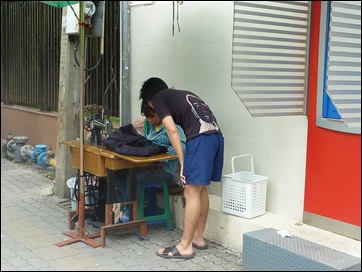
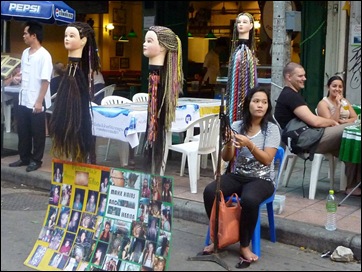
And it’s not only food you can get on the street. It’s a myriad of products and services that are on offer: clothes, handbags, jewellery, fake diplomas (Bachelor of Business from Bristol Univerisity, anyone?), seamstresses, cobblers and hair-braiders.

Bangkok Street Sellers

Bangkok Fake Diplomas

Bangkok Street Seamstress 

Bangkok Street Cobbler 

Bangkok Street Hair Braider 

After my first day I realised I had forgotten to pack my new camera’s battery charger. I was directed by the hotel staff to Pantip Plaza, where I was told there were “a few electronics stores”. What an understatement. This is a 6-7 storey building packed to the seams with stores selling every conceivable piece of software or hardware you can imagine. For those of you familiar with Akihabara district in Tokyo, imagine the entire district folded up into one building. I found a copy of the charger I needed in no time.

Pantip Plaza 1

Pantip Plaza 2

As for transportation. Getting around this busy city is not simple. All the stories about traffic in Bangkok are true. Most major thoroughfares are gridlocked at all hours of the day and night. On my way back to the airport we hit traffic at 5AM in the morning.

Bangkok Traffic

I mentioned the elevated train (SkyTrain), which is very convenient for avoiding traffic but unfortunately covers only a very small part of the city. Therefore, a plethora of transportation possibilities has evolved in Bangkok. Taxis are air-conditioned and cheap (meter starts at 35 Baht, about US$1), but not much use in heavy traffic.

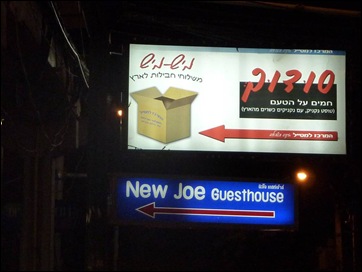
Tuk-Tuk taxis (so called because of the racket their engines make) are everywhere, and their drivers will offer every passing foreigner (farang) a sightseeing tour of Bangkok for “very cheap price”. The price is negotiated in advance. If you’re a lone male tourist, they will invariably also offer to take you to a “good massage”. In fact, the “massage” industry is so prevalent in this city that even an innocent-looking ad for a clinic makes one wonder about hidden meanings:

Bangkok Ad

Here is one of my Tuk-Tuk drivers, the one who took me to Chinatown. Apparently, he moonlights in this job when he’s not assaulting aircraft hijacked by terrorists with his fellow SWAT team members:
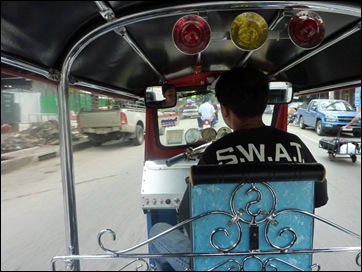
Tuk Tuk Driver 1

Tuk Tuk Driver 2

Although Tuk-Tuks are smaller in size than taxis and therefore more manoeuverable in traffic, they still need to be on the road. That’s just not good enough. So an even more flexible vehicle is on offer on every street corner: the moped or small motorcycle. If you don’t mind hanging on for your life while the driver negotiates his way through cars and pedestrians alike, this is the fastest way to get around.

By the way, what will a Tuk-Tuk driver do when he’s hungry? Simple. He’ll park his vehicle near a gutter, take out his fishing pole and patiently wait for fish – from the gutter! – to take the bait. You don’t believe me? Take a look:

Bangkok Gutter Fishing 1

Bangkok Gutter Fishing 2 

When I asked him what he was doing, he smiled (obviously) and proudly held up a small plastic bag with some foul-looking fish inside. I skipped lunch that day.

After the hearty meal, the driver will take a rest. This is Thailand, after all:

Bangkok Rest

As for the Israeli angle. Israelis have become a prevalent feature in this city. An old joke tells about the airport taxi driver that, upon learning that his passenger is from Israel, asks how many Israelis there are. The passenger replies: about 6 million, to which the taxi driver says: no, I meant not in Thailand only, but in total.

As I mentioned in the opening, many young Israelis backpack in Thailand (and in neighbouring countries) after their military service. Hebrew can be heard everywhere on the “backpacker road” in Bangkok – Kao San Road – and the signs tell it all:

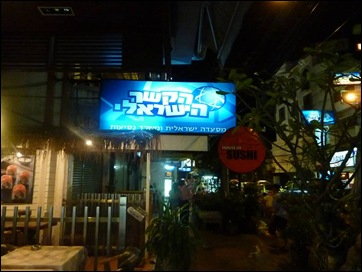
Israeli Bangkok 1

Israeli Bangkok 2

Israeli Bangkok 3

Israeli Bangkok 4    

On my last night in Bangkok I went for a stroll through the Suan Lum night market near Lumpini Park. I expected a noisy and pushy market, but was pleasantly surprised to find a clean and orderly maze of stalls, and also relatively peaceful and quiet. I just wished that by then I hadn’t lost patience for the haggling over useless junk. The vendor basically names a price and if you hesitate for even one millisecond, he/she will say: “But you can bargain! How much you give me?” I saw this family from Australia that was really going at it; the children were total experts and even the vendor looked harassed.

Bangkok Night Market 1

Bangkok Night Market 2

In summary, Bangkok is a very special city, well worth visiting even tough it isn’t exactly my cup of tea. After a few days I felt drained though. The pace of the city, the noise, the traffic, the pollution, the dirt, the haggling – it all started getting a little too much, and I was looking forward to leaving for Tokyo.

As I am writing this post from Tokyo, and I am thankful for the cleanliness and order around me, which I can now appreciate even more than usual. Shame about the prices though!

Tuesday, September 29, 2009

Course Correcting

In one of the episodes of Lost, Desmond explains to Charlie (in his charming Scottish accent) how he is able to view the future and therefore save lives. However, he cannot continue doing so for ever, because “the universe has a way of course-correcting”.

I thought of this quote yesterday, when I checked the news after the fast ended and saw this. Good riddance, and not a moment too soon.

Sometimes – alas, not too often – the universe indeed corrects its course.

Friday, September 25, 2009

Bibi and the Peter Principle

The remarkable speech given by Binyamin (Bibi) Netanyahu, Israel’s Prime Minister, at the UN General Assembly yesterday (dubbed by some pundits as Churchillian), was a painful reminder of the accuracy of the Peter Principle.

If only he could have remained Israel’s Ambassador to the UN (a post he held in the mid 1980s) instead of becoming Prime Minister.

Tuesday, September 15, 2009

Assaf Ramon z”l

I wanted to write yesterday about my feelings with regards to “Israel’s mourning” of Assaf Ramon, but thought it would be polite to wait until after the shiv’ah.

I guess in our day and age, waiting out of politeness is no longer an option. Both Benny Tsiper from Haaretz and Enav Shiff from Walla! wrote today (sorry, Hebrew only) pretty much what I had wanted to write.

Sunday, September 13, 2009

Israeli Society in 2030

Last Friday evening, over a long dinner at the Chabad House in Tokyo (not that shabbat dinners there are ever short), I had a chat with two friends who are local but are also ex- (and future?) Israelis. The conversation, as is the case whenever two or more Israelis sit down together, quickly turned into solving Israel’s problems. After we solved the Iranian issue and the Obama-settlement issue, we turned to the face of Israeli society in the future.

I brought up the issue by stating the fact that in a couple of decades (assuming Israel is still around), the majority of 20-year-old Israelis will be either Arab or Ultra-Orthodox.

Here are the numbers for Jewish pupils in primary schools (from Statistical Abstract of Israel, rounded):

Year State Non-Religious State Religious Ultra Orthodox
1980 74% 20% 6%
1990 71% 21% 8%
2000 60% 19% 20%
2008 54% 19% 27%

In other words, more than a quarter of all primary school Jewish pupils are in the Ultra-Orthodox education system, compared with only 6% thirty years ago. The number for Grade 1 pupils is obviously higher: about a third of the pupils entering the school system this year were Ultra-Orthodox. (For those not familiar with the Israeli system, these schools are recognised and funded by the State, but they set their own curriculum, which in the vast majority of cases – especially for boys – does not include any secular studies and does not culminate in any official diploma). Incidentally, the decline in State Religious schools attendance is also interesting (and something I have strong opinions about), but I won’t go there right now.

Regarding the Arab sector, the percentage of primary school pupils for 2008, from the total, was approximately 27%. In nominal terms, there were about 235,000 Arab primary school pupils in 2008, compared to about 160,000 Ultra-Orthodox pupils.

The trend is clear. Barring some unforeseen demographic event, similar in size to the immigration wave from the ex-Soviet Union in the early 1990s, the face of Israeli society will change dramatically in a couple of decades. Most people finishing school will – under present conditions – not be doing military service. More significantly, a large proportion of these graduates (most of the Ultra-Orthodox ones for certain) will not be joining the work force. Countries like Japan are facing a work force crisis due to the low birth rate; Israel has a high birth rate, but in the “wrong” sectors of society.

In my opinion, this is by far the single biggest challenge facing Israel’s future. This will no longer be the Israel we know, governed by a secular elite with (more or less) Western values and standards. Certain aspects of life in Israel will change dramatically, with consequences that cannot be predicted with any reliable degree of accuracy.

Unfortunately, we were not able to solve this particular issue around the shabbat table in Tokyo. Perhaps the hour was too late.

Sunday, September 06, 2009

Ireland

A couple of weeks ago, we spent a few days in Ireland. The pretext for this trip was a friend’s wedding in London, so looking at the map Ireland looked like a good choice to spend a few days touring before the wedding, as we’ve never been but heard many good things.

We landed in Dublin around noon on Sunday and took a car. Things started off well when Hertz offered me a relatively small car compared to what I had booked, and ended up giving me an upgrade to a BMW Series 5. Unfortunately, my wife didn’t understand what all the fuss was about (to quote: “a car is a car”) so I had nobody to share the excitement with.

 P8240106

We got on the M4 and drove westwards. As we needed to get to the Galway area for the night, we didn’t stop much on the way. We did make a small detour though, to see Clonmacnoise, an ancient monastic settlement situated pretty much in the heart of the island. It was founded about 1,500 years ago and became a major Christian site until the English destroyed it in the 16th century.

P8230011 P8230010

Our stop for the first two nights was the Oranhill Lodge B&B in Oranmore village, just south of Galway. (I link to their website because it’s a beautiful place run by a lovely and welcoming couple – Ann and Michael – so if you’re ever around the area I highly recommend it). We settled in for the night after a short visit to Galway city; it was too cold and too late to walk around much.

On Monday we decided to visit Connemara. We basically drove in a circular route from Galway all the way to Clifden, a lovely town overlooking the Atlantic ocean, and back. The Connemara region is mostly uninhabited (unless you count sheep and cows) and offers stunning views of open and very green landscape (my daughter kept remarking how everything in Ireland was so green). The area is knows for its bogs, which make the roads very bumpy. The Connemara sheep are of a peculiar kind, with black legs and heads.

P8240050

P8240051

We stopped to have a look at Kylemore Abbey, the oldest Benedictine Abbey in Ireland, which is today a girls boarding school (apparently the school is about to close down).

P8240071

[Side note: I left for Ireland without a book to read (the horror!), so I decided to sample an Irish author. A short search led me to believe that Roddy Doyle would do. I looked for Paddy Clarke Ha Ha Ha in a couple of bookstores but couldn’t find it. In Clifden, the bookstore owner recommended The Snapper, so I bought it. She said it was hilarious; I can’t say it was, although it wasn’t a bad companion for the holiday.]

After a good night’s sleep, we set off on Tuesday to drive southwards to Cork. We made several stops along the way:

- Dunguaire Castle in Kinvara, dated to the 16th century and, in my opinion, the most beautiful castle we saw in Ireland.

P8250007

- Poulnabrone Dolmen, an ancient tomb in the Burren region dating back to the Neolithic period. Fortunately for us, we were the only people there so we could wander around the site uninterrupted.

P8250017

- Cliffs of Moher, undoubtedly the foremost tourist attraction in Ireland. Can’t say I was overly impressed, but I guess that’s what you get when a site is oversold and overhyped…OK, they are pretty impressive.

P8250024P8250040

- We bypassed Limerick and stopped at Adare village for a quick lunch. It’s a charming little village with a tranquil public park in its centre.


P8250069

- Our last stop for the day was Killarney, a beautiful town in County Kerry. We had time to walk around the town centre, visit the cathedral and take a short walk through Killarny National Park. This is definitely an area of Ireland worth spending more time visiting.

P8250082

P8250085

We arrived late in Cork where we had dinner in a fancy vegetarian restaurant (the kids demanded pasta; none of those fancy tofu dishes for them), and went straight to bed.

After a big breakfast on Wednesday morning (the B&B we stayed at is famous for its breakfast; you can order pretty much anything you like from the kitchen and they’ll make it for you), we left Cork on the way back to Dublin.

Because we wanted to have at least a day and a half in the capital, we took the N8 and drove pretty much without stops. The only significant stop we made was at Blarney Castle, where we arrived early to avoid the crowds and get a chance to kiss the Blarney stone (only I did; the rest of the family refused to be lowered down).

P8260112

P8260119

After checking in at the hotel in Dublin and returning the car (with a sigh), we headed for the first place any sane person would make sure he visits first in Dublin, just in case the world comes to a sudden end before the end of the visit: The Guinness Storehouse! Home of the famous dry stout beer (the “coal beer” as my wife likes to call it). I don’t drink much beer, but when I do, I prefer Guinness; a friend once asked me why I like to “chew my beer”... Anyway, Guinness Storehouse is apparently the most visited site in Dublin where the visitors self-guide themselves through the seven floors of the building. The visit culminates in a “free” pint at the Gravity Bar on the top floor.

P8260037

P8260036

We then strolled through the center of Dublin, through the medieval quarter and Grafton Street, then back to the hotel.

On Thursday we continued to explore Dublin on foot. We crossed the Liffey to the north side of the river, walking along the quay and up O’Connell Street to see the Old Post Office building and the Spire of Dublin.

P8270025

P8270024

We then crossed back to see the Temple Bar area, the City Hall, Dublin Castle and the impressive Chester Beatty Library. We had lunch neat St. Stephen’s Green and then walked through the government buildings area. We concluded our Dublin visit with a stroll through Trinity College and a visit to the Long Room Library. Now, this is what I call a university campus…

P8270107 

Ireland deserves more than a few days’ visit. I hope to be back there soon. The Irish all seemed very friendly and, surprisingly, I could understand what they were saying (mostly). Perhaps they had mercy on the bumbling tourist and toned down their accent, who knows?

A word about the weather. The joke is that if you don’t like the weather in Ireland, wait five minutes and it’ll change. This is very much true, but nevertheless, these Irish have a very funny notion of what summer should feel like. We saw this funny t-shirt at the airport on the way out: it had four sheep (spring, summer, autumn, winter) all holding umbrellas in the rain, with the only difference being the summer sheep had sunglasses and the winter one had earmuffs.