Why go through the effort of reading the verbose "Men are from Mars, Women are from Venus" to understand the differences between men and women, when you can get to the bottom of things by watching two and half minutes on Saudi TV ?
Friday, June 23, 2006
Tuesday, June 20, 2006
Flag-Gate
Never mind the daily rocket attacks on Sderot. Never mind the quasi-civil war raging in the Gaza strip. Never mind the thousands of Palestinians on the brink of starvation as a result of their intransigent government's policies. Foremost on the daily agenda of the media in most of the Arab-Muslim world is none of the above. It is John Painstil, the Ghanian soccer player that dared wave the Israeli flag after his team scored against the Czech Republic. Painstil plays for a soccer team in Tel Aviv and said he did it to please his friends and fans back in Israel. Israelis (and Jews worldwide) reacted to the admittedly exaggerated reaction in the Arab world with nothing but contempt and disdain. I'm wondering how these "shocked" observers would have reacted had Painstil waved a Palestinian flag instead of an Israeli one. I have a different take on this "flag-gate" episode. Call me cynical, but perhaps this whole gesture was nothing but a shameless self-promoting marketing tactic, designed to boost Painstil's standing in the eyes of his Israeli employer? You see, the flag Painstil waved is one of millions issued on occasion of Israel's independence day last month by Israel's leading bank, the HaPoalim bank. The team Painstill plays for is HaPoel Tel Aviv. Need I elaborate further on this "apparent" coincidence? I dare not.
The uproar was such that Painstil later apologized for his misdeed. The spokesperson for the Ghana team said the gesture was "based on sheer naivety" and added that Painstil is being offered special therapy to ensure he "overcame his current state of mind"...


Sunday, June 18, 2006
Shelach - The Will of God (cont.)
Last year, I posted this thought for parashat Shelach. That post generated a small debate with Jameel today - see the comment section there.
More interestingly, this shabbat I read a commentary by rabbi Avigdor Neventzal ("rabbi of the old city of Jerusalem") for Shelach that was surprisingly similar to the one I heard a couple of years ago from rabbi Amnon Bazak. Surprisingly, because rabbi Neventzal is known for his hard-line right-wing approach, and yet does not hesitate to pose questions regarding the interpretation of "the will of God" in the story of the meragelim and the applicability to today's political debate.
(This would be a good place to recommend rabbi Neventzal's "talks" on the weekly parasha, published in a five-book set.)
Voodoo Judaism
Those who know me, know how much disdain I have for "voodoo Judaism", regrettably so rampant in Israel today: incessant dippings in the mikveh, frequent trips to graves, red strings tied around the wrist, "holy" water, amulets to ward off the evil eye, chairs to "cure" barren women, kabbalah seminars, and so on and so forth.
My sister forwarded me an email today linking to this PowerPoint presentation. As it is in Hebrew, I will summarise it here.
In August 2001, a suicide bomber blew himself up in a fast food restaurant in central Jerusalem, killing 15 and wounding more than 150. Shortly thereafter, followers of the Breslov Hasidic movment printed a miraculous story in the Tikkun HaClali - a booklet containing some psalms and prayers which, if recited daily, they believe will cleanse them of their sins (specifically the sin of masturbation).
The story in the booklet goes like this: minutes before the bombing, the cashier at the restaurant told everyone that the resturant is full and a few customers decided to leave. Among them was this American woman. After the bombing, the woman sought out the cashier and found her in a hospital. Grateful for being saved, she left the girl her phone number in New York telling her to call her if in need. Some time later the cashier called and they agreed to meet in NYC. On the day, the woman left her office at the Twin Towers to go meet the visitor from Israel. You guessed right, the date was September 11, 2001 and thus the American woman was saved once again from certain death by the cashier.
And it just so happens that the cashier had a copy of the Tikkun HaClali next to her when working at the restaurant. Not only did the booklet save her life; it managed to save the American woman's life, twice. Sounds amazing, right? Surely enough to make anyone religious on the spot, joining the dancing Breslov nutcases in busy street intersections, no? Well, not so fast.
The family of the cashier heard about this "miraculous story" and could not believe their ears. Because, you see, the cashier, 19-year-old Tehilah Maoz, died in the bombing. She is buried in Jerusalem. The story was made up in order to shamelessly promote the voodoo booklet by a bunch of so-called believers. Rabbi Nachman must be turning in his grave knowing his name is used by such lowlifes.
This is just one small story and were it representative of the pervasiveness of this "voodoo Judaism" it would not be so interesting. Sadly, rather than dealing with the demanding task of keeping mitzvot, many prefer to wallow in the imaginary comfort of magical instant gratification. Avodah zarah was and remains an easy way out for errant souls.
Wednesday, June 14, 2006
Punctual Delays
As I write these words (which I will post later, as I am not connected right now), I'm sitting on an ICE train from Koeln to Hannover. But the train is not moving; we've been stuck at Hamm station for the past 15 minutes and the forecast right now is that we won't be departing for
another 15.
And this is by all means not a first for me. In the past few months I have witnessed train delays in Germany at least half a dozen times. A couple of them were delays of more than 30 minutes and on one occasion almost 1.5 hours! In my four and a half years in Japan I recall only one delay and that one was for only a few minutes. And I travelled by train almost every day in Japan...
True, the Japanese might at times take their punctuality to extremes, but they've left the "punctual" Germans eons behind. I pity those football fans who paid hundreds of Euros for their ticket and will be late to the game because of Deutsche Bahn.
[Update: the delay turned out to be 1 hour...]
Sunday, June 11, 2006
Double Standards
One of the more irritating traits of "leftists" in Israel (and perhaps everywhere) is their inability to admit to their double standards.
After Rabin's assassination in 1995, they cried foul about the incitement that preceded the murder and produced, as they would have it, the appropriate "environment" for the murderer to act. Images of right-wing demonstrations with placards reading "Rabin is a traitor" and "Rabin is a murderer" were brought as examples of this incitement.
Yet yesterday, in a left-wing demonstration outside the Chief of Staff's home in Tel Aviv (which made headlines mostly due to the participation of the Prime Minister's daughter), the demonstrators called Dan Halutz a "murderer" and a "killer of children". This reminded me of the "mother of all demonstrations" - the 1982 Tel Aviv demonstration following the Sabra & Shatila massacre during the Lebanon war - where Ariel Sharon (later to become darling of the "leftists") was also labelled as a "murderer".
Now, how would your average "leftist" react when you dare mention that perhaps calling the Chief of Staff a "killer of children" might also qualify as incitement?
Rhetorical question. I guess incitement, like pornography, is a question of geography.
World's Funniest Joke
Officially, this is the world's funniest joke. You judge.
Two hunters are out in the woods in New Jersey when one of them collapses. He doesn't seem to be breathing and his eyes are glazed.
The other guy whips out his phone and calls the emergency services. He gasps 'My friend is dead! What can I do?' The operator says: 'Calm down, I can help. First, let's make sure he's dead.'
There is a silence, then a shot is heard. Back on the phone, the guy says 'OK, now what?'
Thursday, June 08, 2006
Sumo in Israel
This week, a Sumo stable from Japan - the Sadogatake Beya - is visiting Israel.
This is a rare happening, as Sumo wrestlers (rikishi) seldom leave Japan. They were hosted by the president and various other officials, "trained" children on Tel Aviv beach and visited a children's hospital (where I accidentally bumped into them yesterday morning on my way to work; fortunately, not literally bumped).
Last night they conducted a friendly tournament in Caesarea, at the ancient Roman open-air amphitheatre. I was pleasantly surprised, both by the almost-full attendance and by how well the whole thing was organized, complete with running commentary by Motti Dichne, who provided much useful information about the sport.
The "competition" was won by Koto-Oshu (a.k.a. Mahlyanov Kaloyan Stefanov), a Bulgarian who is currently no. 3 in Japan. His parents flew in from Bulgaria for the event. Increasingly, non-Japanese are excelling in Sumo; the current champion (yokozuna), Asa Sho Ryu, is from Mongolia.
I will not bore you with lengthy explanations about this exceptional sport (see link above for that); instead, here are some pictures from the event (click on pictures to enlarge):
Dohyou - the arena, made of clay and sand

Fat, but extremly flexible and agile

The Israeli "children Sumo club" take on Koto Oshu

Koto Oshu gets his hair done; each wrestler has a distinctive hairdo

A favourite gimmick in Sumo fights: giant holding baby

Tsuridashi - lifting opponent by mawashi (a.k.a "the diaper")

Koto Oshu and the cup
In short: At an amphitheatre in an ancient Roman city in the Jewish state of Israel, a bunch of Japanese wrestlers got their asses kicked by a Bulgarian.
Monday, June 05, 2006
A Bridge To Nowhere
It must be difficult to admit failure after 36 years of activity around a central idea. Yet this is exactly what Rabbi Dr. Danier Tropper did today in an interview published in Haaretz (Hebrew).
Tropper founded and managed Gesher ("bridge" in Hebrew), an organization that works to promote mutual understanding among Israelis of all backgrounds, specifically religious and secular, through joint seminars, movie productions, etc. It is funded partly by the government and partly by donations (mostly from the US).
Tropper resigned his post recently and these are his observations about the outcome of Gesher's efforts after more than three and a half decades of activity:
- Religious Zionism has marginalised itself to the point of irrelevance by concentrating its efforts around the issue of Greater Israel
- On the other hand, secular Israelis are nothing more than "Hebrew-speaking gentiles" (unsurprisingly this generated the most inflammatory comments from readers)
- What destroyed Judaism in Israel is the politisation of religion (yet he does not reach the obvious conclusion that separation of state and church is necessary)
These are not great insights to anyone who lives here, but hearing these things from someone who dedicated his life to trying to bridge the gaps in Israeli society and make Israel a better place, is both sad and disheartening.
Sunday, June 04, 2006
The Perfect Woman
Last Friday was the holiday of Shavu’ot (Pentacost) and, as is customary, one stays up all night to study Torah. At 3AM I heard an interesting talk from Rabbi Yuval Sherlo which I enjoyed very much. It was based on things said by Rabbi Yaakov Medan (co-head of Har Etzion yeshivah). I will try to reconstruct it from memory.
Every Friday evening, after returning from the synagogue and before dinner, the husband recites the concluding 22 verses of the book of Mishlei (Proverbs), known as Eshet Chayil. The translation of the Hebrew word chayil into English is not simple; some translate it as valour, others as accomplished or competent – hence “woman of valour” or “accomplished woman”.
From the context of the text, it is clear that the eshet chayil is an extremely resourceful woman: she provides for the home, she gets up before dawn, she feeds the poor, she makes and sells things and she is wise and kind. It is not suprising that the expression eshet chayil has become synonymous with a most fine woman, a woman to marry. This acrostic hymn is recited by the husband to symbolize his gratitude for having such a great wife. The Midrash attributes eshet chayil to Abraham, who composed it as a eulogy for his wife Sarah.
But turning back to the book of Mishlei, who is this woman of valour? Was there a historic figure that was the “original” eshet chayil?
Chapter 31 of Mishlei opens with “The words of king Lemuel, the burden with which his mother corrected him”, and continues with the mother’s king chastising her son for consorting with the wrong kind of women and for being drunk. She tells him not to forget his duty as king, which is to judge righteously and plead the cause of the poor and needy. And later in the chapter (verse 23) the husband of the eshet chayil is described as someone who is “known at the gates, where he sits among the elders”. As we know from the Bible, the Judges of Israel sat at the gates of the city, so as to be available to the public. In other words, the husband is none other than the king of Israel, who is by nature of his job also a judge.
[Some commentators went as far as to identify Lemuel as king Shlomo (Solomon), and the whole monologue by his mother taking place on the morning of the day of the consecration of the Temple. Shlomo is late in waking up after a night of excessive drinking and inappropriate consorting, no less...]
So, if the husband is Shlomo, who is the eshet chayil? Is Shlomo’s mother describing a real woman? It seems not. She scolds her son for his present wives and concubines and then launches into the long hymn of Eshet Chayil to describe the woman her son should have married. She gives him the “blueprint” for the woman he should be looking for, the woman of valour that will take care of the poor that he will judge, that will make sure the household is taken care of while he serves the people at the gates.
And now for the interesting part. If we search the Bible we find only one woman who is described in the words “eshet chayil”: Ruth, the Moabite widow who decided to become Jewish and follow her destitute mother-in-law to Israel. After her husband-to-be Boaz finds her sleeping at his feet in the field and hears her story, he cries out “for you are an eshet chayil!” (Ruth 3, 11). Ruth is the archetype of all women of valour; she symbolizes what every man, certainly a king, should aspire to find in the woman he marries. And it is on Shavu'ot that we read the story of Ruth.
Shlomo’s mother is not making up an imaginary woman. She reminds her son where he comes from, what his roots are. Remember, she tells him, "charm is deceptive and beauty is vain, but a woman who fears God shall be praised" (verse 30). She asks him to look to his great-great-grandmother, Ruth, in order to find the model for the woman he should marry – the eshet chayil.
-----------------------
Here is the hymn of Eshet Chayil (Mishlei 31, 10-31) in Hebrew transliteration and English:
Eshet chayil mi yimtza v'rachok mip'ninim michrah
An accomplished woman, who can find? Her value is far beyond pearls.
Batach bah lev ba'lah v'shalal lo yechsar
Her husband's heart relies on her and he shall lack no fortune.
G'malathu tov v'lo ra kol y'mei chayeiha
She does him good and not evil, all the days of her life.
Darshah tzemer ufishtim vata'as b'chefetz kapeiha
She seeks wool and flax, and works with her hands willingly.
Haitah ka'oniyot socher mimerchak tavi lachmah
She is like the merchant ships, she brings her bread from afar.
Vatakom b'od lailah vatiten teref l'vetah v'chok l'na'aroteiha
She arises while it is still night, and gives food to her household and a portion to her maidservants.
Zam'mah sadeh vatikachehu mip'ri chapeiha nat'ah karem
She plans for a field, and buys it. With the fruit of her hands she plants a vineyard.
Chagrah b'oz motneiha vat'ametz zro'oteiha
She girds her loins in strength, and makes her arms strong.
Ta'amah ki tov sachrah lo yichbeh balailah nerah
She knows that her merchandise is good. Her candle does not go out at night.
Yadeha shilchah bakishor v'chapeiha tamchu falech
She sets her hands to the distaff, and holds the spindle in her hands.
Kapah parsah le'ani v'yadeiha shil'chah la'evyon
She extends her hands to the poor, and reaches out her hand to the needy.
Lo tira l'vetah mishaleg ki chol betah lavush shanim
She fears not for her household because of snow, because her whole household is warmly dressed.
Marvadim astah lah shesh v'argaman l'vushah
She makes covers for herself, her clothing is fine linen and purple.
Noda bash'arim ba'lah b'shivto im ziknei aretz
Her husband is known at the gates, when he sits among the elders of the land.
Sadin astah vatimkor vachagor natnah lak'na'ani
She makes a cloak and sells it, and she delivers aprons to the merchant.
Oz v'hadar l'vushah vatischak l'yom acharon
Strength and honor are her clothing, she smiles at the future.
Piha patchah b'chochma v'torat chesed al l'shonah
She opens her mouth in wisdom, and the lesson of kindness is on her tongue.
Tzofi'ah halichot betah v'lechem atzlut lo tochel
She watches over the ways of her household, and does not eat the bread of idleness.
Kamu vaneha vay'ash'ruha ba'lah vay'hal'lah
Her children rise and praise her, her husband lauds her.
Rabot banot asu chayil v'at alit al kulanah
Many women have done worthily, but you surpass them all.
Sheker hachen v'hevel hayofi ishah yir'at Hashem hi tit'halal
Charm is deceptive and beauty is vain, but a woman who fears God shall be praised.
T'nu lah mip'ri yadeiha vihal'luha vash'arim ma'aseha
Give her of the fruit of her hands, and let her works praise her in the gates.
Saturday, June 03, 2006
"We Are Like Donkeys"
Those studying the Daf Yomi have this week come across (one version) of the story about Pinchas Ben Yair's donkey, a story brought by the Talmud to support the saying: "If the rishonim (the sages of early ages) were like men, then we are like donkeys". This saying is oft quoted to illustrate the concept of the "decline of the generations" (yeridat ha-dorot), the decline of Torah scholarship across generations.
First the story about the donkey, then some short thoughts about the notion of the "decline of the generations".
The Yerushalmi in Shekalim 13, tells us about the donkey of Pinchas Ben Yair, one of the early chassidim (not the chassidim of today, but a group of righteous people who were known for their good deeds and close relationship to God). This donkey was stolen and for three days, while in captivity, refused to eat anything. Not wanting a dead donkey on their hands, the thieves released it. The donkey found its way back and stood outside Pinchas Ben Yair's home, braying for attention. Hearing her (for the donkey was a "she", a jennet) Pinchas Ben Yair ordered for food to be brought, but when barley was put before the donkey, again it refused to eat. When told about this, Ben Yair inquired whether tithe was given from this barley, and the answer was positive. He then asked whether tithe was given from the demai (a more strict tithe, we won't go into the details) and the answer was that this was not necessary as the law does not require tithe from demai when the produce is used to feed animals. Pinchas Ben Yair smiled and said: "what can I do if my donkey is so righteous that it won't eat demai without tithing!". He tithed the barley and the donkey finally started eating.
The Talmud tells us the bottom line: yes, it is true we are "like donkeys", but we are not even at the level of Pinchas Ben Yair's donkey...
The notion of yeridat ha-dorot is perfectly understandable with regards to the level of scholarship of the average person in our generation. I am continuously in awe of Rashi, his breadth of knowledge and his capability to generate such a consistent commentary over thousands of Torah and Talmud pages. I am humbled every time I read the Rambam, who managed to codify the entire Jewish Law, write ground-breaking books about Jewish theology and at the same time work as full-time doctor. There is no question about the greatness of the rishonim.
But when applied to the area of halacha and Torah study, this notion is somewhat problematic. Must a modern-day scholar be forced to go against his reasoning simply because it contradicts an earlier, and conflicting, opinion? Surely the quest for halachic truth cannot be muted in mere subservience to past generations. So long as the proper guidelines of Torah study are kept, one must assume that there is for innovation and progress in the area of Torah scholarship.
In fact, the very rule set down by the Sanhedrin - that a court of law (bet din) greater in wisdom and number may reverse the ruling of a previous court of law - presupposes that a later generation's opinion may indeed be superior! The donkey may yet become man once again, so to speak. I fear that while the notion of "generational decline" is correct, it has been interpreted in ways that contributed to the stagnation of Jewish halacha in the last couple of centuries. Respect for previous generations and humbleness before their genius must not stifle the continuity of Jewish thought.
Thursday, May 25, 2006
Man in the Shadows, by Efraim Halevy
What should one expect when picking up a book with a subtitle that reads: "Inside the Middle East Crisis with a Man Who Led the Mossad"? Surely this is going to be a real-life rendering of a Tom Clancy novel, or at the very least, a John Le Carre one? Well, not exactly. Efraim Halevy, who was at the helm of Israel's notorious and legendary secret service organization for five years, is not your typical cloak-and-dagger type. Far from it. I happened to have met him personally on a couple of occasions many years ago, and if anything, he reminded me of Sir Humphrey in the TV show "Yes Minister": the quintessential British civil servant, with impeccable manners and the Queen's English.
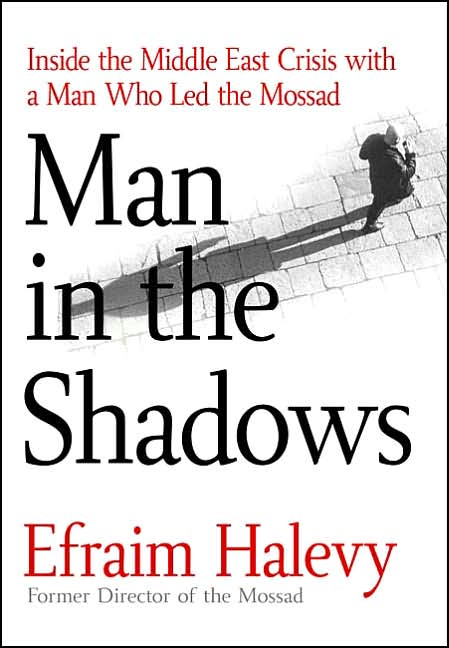 "Man in the Shadows" is more of a political memoir than an account of the Mossad's activities. Halevy played a dominant role as the secret envoy of several Israeli prime ministers (Shamir, Peres, Rabin, Netanyahu, Barak and Sharon) and as such was privy to many negotiations that shaped the region's politics in the 1990s. He writes of these experiences in a low-key and level-headed manner; rarely does he lapse into the emotional zone and when he does so it usually, and suprisingly, concerns Shimon Peres and/or the Israeli foreign services. Although not stated in so many words, it is clear that Halevy has little sympathy for Peres. He speaks fondly of other prime ministers he served under, but for Peres he has nothing but scorn and distrust. As for the foreign office diplomats, he makes them out to look like total amateurs.
A lot of attention is given to Jordan and to its late king, Hussein. This is understandable given Halevy's special relationship with the Hashemite kingdom and the late monarch. His involvement in bringing about the peace agreement between Jordan and Israel was substantial. His account of the Khaled Mashal incident - a botched attempt by the Mossad to kill a Hamas leader in Amman that brought about a serious crisis between the two countries - is probably the most fascinating chapter in the book. Halevy is well aware of this "Jordan bias" of his and admits to it; nevertheless, he remains of the opinion that Jordan plays a pivotal role in the Middle East, well and above what most observers will admit to.
Halevy also devotes many pages to how he views the intelligence community and its interaction with its political masters. I found these parts of the book to be more interesting than the historical accounts (especially as there are no new revelations anyway). Halevy laments the decline of the special standing of the intelligence community, especially in the US, in the aftermath of the 9/11 structural shake-ups. He believes that in the current war of the civilised world against global terrorism - a war he calls "World War 3" - the West cannot win if it does not accord its intelligence organs the proper standing and freedom of operation they deserve.
Monday, May 15, 2006
Sento - Washing Away
Reading the Daily Yomiuri over breakfast this morning (I am in Tokyo this week) I came across some distressing news: the number of sento in Tokyo has fallen below 1,000! The exact number as of today - everything is tracked and recorded in Japan - is 999.
Sento are public baths (literally: "penny baths", sen = penny; to = bath). Most people are familar with the Japanese onsen, the natural water hot springs so popular with tourists and locals. Sento are the ugly step-sisters of onsen. They are spread around the city and comprise of a small changing room with tiny lockers, a few shower stalls (the sitting type, of course) and the hot bath itself. All of the sento today are separated, unlike in the old days when everybody soaked together. They are not easy to spot as usually the entrance is very small with nothing but a small sign saying yu (hot water) over a blue-curtained noren.
Back in the times when most houses in Tokyo were not equipped with running hot water, sento was the way to keep clean. Even today, it is not uncommon in certain neighbourhoods to see people making their way to the sento at the end of the working day. However, with the more hectic life style of Tokyoites and the availability of higher-end spas and health centres, onsen are gradually washing away, yet another sign of the changing face of Japan.
Saturday, May 06, 2006
Four Billion Dollars
Many years ago - it was either in the application for an MBA or during the Foreign Office tests, I don't recall exactly - I was asked to write a short essay about the person I admired most. I chose Steph Wertheimer, the Israeli entrepreneur who set up his business empire, the Iscar group, in northern Israel. Wertheimer was a Member of the Knesset for four years, built the industrial park in Tefen and the neighbouring community of Kefar Veradim. In 1991 he received the highest award the State of Israel can bestow upon its citizens - The Israel Prize.
Warren Buffet, the legendary investor and "the world's second richest man", announced yesterday that his investment company will buy 80% of Iscar for 4 billion dollars. That's a valuation worth more than 4% of Israel's annual GDP, for a privately-owned company!
Beyond its economic value, this deal has tremendous implications regarding foreign investment in Israel. Kudos to the Wertheimer family; Israel needs more of these people.
Sunday, April 30, 2006
Maccabees - Then and Now
A few minutes ago Maccabi Tel Aviv lost to CSKA Moscow in the European basketball finals in Prague.
The original Maccabees were warriors from the house of Matityahu the Hasmonean, whose name derived from the Jewish word for "hammer" (makevet) and who rose up in revolt and fought an heroic war against Hellenism in the 2nd century B.C.E. Their victory is celebrated every year during the festival of Hannukah.
I admit that I too am occasionally interested in the modern-day "maccabeem". I watched the second half (I missed the first half due to the Daf Hayomi shi'ur) and I too cheered for Maccabi during certain moments in the game. But the passion just isn't there any more. Why? Consider the following picture, from today's game:

A Maccabi player against a CSKA player. Both 2nd rate players from the US, NBA dropouts or wannabees, mercenaries in the world of professional basketball. And yet they manage to stir up enough passion and interest among Israelis (me included!), who still view a victory by Maccabi Tel Aviv as a victory of "the Jews against the goyim".
I struggle to find that passion within me. It does not come easily. Gone are the days of a team of Israeli (or at least Jewish) players - like Mickey Berkowits, Motti Aroesti and Tal Brodi - who made me proud as a teenager growing up in Italy when they beat Mobilgirgi Varese in 1977. It's all business nowadays and passion for business I keep for my working hours, not my leisure time.
Wednesday, April 26, 2006
Basel, Switzerland
A few hours spent earlier this week walking aimlessly around Basel, in northern Switzerland, during a beautiful sunny spring afternoon, generated the following random thoughts:
1. Basel is a lot more multi-cultural than I had imagined, even given the fact it sits in the junction between three countries. Aside from the obvious German and French, I heard Italian, Turkish, Russian, English, Greek and a few other languages I could not name.
2. Why can't any city, or even a small town, or you know what, the tiniest village in Israel, be half as clean as Basel is?
3. How pleasant is the sight of mothers and their children riding together on a bicycle to/from school, weaving their way patiently through traffic composed of cars and trams, and yet not for a moment looking worried that someone will cut them rudely off the road.
4. The cherry trees blossom also in Basel, not only in Tokyo. And these are real cherry trees, with real fruit, unlike the Japanese "fake" sakura.
5. For an airport carrying the dual name Basel-Mulhouse (after the Swiss and French cities it serves), Euro Airport is astonishingly small.
6. A kosher restaurant outside Israel can serve good food, in a quiet and clean environment and for a reasonable price. Sounds impossibly crazy? Try the Topas restaurant at the Jewish Community Centre on Leimenstrasse 24 in Basel.
7. Finally, the Israeli angle. The Three Kings Hotel is closed for restoration, so to try and recreate what Herzl felt like when he was contemplating the establishment of a Jewish state, I had to make my way to the promenade underneath the hotel.

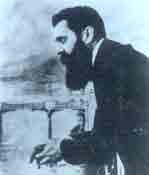
The Balcony: then and now.
I put my elbows on the stone wall, leaned forward, looked thoughtfully at the other bank and tried to concentrate hard, to capture that unique "Zionist moment". Conclusion: I have no clue what made Theodor yearn for the dusty landscape of Palestine while watching the beautiful Rhine river flowing vigorously a few feet below. He must have been smoking something. Or perhaps I should have waited longer, enough time to grow a beard.
Thursday, April 20, 2006
The Israeli Arse
One of the least appealing aspects of life in Israel is living side-by-side with "The Israeli Arse". No, I am not referring to the backsides of my fellow denizens. I'm talking about that ubiquitous character that makes life in Israel much more colourful perhaps, but at times also very annoying and almost unbearable.
The "Arse" is by now a stereotype: tight jeans, white t-shirts, copious amounts of hair jel, heavy golden jewelery, hand jestures, blue neon lights under the car, etc... (if you've lost me here, watch the movie I linked to above). But what used to be an amusing anthropological pastime has fast become the norm of Israeli society. "Arseem" are everywhere: on the road, in supermarkets, in malls, at the airport, in the synagogue. Perhaps it's just my being away for a few years, but it seems like the "Arseem" population has grown immensely.
But it's more than that really. The "Arseem" themselves are not the whole problem. What bothers me is the the "Arse culture" which seems to have become the de-facto Israeli culture, the zeitgeist. The total lack of basic manners (queuing up, or saying "sorry" after bumping into someone), the rudeness, the loud talking, the lack of respect for other people's space or even presence. I find myself appraising people judgmentally on the street and in shops, to ascertain whether they are friends or foes.
I am currently reading a book about the 1967 "six day war", which describes the general atmosphere of Israeli society before, during and after the war. What a different country! I'm not referring to the political/military differences but to how people wrote, spoke and behaved. Despite the harder times - both economically and politically - people back then had respect for fellow citizen and for country. I regret to say I don't see that around me today. It's every man for himself (except for rare moments of short-lived unity, around some major tragedy like a suicide bombing).
Last week, after a particularly nasty road incident with an "Arse" (I use the term freely here; he looked pretty respectable but his driving was definitely "Arse" in nature), I remembered something a friend told me many years ago. We were talking about life in Israel and how hard it was to get used to some aspects of it, and he said: "There is no choice. At a certain point in your life you come to realize that in order to protect your family and your sanity, you need to erect virtual walls around you. You block yourself off from the rest of the world and care only about the ones you love most". How true, and how sad.
Monday, April 03, 2006
Midlife Crisis and Hairdressing
A friend of mine opened a hair styling salon in Tel Aviv last month. He and I did our MBA together. Like me, he works at a high-tech company and is used to life in the fast lane, but a couple of years ago he decided he would learn how to cut hair and open his own salon.
"Atmospera", as the place is called, is a cross between a hair salon and an art gallery. The idea is to promote young artists' work with a revolving display.
I wish him all the best with this initiative. I know we're all going through our midlife crisis right now, but hair styling!? I admire him for taking the leap and doing what he felt he wanted to do (whilst keeping his day job...).

Sunday, April 02, 2006
I am Charlotte Simmons, by Tom Wolfe
This book is about the corruption of a young American girl from Sparta, a remote mountain town in North Carolina, who makes it against all odds to a top university in Pennsylvania ("Dupont"), only to find out that not top-notch education but rather sex, alcohol, drugs and generlly being "cool" are top-most on her fellow students' minds. Tom Wolfe paints a vivid picture of college life on American campuses, or at least that's what he would have us believe, not too successfully in my mind.
 I guess Wolfe was out to write the definitive book about college life. And indeed the book is nothing but a long (700+ pages) description of the frivolities of college students. It is full of stereotypical characters: the basketball players who get academic discounts and lead a life (literally) above the rest, the drunken frat boys and the giggly sorority girls, the group of smart nerds who are after the Rhodes scholarship and, above all, the innocent hillybilly who cannot believe it all - Charlotte. Wolfe, in his charcteristic style, does not leave much to the imagination when describing Charlotte's encounter with college life. One of ther first experiences on campus are the sounds produced by a boy defecating loudly in the stalls of the co-ed bathroom (I will spare you the details). Shortly thereafter, Charlotte's room-mate throws her out in the middle of the night so that she can spend time there alone with her boyfriend; thus Charlotte learns what it means to be "sexiled". And so on and so forth.
Despite its weakness in credibility - I refuse to believe this is what life in Ivy League colleges is all about - what saves this book is Wolfe's excellent writing style, captivating the reader and transporting him to a world that although removed from reality seems at the same time very realistic. I read the book while travelling between three continents and it was a faithful companion on the long flights and sleepless nights. As far as pop fiction goes, it's an entertaining read.
One final thought. Wolfe, author of excellent books such as Bonfire of Vanities and A Man in Full, gives thanks in the foreward to the book to his daughters, who apparently let him into the secret lives of college students based on first-hand experiences. If I am Charlotte Simmons faithfully portrays what Wolfe's daughters went through in college, I shudder to think how he reacted, as a father, when hearing their stories.
Wednesday, March 29, 2006
A Partial Eclipse
There was a solar eclipse today. In Israel it was only partial, but still quite impressive.
Sadly, while I was watching the sun being gradually eclipsed by the shadow of the moon, I could not but think about the greater eclipse that occurred only hours earlier: the great vanishing act of the Israeli electorate. In this election - which saw the disappearance of the third largest party, the near-disappearance of the ruling party and the suprising rise of a party of sexagenarians - a large portion of the Israeli public chose not to choose. This election set a record low turnout (just over 60%), in a country that used to be proud of the deep involvement of its citizens in the democratic process.
Some say this is the result of a general feeling of "what's the point?". Israelis have long distrusted their politicians and with Prime Ministers such as Netanyahu and Barak who can blame them? But maybe this is only another sign of Israel growing up and becoming a "normal" country; after all, in most Western democracies the voter turnout is even lower. Perhaps it is time to follow the Australian example, and fine people who choose not to vote. Especially as election day is traditionally a day off in Israel, giving people ample time to spend a few minutes fulfilling their democratic duty. The chutzpah has no limits..
Subscribe to:
Posts (Atom)


 Posts
Posts

