This Blog Has Moved


APRIL 2010: THIS BLOG HAS MOVED
GO TO THE NEW ADDRESS TO COMMENT. THANK YOU.

New Address:

http://nafkamina.wordpress.com

All posts are available in the new blog

Please do not post any comments here. Go to the new address to comment. Thank you.


Monday, July 17, 2006

Lies, Lies and More Lies

The saying goes: when the cannons speak, the muse falls silent. Listening to the various official statements in the media, it seems that not only the muse but all common sense falls silent. Let's examine some of the "truths" we are being told:

We are fighting to get the kidnapped soldiers back. Nothing could be further from the truth. If getting the soldiers back was genuinely the top-most item on the government's agenda, Israel would be negotiating with Hezbollah for their release. Just as it did to release the shady Tenenbaum and three corpses only a couple of years ago.

Our aim is to crush Hezbollah. Right, just like we crashed the PLO in Lebanon in the 1980s. The sad truth is that the current military campaign will succeed only in bringing about another lull in the war between Israel and those bent on destroying it. Until the next time. The objective is making this interim period of relative peace as long as possible, no more.

The air campaign is effective. The truth is that no military campaign can be won from the air and both the IDF and the government know this. Israel is afraid to send troops into Lebanon because Israeli public opinion will not tolerate the mounting toll of casualties, especially as time will go by with no definitive "crushing" of Hezbollah.

The people are behind us. This is true, but only partly and only for a short time. Olmert and his colleagues know that if missiles keep falling on Israeli cities for much longer, popular support will erode and people will demand either firmer action (which is not possible) or a settlement.

The world is behind us. This is not even partly true. Yes, the US agreed to supply us with that most precious resource, jet fuel, but if fighting prolongs then not only the world but also the US will start pressuring Israel to settle. Suddenly, supplies of jet fuel will become harder to get by.

We will establish a security zone in Lebanon without IDF's presence. This is the latest gem from Peretz. Perhaps someone should hand him a book about the history of the Israeli-Lebanses border and the outstanding role of UNIFIL there over the decades.

And the list goes on, but I think the point is clear. The thrill of the first days of war is blocking all common sense and clear vision. No worries, things will become familiarly and bitterly clearer quite soon. Israelis, as I wrote earlier, have very short memories. This has always been perplexing to me, especially as Jews carry thousands of years of history on their backs. But this is a subject for a different post.

Wednesday, July 12, 2006

Empty Threats

For years, Israelis viewed Arab rhetoric as empty threats. Palestinian terrorist groups threatened with "mega-attacks", Saddam Hussein promised that half of Israel will burn like a dry fig leaf, Nasrallah told Israel to "bring it on", and so on and so forth. It was widely understood and accepted that the lion roar will turn into a mouse squeak.

Now it seems the Israeli government has adopted the same farcical strategy. Minutes after Gilad Shalit was kidnapped in Gaza, government officials threatened that life in Gaza will become unbearable. Today the Chief of Staff, speaking after the disastrous events in the north, warned that Lebanon would be set back "twenty years" if the kidnapped soldiers are not promptly returned. Not only Israelis, but sadly also most of the Arab world, know that these are nothing but empty threats.

It is time for Israel's government to put its actions where its mouth is, or else shut up.

Monday, July 10, 2006

Criminal Fauna

The Economist's latest briefing about Tokyo has the following story:

Crow-barred

The capital's increasingly aggressive jungle crows have become inadvertent cyber-criminals, denying thousands of Tokyoites broadband access. It turns out that fibre-optic broadband wires are perfect material for their nests, and can be dislodged from junction boxes with a well-judged peck. NTT and Tepco, the principal providers of fibre-optic cable in Tokyo, have reported sharp surges in vandalism committed by crows, who have no such success with the copper telephone and electricity cables that criss-cross the skyline.

The crows' rising boldness must be a disappointment to Shintaro Ishihara, Tokyo's governor, who declared war on the birds some five years ago, but has watched their numbers more than quadruple since. Even if the crows are somehow dissuaded from their destruction, the attacks on broadband access are expected to continue. Cicadas have discovered that fibre-optic cable is the ideal place to lay eggs, and have been staking out breeding grounds on the telegraph poles.

In Tokyo, one of the most-populated cities in the world, the worst vandals are still crows and cicadas, not humans...

Sunday, July 09, 2006

Zidane - Sic Transit Gloria Mundi


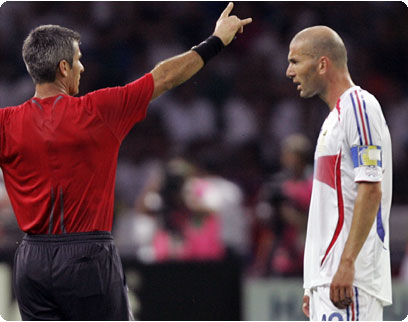
The Talmud says that there are people who "buy their entrance ticket" to the afterworld in "one hour", meaning that one good deed can turn around a person's destiny. Tonight, in the world cup final, one of the greatest players of all times, Zinadine Zidane, demonstrated that it is possible to do just the opposite.

In one moment of anger Zidane brought his football career to a shameful end, butting his head against an Italian player and getting sent off. Instead of being remembered for his wonderful, long career, he will be remembered as the team captain who could not control his temper minutes from the end of the world cup.

And justice was done. Italy won!

Friday, July 07, 2006

Panic: Flying Tubes


Following up on a previous post, consider if you will these two pictures:


The first picture is of a kassam rocket that landed some time ago in the Negev. The second is of the kassam rocket that landed in a school yard in Ashkelon a couple of days ago. Look closely. In the first picture, you see that the rocket does not explode (as is usually the case); it merely hits the ground and bends. In the second picture you see the damage caused by the rocket: a couple of Ackerstein blocks are broken.

My point is: these "rockets" are pretty harmless unless they fall directly on your head. Can they cause injury? Yes. Can they cause fatalities? Of course. But the likelihood of either is small, as the statistics clearly show. However, listening to the accounts in the media and to the dramatic scenarios by the politicians, one is led to believe that kassams are a little short of mini nuclear devices.

So am I saying that there are no problems with the kassams? No, I'm not. Yes, Israeli cities living under the threat of daily bombardments is an unacceptable situation (and I support the military actions taken in Gaza). Yes, the citizens of Sderot, Ashkelon and other southern cities have all the right in the world to demand that the government solve the problem. And yes, under the same circumstances I would most likely react the same way.

But a little proportion is in order. Panicking in face of these flying tubes may be a natural reaction, but it also sends a clear message of how easy it is for two-bit terrorists to terrorise the Israeli population. Perhaps some history lessons about the behaviour of London's citizens during WW2 is in order.

Wednesday, July 05, 2006

Why I Hate Soccer

Yes, I watched the game last night. I promised myself I would watch only the semifinals and the final. Or at least try to...

What happened was I watched the first 90 minutes but when the regular time ended at 0-0 and it looked like this game, like many others before it, will be won by penalty kicks, I decided to call it a night. Waking up this morning to read that Italy won by scoring two goals in the last couple of minutes, reminded me of how much I hate this game.

Does one need to sit through 120 agonising minutes of boredom in the hope that something dramatic will happen (as it did yesterday), knowing that the chances of drama are close to nil? I'm no soccer expert, but something must be done about the rules of this game to make it more interesting. I know cricket and baseball are much more boring, but they were designed to be so from the beginning. Soccer, on the other hand, used to be an interesting sport. In my youth in Italy I distinctly remember soccer that was a pleasure to watch. Now, with all these "advanced defence techniques" and ubiquitous fouling, I find myself dozing off minutes into the game. What a waste of time!

The only good news is that Germany lost. (It may be unpolitically correct to say so, but it does warm the heart to watch Germans weep...)

Forza Azzurri!

Short Memory and Mass Hysteria

The reaction of the Israeli media, the Israeli public and particularly the Israeli right, to the kidnapping of Gilad Shalit by the Hamas and to the continued firing of rockets from Gaza into Israeli territory, provides an interesting lesson in the collective psychology of our nation. Shimon Peres was practically ostracized for daring to draw the obvious conclusion from this behaviour: it is nothing short of mass hysteria. Over and again, Israelis prove that they have a very short memory.

Here are a couple of examples of the "truths" we are told these days:

Shalit's kidnapping is proof the IDF should never have left Gaza. Kidnappings of Israeli soldiers (and civilians) have happened before, not only from territories we were in control of, but from within Israel itself! Nachshon Waksman was kidnapped in the West Bank when the IDF was in full control; Benny Avraham, Omar Souad and Adi Avitan were kidnapped from northern Israel and taken to Lebanon; and only last week, Eliyahu Asheri was kidnapped (and later murdered) from a bus-stop in Jerusalem.

The continued firing of Kassam rockets proves the IDF should never have left Gaza. Right, just as the shelling of northern Israel by Katyusah rockets for years while Israel occupied southern Lebanon is proof we should have never left Lebanon. Not to mention that Gush Katif settlements in Gaza were bombarded daily by rockets - thousands in a period of two years - while the IDF was in full occupation of Gaza.

Perhaps the most telling indication of this mass hysteria is the psak halacha (religious edict) issued by prominent rabbis, among them the Chief Rabbi of Israel, that forbids hitchhiking. It followed the kidnap and murder of Asheri last week. Written in the traditional flowery language of such edicts, the rabbis go to great lenghts to explain why the Torah forbids hitchhiking as part of the general rule of avoiding danger and taking care of oneself. One would think that after hundreds of Israelis were killed and thousands maimed for life in terrorist attacks against buses and shopping malls within Israel, the rabbis would have long ago used the same logic to forbid bus rides and shopping. But they didn't. Rather, they rode the waves of mass hysteria and short memory to speak out now against hitchhiking.

To me, these are all signs of the general "tiredeness" that is permeating Israeli society. Most Israelis are fed up with the way Israeli governments have handled the Israeli-Palestinian conflict and with the "no light at the end of the tunnel" situation. This normal reaction of a healthy people, that wants to lead a normal life, is translated by eye-rolling politicians and rabbis as a sign of weakness. The mass hysteria over a few flying tubes of metal that caused no fatalities thus far (compared with the dozens of fatalities of Israeli soldiers yearly when the IDF was occupying Lebanon or Gaza!) is understandable; after all, terrorism is exactly about that: instilling terror. My criticism is not against the people of Sderot and Ashkelon. I would have reacted in the same manner, if not worse, were a rocket to land in my son's school. My criticism is against vast majority of the political leaders and the mass media, who instead of putting matters into the right perspective, prefer to get carried away with populist scaremongering and visions of doom. Instead of leading they prefer to be led.

Yitzhak Rabin was right. He arrived at the conclusion that the sooner we strike an agreement with the Palestinians the better, even at the supposedly high "cost" of losing most of the lands occupied in 1967. He understood that Israeli society, like other societies in democratic countries, is no longer willing to put up with the unbearable costs associated with the occupation of territories where Jews are vastly outnumbered, and all in the name of nationalistic ideals that may be historically and morally correct, but defy basic reason given the possible realistic outcomes. He did not delude himself (like most of his left-wing supporters did) that the Palestinians love us; he understood the terms of the agreement need to ensure a state of non-belligerency and that it would take generations to reach a semblance of "peace". Unfortunately, his so-called "followers" (Kadima and their likes) have yet to come to the same realization.

Friday, June 30, 2006

Chukat - Not by Might, Nor by Power

ויפנו ויעלו דרך הבשן, ויצא עוג מלך-הבשן לקראתם הוא וכל-עמו, למלחמה אדרעי. ויאמר יהוה אל-משה, אל-תירא אתו, כי בידך נתתי אתו ואת-כל-עמו, ואת-ארצו; ועשית לו כאשר עשית לסיחן מלך האמרי, אשר יושב בחשבון

(במדבר כ"א, ל"ג-ל"ד)

At the end of parashat Chukat the conquest of the Promised Land begins. Finally, after almost 40 years of wanderings in the desert, the people of Israel under the leadership of Moshe begin fulfilling the divine promise by conquering the eastern part of Eretz Israel (what is today Jordan).

After defeating Sichon, king of the Emorites, the people of Israel are faced with a new threat: Og, king of Bashan, deploys his army and ventures out to meet this nomadic people that dared challenge his land. And this is how the Torah tells it:

And they turned and went up by the way of Bashan; and Og the king of Bashan went out against them, he and all his people, to battle at Edrei. And God said unto Moses: "Fear him not; for I have delivered him into thy hand, and all his people, and his land; and thou shalt do to him as thou didst unto Sihon king of the Amorites, who dwelt at Heshbon."

(BaMidbar, 21, 34-35)

How surprising. Moshe, who is well awaer of God's promise to give the land to the people of Israel and who has just defeated an enemy no less powerful than Og, is so afraid of the upcoming battle that God needs to reassure him that all will be well? We would have expected the people, perhaps following in the footsteps of the ten spies, to fear the army of Og, but Moshe? What is it in Og specifically that scares Moshe so?

The Midrash tells us that Og, the giant, had special merits. He survived the flood (by hanging onto Noah's ark), but more importantly, he is the palit (refugee) that alerted Avraham and told him about the capture of Lot in Soddom. This brute king is not just another enemy. Moshe, knowing his history, is afraid that Og's good deeds in the past will work in his favour and is therefore afraid of losing this battle. Hence the reassurances from God's side.

The same Midrash continues and tells us of how the actual "battle" was fought. Og picked up a mountain the size of the encampment of Israel, and threatened Moshe with it. Moshe and Israel prayed to God and small bugs ate up the mountain from the inside, causing it to crumble on top of Og, thus trapping the giant. Moshe then fell the giant with a one precise hit aimed at his ankle (I guess this the Jewish version of Achille's Heel...).

If we look at this story not literally but symbolically, Og was beaten not by military force but by spiritual force. It was by the prayer of Israel that Og's might (the mountain) was destroyed from within. Moshe had to deal with whatever merits Og had by fighting back with superior merits, the force of true prayer. The lesson learnt here is that the war fought against the inhabitants of the Land of Israel cannot be won by sheer force. However strong Israel's army might be, if it does not attain and maintain higher moral and spiritual standards compared with the enemy, it will not win. Once these higher standards are reached, then, and only then, can the use of force be successful. In the words of the prophet: "Not by might, nor by power, but by My spirit, said the Lord of hosts" (Zechariah, 4, 6).

May this lesson of Moshe's fight against Og be a lesson for our generation as well.

Toulouse, France


This was a busy travelling week. On one of the days I had breakfast alone in Frankfurt, lunch with a customer in Lisbon and dinner with a friend in London.

I also spent a day in Toulouse for a meeting at Airbus, the aircraft manufacturer that has recently run into trouble following the announcement of delays in the new "super jumbo" (A-380) delivery. I saw the A-380 take off and land a couple of times at Toulouse and it's a veritable monster. I find it difficult to understand who would want to travel together with more than 500 people. Surely the waiting time for boarding or collecting baggage will be insufferable.

Anyway, despite my very short stay-over in "Airbusville" (as Newsweek called Toulouse this week), I had a few hours' spare time to take a stroll around the city. Toulouse is apparently the 4th largest city in France and is famous for the pinkish hue of its buildings. I came across the St. Etienne cathedral and ventured inside, thinking it would be just another cathedral. The entrance did not look too impressive, but the inside turned out to be quite interesting. Unlike other cathedrals, this one is a collection of several buildings built in different periods, so it is not as symmetric and well-proportioned as others. Standing in the middle of this huge edifice gives a nice perspective into the different building styles.

Another impressive landmark in Toulouse is the main square, the "Capitole". The building, which serves as the city hall, is magnificient, as are the proportions of the square itself. The game between Italy and Australia just ended and a few Italian fans filled the square, brandishing huge tri-colour flags and being generally very loud about their team's triumph. I refrained from reminding them that they only barely won in the last few seconds of the game, and that only thanks to an penalty kick for a foul that never happened. Something told me they were not in the mood for a dose of truth...


The weather was rather hot, but as the day was waning, it cooled off and the streets filled up with people. Suprisingly (this being France) most people were smiling and seemed rather friendly. Which reminded me of an incident a few weeks ago in Paris. I was having dinner with three distinguished businessmen from a company we work with, together with my boss (an Israeli-American). As the wine flowed and the conversation veered off business, my boss mentioned that he once took a holiday in France. And then he said: "actually, when I was driving around France, the people were very nice and friendly, unlike in Paris!" There was an awkward silence before he realized what he had said in the company of three Parisians... Just as with the Italian fans mentioned above, this was another example of a situation where one should remain silent rather than blurt out the truth.

Sunday, June 25, 2006

Praying for Gilad Shalit

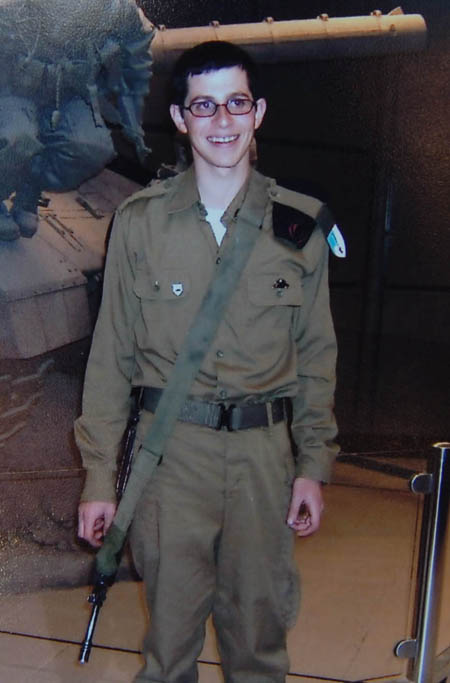
Together with everyone in Israel I am praying for the swift return home of Gilad Shalit ben Aviva, who was kidnapped this morning by Palestinian terrorists in Gaza.

May God keep him safe and healthy and return him to his family soon.

Nihilistic Soccer

I guess I need to post something about the World Cup, a.k.a. Mondial. But I'm not prepared to write more than a few sentences on the subject.

So I refer you to this piece from The Daily Standard, which aptly summarises my feelings about the game.

PS - I'm guessing that this team will win. However, the team that should win is this one.


Friday, June 23, 2006

Difference Between Women and Men

Why go through the effort of reading the verbose "Men are from Mars, Women are from Venus" to understand the differences between men and women, when you can get to the bottom of things by watching two and half minutes on Saudi TV ?

Tuesday, June 20, 2006

Flag-Gate

Never mind the daily rocket attacks on Sderot. Never mind the quasi-civil war raging in the Gaza strip. Never mind the thousands of Palestinians on the brink of starvation as a result of their intransigent government's policies. Foremost on the daily agenda of the media in most of the Arab-Muslim world is none of the above. It is John Painstil, the Ghanian soccer player that dared wave the Israeli flag after his team scored against the Czech Republic. Painstil plays for a soccer team in Tel Aviv and said he did it to please his friends and fans back in Israel.


The uproar was such that Painstil later apologized for his misdeed. The spokesperson for the Ghana team said the gesture was "based on sheer naivety" and added that Painstil is being offered special therapy to ensure he "overcame his current state of mind"...

Israelis (and Jews worldwide) reacted to the admittedly exaggerated reaction in the Arab world with nothing but contempt and disdain. I'm wondering how these "shocked" observers would have reacted had Painstil waved a Palestinian flag instead of an Israeli one.

I have a different take on this "flag-gate" episode. Call me cynical, but perhaps this whole gesture was nothing but a shameless self-promoting marketing tactic, designed to boost Painstil's standing in the eyes of his Israeli employer? You see, the flag Painstil waved is one of millions issued on occasion of Israel's independence day last month by Israel's leading bank, the HaPoalim bank. The team Painstill plays for is HaPoel Tel Aviv. Need I elaborate further on this "apparent" coincidence? I dare not.

Sunday, June 18, 2006

Shelach - The Will of God (cont.)

Last year, I posted this thought for parashat Shelach. That post generated a small debate with Jameel today - see the comment section there.

More interestingly, this shabbat I read a commentary by rabbi Avigdor Neventzal ("rabbi of the old city of Jerusalem") for Shelach that was surprisingly similar to the one I heard a couple of years ago from rabbi Amnon Bazak. Surprisingly, because rabbi Neventzal is known for his hard-line right-wing approach, and yet does not hesitate to pose questions regarding the interpretation of "the will of God" in the story of the meragelim and the applicability to today's political debate.

(This would be a good place to recommend rabbi Neventzal's "talks" on the weekly parasha, published in a five-book set.)

Voodoo Judaism

Those who know me, know how much disdain I have for "voodoo Judaism", regrettably so rampant in Israel today: incessant dippings in the mikveh, frequent trips to graves, red strings tied around the wrist, "holy" water, amulets to ward off the evil eye, chairs to "cure" barren women, kabbalah seminars, and so on and so forth.

My sister forwarded me an email today linking to this PowerPoint presentation. As it is in Hebrew, I will summarise it here.

In August 2001, a suicide bomber blew himself up in a fast food restaurant in central Jerusalem, killing 15 and wounding more than 150. Shortly thereafter, followers of the Breslov Hasidic movment printed a miraculous story in the Tikkun HaClali - a booklet containing some psalms and prayers which, if recited daily, they believe will cleanse them of their sins (specifically the sin of masturbation).

The story in the booklet goes like this: minutes before the bombing, the cashier at the restaurant told everyone that the resturant is full and a few customers decided to leave. Among them was this American woman. After the bombing, the woman sought out the cashier and found her in a hospital. Grateful for being saved, she left the girl her phone number in New York telling her to call her if in need. Some time later the cashier called and they agreed to meet in NYC. On the day, the woman left her office at the Twin Towers to go meet the visitor from Israel. You guessed right, the date was September 11, 2001 and thus the American woman was saved once again from certain death by the cashier.

And it just so happens that the cashier had a copy of the Tikkun HaClali next to her when working at the restaurant. Not only did the booklet save her life; it managed to save the American woman's life, twice. Sounds amazing, right? Surely enough to make anyone religious on the spot, joining the dancing Breslov nutcases in busy street intersections, no? Well, not so fast.

The family of the cashier heard about this "miraculous story" and could not believe their ears. Because, you see, the cashier, 19-year-old Tehilah Maoz, died in the bombing. She is buried in Jerusalem. The story was made up in order to shamelessly promote the voodoo booklet by a bunch of so-called believers. Rabbi Nachman must be turning in his grave knowing his name is used by such lowlifes.

This is just one small story and were it representative of the pervasiveness of this "voodoo Judaism" it would not be so interesting. Sadly, rather than dealing with the demanding task of keeping mitzvot, many prefer to wallow in the imaginary comfort of magical instant gratification. Avodah zarah was and remains an easy way out for errant souls.

Wednesday, June 14, 2006

Punctual Delays

As I write these words (which I will post later, as I am not connected right now), I'm sitting on an ICE train from Koeln to Hannover. But the train is not moving; we've been stuck at Hamm station for the past 15 minutes and the forecast right now is that we won't be departing for
another 15.

And this is by all means not a first for me. In the past few months I have witnessed train delays in Germany at least half a dozen times. A couple of them were delays of more than 30 minutes and on one occasion almost 1.5 hours! In my four and a half years in Japan I recall only one delay and that one was for only a few minutes. And I travelled by train almost every day in Japan...

True, the Japanese might at times take their punctuality to extremes, but they've left the "punctual" Germans eons behind. I pity those football fans who paid hundreds of Euros for their ticket and will be late to the game because of Deutsche Bahn.

[Update: the delay turned out to be 1 hour...]

Sunday, June 11, 2006

Double Standards

One of the more irritating traits of "leftists" in Israel (and perhaps everywhere) is their inability to admit to their double standards.

After Rabin's assassination in 1995, they cried foul about the incitement that preceded the murder and produced, as they would have it, the appropriate "environment" for the murderer to act. Images of right-wing demonstrations with placards reading "Rabin is a traitor" and "Rabin is a murderer" were brought as examples of this incitement.

Yet yesterday, in a left-wing demonstration outside the Chief of Staff's home in Tel Aviv (which made headlines mostly due to the participation of the Prime Minister's daughter), the demonstrators called Dan Halutz a "murderer" and a "killer of children". This reminded me of the "mother of all demonstrations" - the 1982 Tel Aviv demonstration following the Sabra & Shatila massacre during the Lebanon war - where Ariel Sharon (later to become darling of the "leftists") was also labelled as a "murderer".

Now, how would your average "leftist" react when you dare mention that perhaps calling the Chief of Staff a "killer of children" might also qualify as incitement?

Rhetorical question. I guess incitement, like pornography, is a question of geography.

World's Funniest Joke

Officially, this is the world's funniest joke. You judge.

Two hunters are out in the woods in New Jersey when one of them collapses. He doesn't seem to be breathing and his eyes are glazed.

The other guy whips out his phone and calls the emergency services. He gasps 'My friend is dead! What can I do?' The operator says: 'Calm down, I can help. First, let's make sure he's dead.'

There is a silence, then a shot is heard. Back on the phone, the guy says 'OK, now what?'

Thursday, June 08, 2006

Sumo in Israel

This week, a Sumo stable from Japan - the Sadogatake Beya - is visiting Israel.

This is a rare happening, as Sumo wrestlers (rikishi) seldom leave Japan. They were hosted by the president and various other officials, "trained" children on Tel Aviv beach and visited a children's hospital (where I accidentally bumped into them yesterday morning on my way to work; fortunately, not literally bumped).

Last night they conducted a friendly tournament in Caesarea, at the ancient Roman open-air amphitheatre. I was pleasantly surprised, both by the almost-full attendance and by how well the whole thing was organized, complete with running commentary by Motti Dichne, who provided much useful information about the sport.

The "competition" was won by Koto-Oshu (a.k.a. Mahlyanov Kaloyan Stefanov), a Bulgarian who is currently no. 3 in Japan. His parents flew in from Bulgaria for the event. Increasingly, non-Japanese are excelling in Sumo; the current champion (yokozuna), Asa Sho Ryu, is from Mongolia.

I will not bore you with lengthy explanations about this exceptional sport (see link above for that); instead, here are some pictures from the event (click on pictures to enlarge):

Dohyou - the arena, made of clay and sand


Fat, but extremly flexible and agile


The Israeli "children Sumo club" take on Koto Oshu


Koto Oshu gets his hair done; each wrestler has a distinctive hairdo


A favourite gimmick in Sumo fights: giant holding baby


Tsuridashi - lifting opponent by mawashi (a.k.a "the diaper")


Koto Oshu and the cup


In short: At an amphitheatre in an ancient Roman city in the Jewish state of Israel, a bunch of Japanese wrestlers got their asses kicked by a Bulgarian.

Monday, June 05, 2006

A Bridge To Nowhere

It must be difficult to admit failure after 36 years of activity around a central idea. Yet this is exactly what Rabbi Dr. Danier Tropper did today in an interview published in Haaretz (Hebrew).

Tropper founded and managed Gesher ("bridge" in Hebrew), an organization that works to promote mutual understanding among Israelis of all backgrounds, specifically religious and secular, through joint seminars, movie productions, etc. It is funded partly by the government and partly by donations (mostly from the US).

Tropper resigned his post recently and these are his observations about the outcome of Gesher's efforts after more than three and a half decades of activity:

  • Religious Zionism has marginalised itself to the point of irrelevance by concentrating its efforts around the issue of Greater Israel
  • On the other hand, secular Israelis are nothing more than "Hebrew-speaking gentiles" (unsurprisingly this generated the most inflammatory comments from readers)
  • What destroyed Judaism in Israel is the politisation of religion (yet he does not reach the obvious conclusion that separation of state and church is necessary)

These are not great insights to anyone who lives here, but hearing these things from someone who dedicated his life to trying to bridge the gaps in Israeli society and make Israel a better place, is both sad and disheartening.